
Autism Diagnostic Interview-Revised
At what age is the ADI-R used for a child?
The Autism Diagnostic Interview-Revised (ADI-R) is used for children with a developmental age of about 2 years and above — through childhood and into adulthood. It is based on developmental level rather than calendar age alone, because the social-communication and play behaviours it asks about only become meaningful from around a two-year stage. It is a structured interview conducted by a clinician with the parent or main caregiver, and is typically used alongside direct observation of the child as part of a fuller assessment.
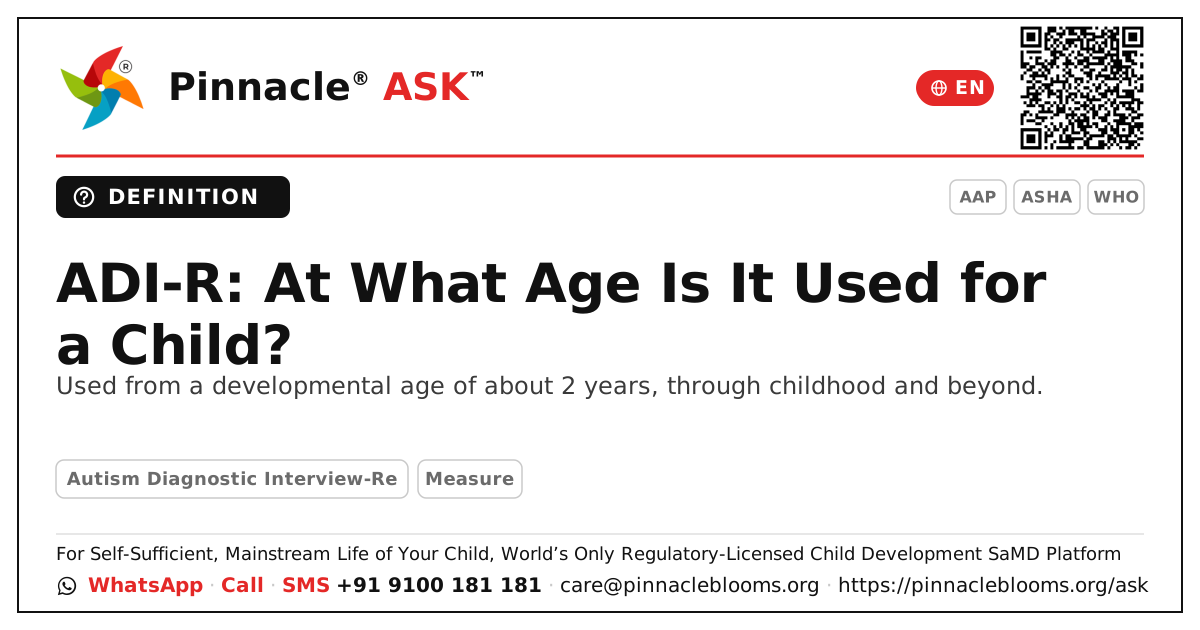
The ADI-R is a careful interview with you, the parent — and it works best once your child has reached a certain developmental stage.
In short
The Autism Diagnostic Interview-Revised (ADI-R) is used for children with a developmental age of at least around 2 years — broadly from toddlerhood through childhood and into adulthood. It is not based purely on calendar age but on developmental level, because the interview asks about social communication and play behaviours that only become meaningful once a child has reached roughly a two-year developmental stage. It is a structured, clinician-led interview with the parent or main caregiver, not a test done directly on the child.How the ADI-R is used
The ADI-R is a detailed, standardised interview that a trained clinician conducts with you — the person who knows your child's history best. It explores three areas central to understanding autism: social interaction, communication and language, and repetitive or restricted behaviours and interests. The clinician asks both about your child's behaviour now and about earlier development, particularly around the ages of 4 to 5 years where certain patterns are most informative.Because it relies on a child having a developmental age of about 2 years or more, the ADI-R is rarely the right tool for a very young infant. For younger or pre-verbal children, clinicians choose age-appropriate observation and screening tools instead. The ADI-R is usually used alongside direct observation of the child (such as the ADOS) and a broader developmental picture — no single instrument stands alone.
When this matters for your family
If you have questions about how your child communicates, plays or relates to others, an assessment is the gentle first step — never a label. A clinician decides which tools fit your child's age and developmental stage, and the ADI-R may be one part of a fuller picture for children at or beyond a roughly two-year developmental level.The Pinnacle way
This is general information, not a diagnosis — a clinical AbilityScore® and any diagnosis are formed only at a Pinnacle Blooms Network centre, under qualified clinician care, never from an app or form. Our clinicians select the right combination of tools, including instruments like the ADI-R where appropriate, and build an individualised plan that may draw on autism therapy tailored to your child's strengths.Trusted sources
WHO ICD guidance on autism spectrum conditions; the American Academy of Pediatrics and HealthyChildren on developmental assessment and screening; ASHA on communication assessment in children.Next step — If you would like to understand your child's development, book a developmental review and let a qualified clinician choose the assessments that fit your child best.
What to watch
Whether your child has reached roughly a two-year developmental stage, since the ADI-R depends on developmental level rather than calendar age alone; for younger or pre-verbal children, clinicians choose other age-appropriate tools.
Try this at home
Before any assessment, jot down notes about how your child communicates, plays and relates to others at different ages — these everyday observations help a clinician build the fullest, kindest picture during a parent interview like the ADI-R.
Trusted sources
Developed by SETU Consortium · Pinnacle Blooms Network · Last reviewed 2026-06-10 · reviewed every 365 days
This is general information, not a diagnosis. A clinical AbilityScore® and any diagnosis are formed only at a Pinnacle Blooms Network centre, under qualified clinician care.
Frequently asked
What is the youngest age the ADI-R can be used?
The ADI-R is suited to children with a developmental age of at least around 2 years. It is based on developmental level rather than calendar age, so it is not the right tool for very young or pre-verbal infants — clinicians use other age-appropriate tools for them.
Is the ADI-R done with the child or the parent?
The ADI-R is a structured interview conducted by a trained clinician with the parent or main caregiver. It draws on your knowledge of your child's history and current behaviour, and is usually combined with direct observation of the child.
Is the ADI-R enough to diagnose autism on its own?
No single instrument stands alone. The ADI-R is typically used alongside direct observation and a broader developmental picture. Any diagnosis is formed only by a qualified clinician at a Pinnacle Blooms Network centre.