
YOUR QUESTION. A CLEARER NEXT STEP.
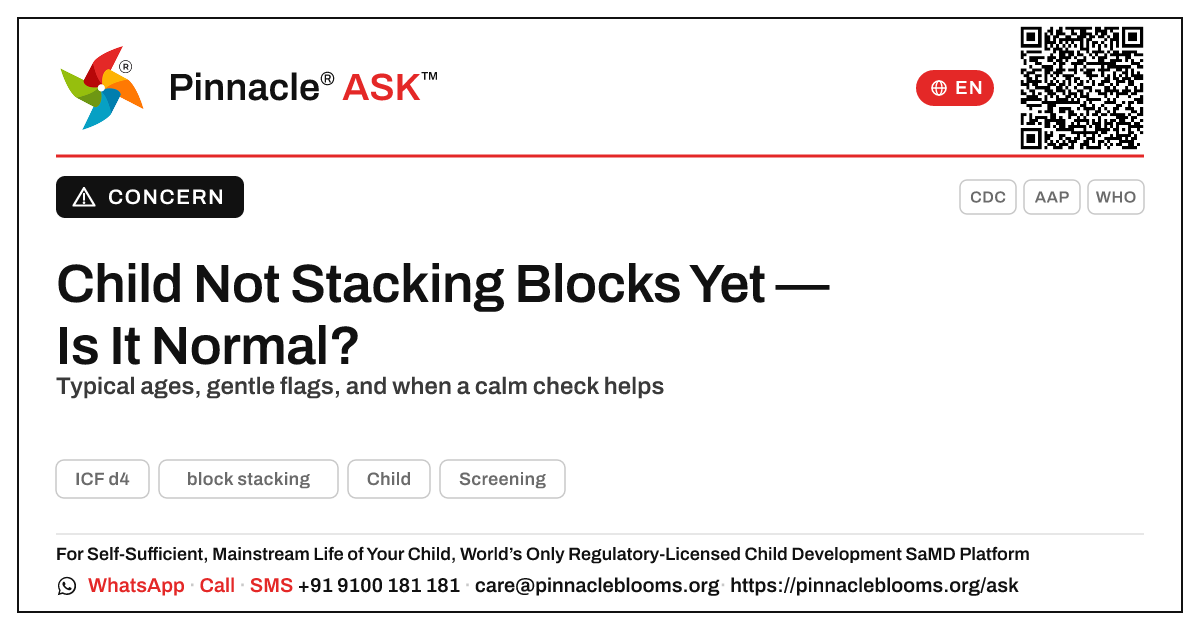
Is It Normal My Child Isn't Stacking Blocks Yet?
Block stacking develops across a wide window — about 2 blocks by 15 months, 4–6 by 18–24 months, and 6–8 by 2½–3 years. A single 'not yet' is rarely a worry, as children vary in interest and hand skill. Seek a developmental check if there's little progress over several months, trouble with other hand skills, or delays in talking and play. This is reassurance, not a diagnosis — a clinician's gentle look turns small questions into early opportunities.
In this answer 5 sections
Watching your little one fumble with blocks while others build towers can stir a quiet worry — and pausing to ask is thoughtful, loving parenting.
In short
Block stacking develops over a wide, normal window. Most children stack 2 blocks around 15 months, a tower of 4–6 by about 18–24 months, and 6–8 or more by 2½–3 years. So a single 'not yet' is rarely cause for alarm — children vary, and interest in blocks differs hugely. A gentle developmental check is wise if your child shows little progress over several months, struggles with other hand skills, or this sits alongside delays in talking or play. This is reassurance, not diagnosis.
What to watch by age
Block stacking is a lovely window into fine-motor control, hand-eye coordination and focused play. Gentle flags worth a clinician's calm look include:
- By around 24 months — not yet able to stack 2–3 blocks, even with encouragement and demonstration.
- By around 3 years — unable to build a small tower of 5–6 blocks, or showing no interest in stacking-type play at all.
- Hand difficulties — trouble grasping, releasing or placing objects neatly; very clumsy or weak hand use; persistent fisting.
- Travelling with other differences — few words, little pretend play, not pointing, or trouble following simple instructions.
Remember: some children simply prefer to knock towers down or explore other play. Offer blocks at a calm, unhurried moment before drawing conclusions.
The science
Stacking needs the pincer grasp, controlled release, and the visual-motor planning to balance one block on another. The Bayley-4 and similar tools use block tasks as one marker of fine-motor maturity — but always read alongside the whole picture, never in isolation.
The Pinnacle way
A clinical AbilityScore® and any diagnosis are formed only at a Pinnacle Blooms Network centre under qualified clinician care — never from an online list. Learn more about block stacking as a milestone, and how our occupational therapy team gently builds grasp, release and hand-eye control through play.
Trusted sources
CDC developmental milestones and 'Learn the Signs, Act Early' guidance on fine-motor play; American Academy of Pediatrics (healthychildren.org) on hand skills in toddlers; WHO ICF activity framework (domain d4, mobility and hand use).
Next step — Trust what you've noticed. Book a developmental screen with a Pinnacle clinician for a warm, clear review of your child's fine-motor play.
This is general information, not a diagnosis — individual assessment and diagnosis require an appropriately qualified healthcare professional.
CONNECT THE ANSWER TO YOUR CHILD’S DAY
Something to notice. Something to discuss.
What to notice
Seek a developmental check if your child isn't stacking 2–3 blocks by around 24 months, can't build a tower of 5–6 by 3 years, or shows no interest in stacking at all. Watch for trouble grasping, placing or releasing objects, very clumsy or weak hand use, or delays travelling alongside few words, little pretend play or not following simple instructions.
In everyday life
Offer chunky blocks at a calm, unhurried moment and build a tower together first, slowly, so your child can copy. Celebrate every block placed — and the knock-down too. Note whether interest or hand control seems to be the sticking point.
Bring your observations and questions to your child’s professional. Choose activities that suit your child’s comfort, abilities and agreed plan.
Bring your questions to a first visitQuestions families ask
At what age should my child stack blocks?
Most children stack 2 blocks around 15 months, a tower of 4–6 by 18–24 months, and 6–8 or more by 2½–3 years. The window is wide, and children vary a great deal in interest and pace.
My child knocks towers down instead of stacking — should I worry?
Not at all — knocking towers down is normal, joyful play and shows your child understands cause and effect. Keep building together and let them explore both.
When should I seek a check about block stacking?
Consider a gentle developmental check if there's little progress over several months, if your child can't stack 2–3 blocks by around 24 months or build 5–6 by 3 years, or if hand skills and play seem delayed overall.
FOLLOW THE SOURCE
References behind this answer.
- Source referenceCDC developmental milestones and Learn the Signs, Act Early
- Organisation website · further readingAAP guidance on toddler hand skills (healthychildren.org)
- Organisation website · further readingWHO ICF activity framework (domain d4)
References are supplied with this answer. An organisation homepage offers further reading; it does not establish an independent review of this page.
Content attribution: SETU Consortium · Pinnacle Blooms Network.
PEOPLE, TOPICS & DEVELOPMENT
See the connections.
Browse the wider question collections connected with this answer’s audience, developmental area and stage.
FROM UNDERSTANDING TO PURPOSEFUL SUPPORT
One question. Your child’s whole life.
Your child’s self-sufficient, mainstream-included life is the purpose from the beginning. At Pinnacle, that purpose shapes what we understand, the goals we choose, the people we bring together, everyday practice and review.
Connect this question with the right support.
Start with your child’s strengths, your observations and what you want everyday life to become.
Make the next conversation useful.
Bring the situations you notice at home or school. We’ll explain a suitable service, centre and first visit, including availability and fees, before you decide.
How PinnacleAI® connects the journeyExplore the seven stages
- 1Understand abilities
A starting picture of your child’s capabilities.
- 2Choose meaningful goals
Readiness and a plan shaped around the child.
- 3Bring the right support together
Suitable therapies and people for those goals.
- 4Carry practice into everyday life
Guidance for family, home and school.
- 5Track and correct
Use observations to adjust the plan.
- 6Reassess and review
Decide what to continue, change or do next.
- 7Grow independence and participation
The child’s life gives each step its purpose.
Explore the whole PinnacleAI® system → · Participation at school and in the community →
PINNACLE’S EVIDENCE, OPEN TO YOU
Look at the evidence behind our work.
Read our research, inspect the original regulatory documents and check what each institutional measure means.
General information supports a conversation with an appropriately qualified professional. Advice, goals and support depend on the individual child.