
YOUR QUESTION. A CLEARER NEXT STEP.
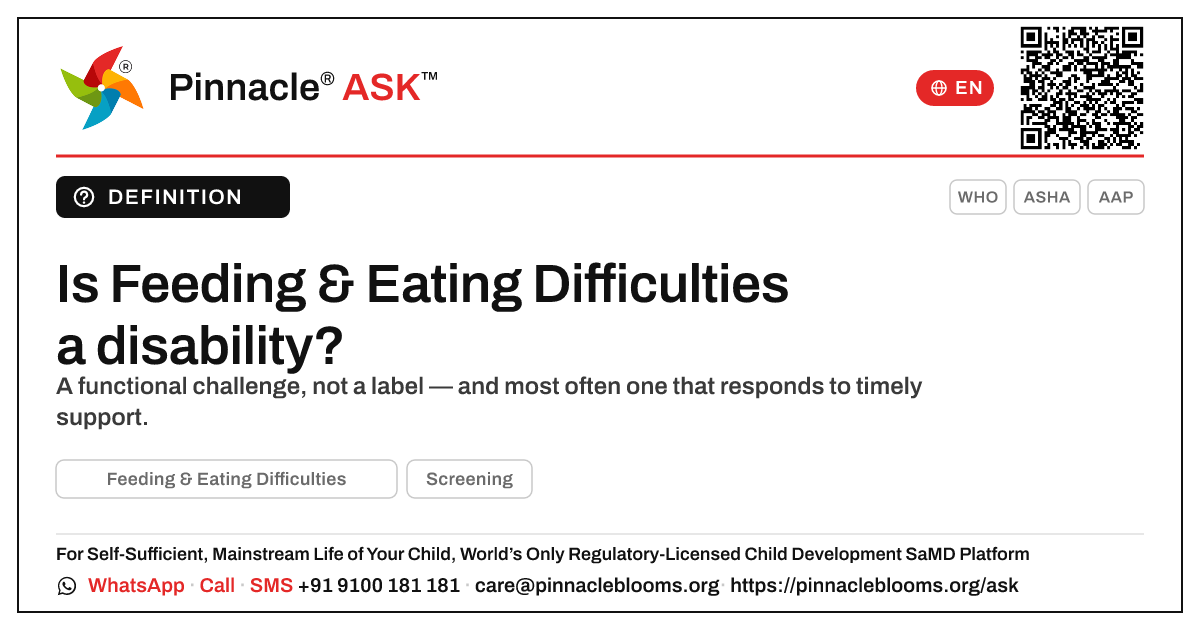
Is Feeding & Eating Difficulties considered a disability?
Feeding and eating difficulties are not in themselves a disability — they are a functional challenge most children overcome with the right support. Under the WHO ICF framework, disability describes lasting impact on everyday participation; a feeding difficulty may be part of a broader condition, but on its own it is usually responsive to timely therapy. Any diagnosis is formed only at a Pinnacle centre under clinician care.
In this answer 5 sections
The first worry many parents share isn't "will my child eat?" — it's "does this mean my child has a disability?" Let's answer that gently and clearly.
In short
Feeding and eating difficulties are not, in themselves, a disability — they are a functional challenge that many children experience, and most respond well to the right support. Whether the word "disability" applies depends on the underlying cause, how much it affects everyday life, and whether it persists over time. Far more often, feeding difficulties are a signal that a child needs help with skills like oral-motor coordination, sensory comfort with textures, or a calmer mealtime routine — not a permanent label.
What this really means
Think of feeding as a complex skill built from many smaller ones — sucking, chewing, moving food safely, tolerating tastes and textures, and feeling regulated enough to eat. When one of these is still developing, eating becomes hard. That difficulty can show up on its own, or alongside other conditions such as prematurity, oral-motor delay, sensory sensitivities, reflux, or developmental differences.
Under the WHO's framework for functioning (ICF), "disability" describes how a difficulty affects participation in everyday life — not the difficulty itself. So a feeding challenge may be part of a broader disability when it is linked to a lasting underlying condition, but on its own it is most often something that improves with timely, targeted therapy.
When to seek a check
- Mealtimes regularly take very long, end in distress, or are skipped
- Coughing, gagging or choking with food or drink
- A very narrow range of accepted foods or textures
- Poor weight gain, or your doctor has raised a growth concern
- Difficulty moving from purees to lumps and solids well past the usual window
These deserve a prompt look — early support is simpler and more effective than waiting.
The Pinnacle way
A clinical AbilityScore® and any diagnosis are formed only at a Pinnacle Blooms Network centre, under qualified clinician care — never from an online form or an app. Our team looks at the whole picture of feeding and eating difficulties, from oral-motor skills to sensory comfort, and builds a plan with feeding and oral-motor therapy that meets your child exactly where they are.
Trusted sources
WHO International Classification of Functioning, Disability and Health (ICF), which frames disability as an interaction between a child and their everyday environment; American Speech-Language-Hearing Association guidance on paediatric feeding and swallowing; AAP healthychildren.org guidance on feeding and growth.
Next step — Worried about your child's eating? Book a feeding screen with a Pinnacle clinician for clarity and a clear plan.
This is general information, not a diagnosis — individual assessment and diagnosis require an appropriately qualified healthcare professional.
CONNECT THE ANSWER TO YOUR CHILD’S DAY
Something to notice. Something to discuss.
What to notice
Mealtimes that regularly take very long, end in distress or are skipped; coughing, gagging or choking; a very narrow range of foods or textures; poor weight gain; or trouble moving from purees to lumps and solids well past the usual window.
In everyday life
Keep mealtimes calm and pressure-free — offer one new food alongside familiar favourites, and let your child explore textures with their hands. Reducing stress at the table often helps eating more than coaxing does.
Bring your observations and questions to your child’s professional. Choose activities that suit your child’s comfort, abilities and agreed plan.
Bring your questions to a first visitQuestions families ask
Are feeding difficulties always a sign of something serious?
No. Many children go through periods of fussy or difficult eating that are developmental and temporary. It is worth seeking a check when difficulties persist, involve choking or distress, or affect your child's growth — early support is simpler and more effective than waiting.
Can feeding difficulties be part of a disability?
Sometimes. Feeding challenges can appear alongside conditions such as prematurity, oral-motor delay, sensory differences or developmental conditions. Under the WHO framework, disability describes lasting impact on everyday participation — so a feeding difficulty may be one part of a broader picture, but on its own it is most often something that improves with therapy.
Will my child grow out of it?
Many children improve, especially with the right support for oral-motor skills, sensory comfort and mealtime routines. A clinician can identify what is driving the difficulty so the right help is given early, rather than leaving it to chance.
FOLLOW THE SOURCE
References behind this answer.
- Source referenceWHO ICF — framework for functioning and disability
- Source referenceASHA — Paediatric Feeding and Swallowing
- Organisation website · further readingAAP healthychildren.org — feeding and growth guidance
References are supplied with this answer. An organisation homepage offers further reading; it does not establish an independent review of this page.
Content attribution: SETU Consortium · Pinnacle Blooms Network.
PEOPLE, TOPICS & DEVELOPMENT
See the connections.
Browse the wider question collections connected with this answer’s audience, developmental area and stage.
FROM UNDERSTANDING TO PURPOSEFUL SUPPORT
One question. Your child’s whole life.
Your child’s self-sufficient, mainstream-included life is the purpose from the beginning. At Pinnacle, that purpose shapes what we understand, the goals we choose, the people we bring together, everyday practice and review.
Connect this question with the right support.
Explore how the relevant service contributes to everyday abilities, then speak with us about your child.
Make the next conversation useful.
Bring the situations you notice at home or school. We’ll explain a suitable service, centre and first visit, including availability and fees, before you decide.
How PinnacleAI® connects the journeyExplore the seven stages
- 1Understand abilities
A starting picture of your child’s capabilities.
- 2Choose meaningful goals
Readiness and a plan shaped around the child.
- 3Bring the right support together
Suitable therapies and people for those goals.
- 4Carry practice into everyday life
Guidance for family, home and school.
- 5Track and correct
Use observations to adjust the plan.
- 6Reassess and review
Decide what to continue, change or do next.
- 7Grow independence and participation
The child’s life gives each step its purpose.
Explore the whole PinnacleAI® system → · Participation at school and in the community →
PINNACLE’S EVIDENCE, OPEN TO YOU
Look at the evidence behind our work.
Read our research, inspect the original regulatory documents and check what each institutional measure means.
General information supports a conversation with an appropriately qualified professional. Advice, goals and support depend on the individual child.