
YOUR QUESTION. A CLEARER NEXT STEP.
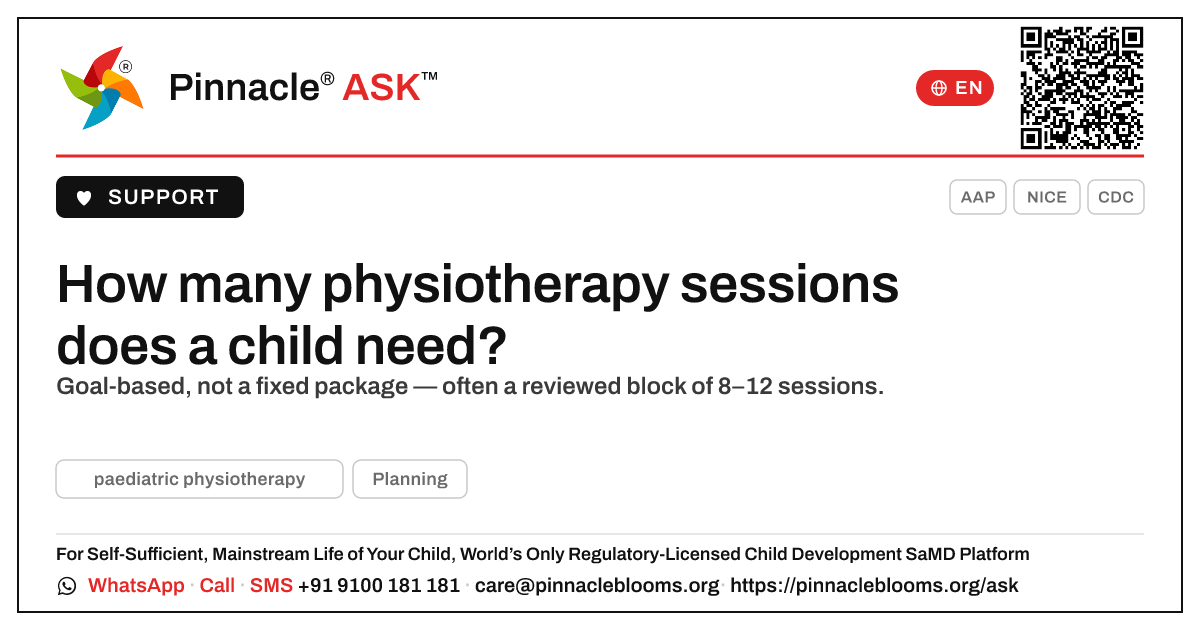
How many sessions of paediatric physiotherapy does a child need?
Paediatric physiotherapy has no fixed session count — it is tailored to a child's goals. Many children benefit from an initial block of around 8 to 12 sessions, after which progress is reviewed and the plan is adjusted, extended or stepped down. The number depends on the goal, the child's age and starting point, home practice and response to therapy. AbilityScore® is part of Pinnacle’s developmental assessment. Diagnosis, where needed, requires an appropriately qualified healthcare professional.
In this answer 5 sections
"How many sessions will my child need?" is one of the first questions every parent asks — and the honest, reassuring answer is that it depends on your child, not on a fixed number.
In short
There is no single fixed number — paediatric physiotherapy is tailored to each child's goals, not a one-size package. As a rough guide, many children benefit from an initial block of 8 to 12 sessions (often weekly or fortnightly), after which progress is reviewed and the plan is adjusted, extended, or stepped down. Some children with a mild, specific issue need only a handful of sessions plus a home programme; others with more complex motor needs benefit from longer, ongoing support. The true 'dose' is decided together with your therapist after assessing your child.
What decides the number of sessions
Several things shape how many sessions your child will need:
- The goal — a focused goal like correcting toe-walking or strengthening after an injury usually needs fewer sessions than building gross-motor skills in a child with cerebral palsy or global developmental delay.
- Your child's age and starting point — younger children and those with more complex needs often progress in longer, gentler arcs.
- How the plan is delivered — much of the real progress happens at home. A good physiotherapist coaches you with daily play-based exercises, so clinic sessions guide and review rather than do all the work.
- Response to therapy — plans are reviewed in blocks. If goals are met early, sessions reduce; if a new goal emerges, a fresh block begins.
Think of it as cycles of assess → block of therapy → review, rather than a countdown to a finish line. Consistency at home between sessions often matters more than the raw session count.
When to seek a check
If your child is not meeting motor milestones (not sitting by around 9 months, not walking by around 18 months), seems unusually stiff or floppy, strongly favours one side of the body, or has lost a skill they once had, it is worth a developmental check sooner rather than later. Early, well-targeted physiotherapy often means fewer sessions overall.
The Pinnacle way
AbilityScore® is part of Pinnacle’s developmental assessment. Diagnosis, where needed, requires an appropriately qualified healthcare professional — never from an app or a fixed package. From your child's structured clinician assessment, our therapists set clear, measurable motor goals and build a personalised paediatric physiotherapy plan — reviewed in blocks so you always know what comes next and why. Explore how our whole-child developmental support works around your family across 70+ centres.
Trusted sources
American Academy of Pediatrics (HealthyChildren.org) guidance on motor development and milestones; NICE guidance on physiotherapy and rehabilitation for children; CDC developmental milestone resources. These describe goal-based, individualised therapy rather than fixed session counts.
Next step — Want a clear, personalised plan instead of a guess at numbers? Book a paediatric physiotherapy assessment with a Pinnacle clinician.
This is general information, not a diagnosis — individual assessment and diagnosis require an appropriately qualified healthcare professional.
CONNECT THE ANSWER TO YOUR CHILD’S DAY
Something to notice. Something to discuss.
What to notice
Watch for missed motor milestones (not sitting by ~9 months, not walking by ~18 months), unusual stiffness or floppiness, strong one-sided preference, or loss of a previously gained skill — these warrant an earlier developmental check.
In everyday life
Progress lives between sessions — weave your therapist's exercises into everyday play, a few short, fun goes each day, rather than one long effort. Consistency at home often matters more than the session count.
Bring your observations and questions to your child’s professional. Choose activities that suit your child’s comfort, abilities and agreed plan.
Bring your questions to a first visitQuestions families ask
Is there a fixed number of physiotherapy sessions for children?
No. Paediatric physiotherapy is goal-based and individualised. Many children begin with a block of around 8 to 12 sessions, after which progress is reviewed and the plan is extended, stepped down, or ended — depending on your child's goals and response.
How often will my child attend?
Frequency varies — weekly or fortnightly sessions are common for an active block, with reviews built in. Children with more complex motor needs may attend over a longer period, while a focused issue may need only a few sessions plus a home programme.
Can fewer sessions still help my child?
Yes. For many children, much of the progress happens through daily play-based exercises at home, with clinic sessions guiding and reviewing. A therapist who coaches you well can help your child achieve goals with fewer in-clinic sessions.
How will I know when my child no longer needs physiotherapy?
Plans are reviewed in blocks against clear, measurable goals. When those goals are met and skills are holding steady in everyday life, sessions are reduced or stepped down, often with a home programme to maintain progress.
FOLLOW THE SOURCE
References behind this answer.
- Organisation website · further readingAAP HealthyChildren.org — motor development and milestones
- Organisation website · further readingNICE — guidance on children's physiotherapy and rehabilitation
- Organisation website · further readingCDC — developmental milestone resources
References are supplied with this answer. An organisation homepage offers further reading; it does not establish an independent review of this page.
Content attribution: SETU Consortium · Pinnacle Blooms Network.
PEOPLE, TOPICS & DEVELOPMENT
See the connections.
Browse the wider question collections connected with this answer’s audience, developmental area and stage.
FROM UNDERSTANDING TO PURPOSEFUL SUPPORT
One question. Your child’s whole life.
Your child’s self-sufficient, mainstream-included life is the purpose from the beginning. At Pinnacle, that purpose shapes what we understand, the goals we choose, the people we bring together, everyday practice and review.
Connect this question with the right support.
Start with your child’s strengths, your observations and what you want everyday life to become.
Make the next conversation useful.
Bring the situations you notice at home or school. We’ll explain a suitable service, centre and first visit, including availability and fees, before you decide.
How PinnacleAI® connects the journeyExplore the seven stages
- 1Understand abilities
A starting picture of your child’s capabilities.
- 2Choose meaningful goals
Readiness and a plan shaped around the child.
- 3Bring the right support together
Suitable therapies and people for those goals.
- 4Carry practice into everyday life
Guidance for family, home and school.
- 5Track and correct
Use observations to adjust the plan.
- 6Reassess and review
Decide what to continue, change or do next.
- 7Grow independence and participation
The child’s life gives each step its purpose.
Explore the whole PinnacleAI® system → · Participation at school and in the community →
PINNACLE’S EVIDENCE, OPEN TO YOU
Look at the evidence behind our work.
Read our research, inspect the original regulatory documents and check what each institutional measure means.
General information supports a conversation with an appropriately qualified professional. Advice, goals and support depend on the individual child.