
YOUR QUESTION. A CLEARER NEXT STEP.
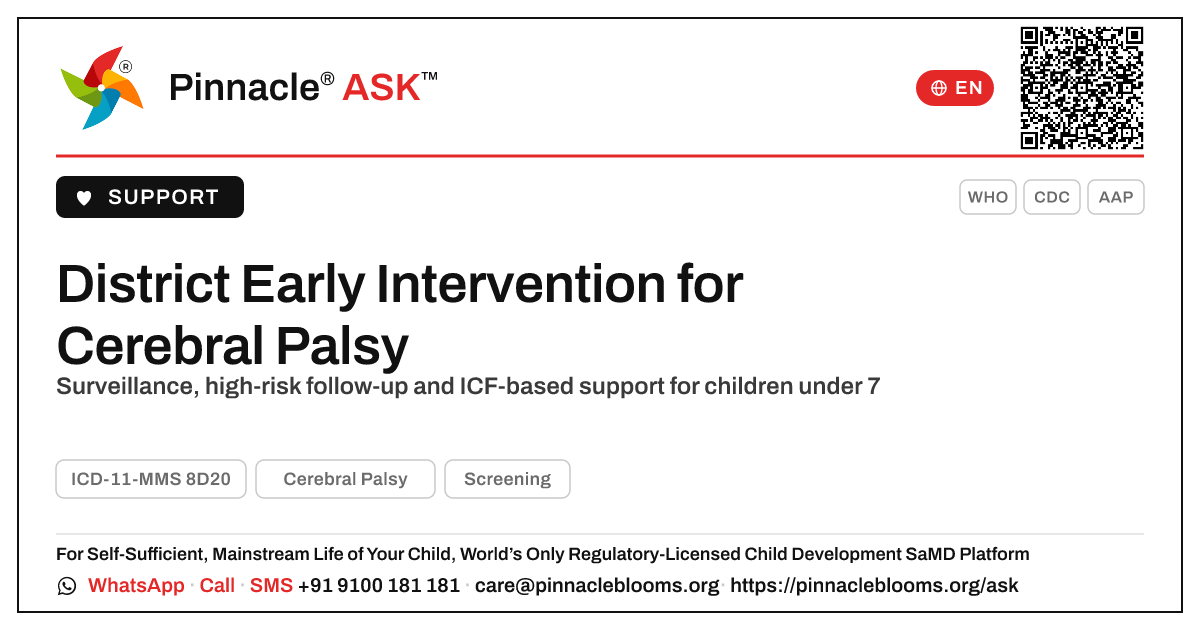
Identifying and supporting children under 7 with Cerebral Palsy in a district programme
A district programme identifies children under 7 with Cerebral Palsy through routine developmental surveillance, high-risk infant follow-up (preterm, NICU graduates, birth asphyxia), and a clear referral pathway to multidisciplinary assessment. Support follows the WHO ICF model — function-first physiotherapy, occupational and speech therapy, assistive devices and caregiver coaching delivered close to home. Diagnosis is clinician-confirmed; the district role is to find and route early.
In this answer 5 sections
A district programme succeeds when no child with Cerebral Palsy slips through the gap between birth and school — and that begins with a reliable way to find them early.
In short
A district early intervention programme can identify children under 7 with Cerebral Palsy (ICD-11 8D20) through three linked layers: routine developmental surveillance at every immunisation and well-child contact, structured screening of high-risk infants (preterm, low birth weight, neonatal encephalopathy, NICU graduates), and a clear referral pathway into multidisciplinary assessment. Support then follows the WHO ICF model — focusing on functioning and participation, not the diagnosis alone — delivered close to the family through physiotherapy, occupational and speech therapy, assistive devices, and caregiver coaching. The aim is the earliest possible window, because the developing brain responds best when intervention starts young.
Building identification at district scale
Surveillance — catch the signs in routine contacts. Train ASHA, ANM and Anganwadi workers and primary paediatric staff to use a milestone-tracking approach (such as the CDC Learn the Signs. Act Early. milestones) at every contact. Motor red flags worth acting on include: persistent fisting or stiffness, asymmetric movement or early hand preference before 12 months, poor head control beyond 4 months, not sitting by 9 months, and abnormal tone (floppy or rigid).
High-risk follow-up. Establish a register for NICU graduates, preterm and low-birth-weight infants, and babies with birth asphyxia or neonatal seizures — these children warrant scheduled developmental review rather than waiting for concern to arise.
Referral and confirmation. Any flagged child should move quickly to a paediatrician or developmental team. CP is a clinical diagnosis confirmed by a qualified clinician; the district pathway's job is to find and route, not to label at the periphery.
Supporting children once identified
- Function-first goals mapped to the WHO ICF — mobility, communication, self-care, play and participation.
- Therapy close to home — physiotherapy, occupational therapy and speech therapy, with caregiver coaching so families become daily co-therapists.
- Assistive technology and seating, nutrition and feeding support, and links to inclusive Anganwadi and school readiness.
- A shared progress measure so every centre and family tracks the same gains over time.
The Pinnacle way
A clinical AbilityScore® and any diagnosis are formed only at a Pinnacle Blooms Network centre, under qualified clinician care — never from a screening tool or an app. As a partner to government programmes, Pinnacle brings 2.5 billion+ data points, 25 million+ therapy sessions and 700+ therapists across 70+ centres in 4 states to strengthen district capacity. Learn more about Cerebral Palsy, how a structured clinician-administered assessment works, and how partnerships extend reach.
Trusted sources
WHO ICD-11 (Cerebral Palsy, 8D20); CDC Learn the Signs. Act Early. milestone guidance; Indian Academy of Pediatrics; American Academy of Pediatrics (HealthyChildren.org); WHO ICF functioning framework.
Next step — Planning a district early intervention pathway for Cerebral Palsy? Partner with Pinnacle Blooms Network.
This is general information, not a diagnosis — individual assessment and diagnosis require an appropriately qualified healthcare professional.
CONNECT THE ANSWER TO YOUR CHILD’S DAY
Something to notice. Something to discuss.
What to notice
Persistent fisting or stiffness, asymmetric movement or hand preference before 12 months, poor head control beyond 4 months, not sitting by 9 months, and abnormal floppy or rigid tone — especially in preterm, low-birth-weight or NICU-graduate infants.
In everyday life
Equip frontline workers to ask one simple question at every contact: 'Is this child moving on both sides equally and meeting motor milestones?' Asymmetry and missed motor steps are the earliest, most actionable cues.
Bring your observations and questions to your child’s professional. Choose activities that suit your child’s comfort, abilities and agreed plan.
Bring your questions to a first visitQuestions families ask
At what age can Cerebral Palsy be identified in a district programme?
Motor signs can often be detected in the first months, especially in high-risk infants such as preterm, low-birth-weight or NICU-graduate babies. Surveillance at every routine contact, combined with structured follow-up of high-risk infants, allows many children to be flagged well before their first birthday. Diagnosis is confirmed by a qualified clinician through multidisciplinary assessment.
Which frontline workers should be trained to screen for Cerebral Palsy?
ASHA, ANM and Anganwadi workers and primary paediatric staff can be trained in milestone surveillance and motor red flags. Their role is to recognise and refer — not to diagnose — ensuring flagged children move quickly into multidisciplinary assessment and support.
What support should follow identification?
Support follows the WHO ICF model with function-first goals: physiotherapy, occupational and speech therapy, assistive devices and seating, nutrition and feeding support, caregiver coaching, and links to inclusive Anganwadi and school readiness — delivered as close to the family's home as possible.
FOLLOW THE SOURCE
References behind this answer.
- Source referenceWHO ICD-11 — Cerebral Palsy
- Source referenceCDC — Learn the Signs. Act Early.
- Source referenceWHO ICF — functioning profile
- Organisation website · further readingAmerican Academy of Pediatrics (HealthyChildren.org)
References are supplied with this answer. An organisation homepage offers further reading; it does not establish an independent review of this page.
Content attribution: SETU Consortium · Pinnacle Blooms Network.
PEOPLE, TOPICS & DEVELOPMENT
See the connections.
Browse the wider question collections connected with this answer’s audience, developmental area and stage.
FROM UNDERSTANDING TO PURPOSEFUL SUPPORT
One question. Your child’s whole life.
Your child’s self-sufficient, mainstream-included life is the purpose from the beginning. At Pinnacle, that purpose shapes what we understand, the goals we choose, the people we bring together, everyday practice and review.
Connect this question with the right support.
Start with your child’s strengths, your observations and what you want everyday life to become.
Make the next conversation useful.
Bring the situations you notice at home or school. We’ll explain a suitable service, centre and first visit, including availability and fees, before you decide.
How PinnacleAI® connects the journeyExplore the seven stages
- 1Understand abilities
A starting picture of your child’s capabilities.
- 2Choose meaningful goals
Readiness and a plan shaped around the child.
- 3Bring the right support together
Suitable therapies and people for those goals.
- 4Carry practice into everyday life
Guidance for family, home and school.
- 5Track and correct
Use observations to adjust the plan.
- 6Reassess and review
Decide what to continue, change or do next.
- 7Grow independence and participation
The child’s life gives each step its purpose.
Explore the whole PinnacleAI® system → · Participation at school and in the community →
PINNACLE’S EVIDENCE, OPEN TO YOU
Look at the evidence behind our work.
Read our research, inspect the original regulatory documents and check what each institutional measure means.
General information supports a conversation with an appropriately qualified professional. Advice, goals and support depend on the individual child.