
YOUR QUESTION. A CLEARER NEXT STEP.
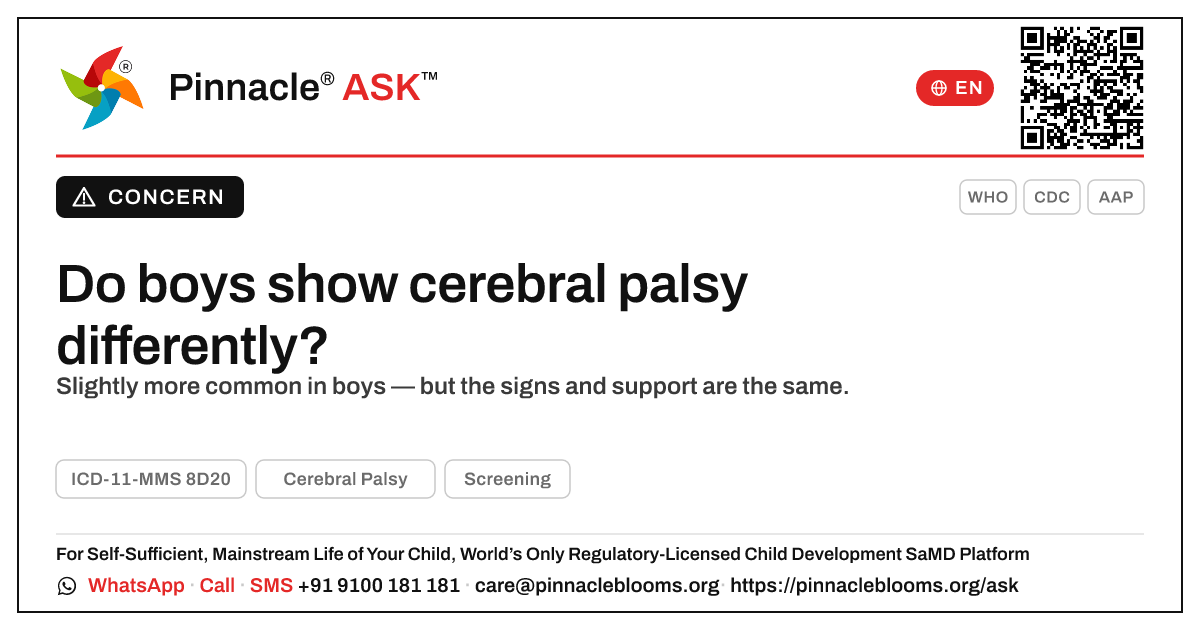
Do boys show cerebral palsy differently?
Cerebral palsy is slightly more common in boys, but it is not a different condition by sex. What shapes a child's journey is the type and severity of CP, not whether they are a boy or girl — and the signs to watch for are the same. Only a clinician can assess and diagnose.
In this answer 5 sections
If you've heard that boys are affected more often, it's natural to wonder whether cerebral palsy looks different in a son — here's what is true, and what truly matters.
In short
Cerebral palsy (CP) is slightly more common in boys than girls, and some studies suggest boys may more often have certain patterns or be born preterm — but CP is not fundamentally a "different condition" by sex. What shapes your child's journey is the type of CP, which body parts are affected, and how it affects movement and daily life — far more than whether they are a boy or a girl. The signs to watch for are the same.
What to actually watch for
CP comes from differences in how the developing brain controls movement and posture. Across all children, gentle flags worth a check include:
- Stiffness or floppiness — limbs that feel too tight or unusually loose when you dress or lift your child
- Asymmetry — strongly favouring one hand before age 1, or one side of the body moving differently
- Delayed motor milestones — not holding the head steady, rolling, sitting or pulling to stand around expected times
- Feeding or swallowing difficulty, or persistent unusual posturing
Boys being affected a little more often is a population-level statistic — it does not change what you watch for in your own child, or what helps.
When to seek a check
If you notice persistent stiffness, floppiness, a strong hand preference before one year, or milestones consistently slipping behind, ask for a developmental review promptly. Early movement support genuinely improves long-term function — and the earlier the start, the better.
The Pinnacle way
A clinical AbilityScore® and any diagnosis are formed only at a Pinnacle Blooms Network centre, under qualified clinician care — never from an online description or your child's sex alone. Our clinicians look at your child's whole movement and functioning profile and build a plan around their strengths. Explore occupational and physical therapy support or start here.
Trusted sources
WHO ICD-11 (8D20, cerebral palsy); WHO ICF functioning framework; CDC Learn the Signs, Act Early; American Academy of Pediatrics (HealthyChildren.org); Indian Academy of Pediatrics.
Next step — If movement milestones worry you, the kindest move is to check early. Book a developmental assessment with a Pinnacle clinician.
This is general information, not a diagnosis — individual assessment and diagnosis require an appropriately qualified healthcare professional.
CONNECT THE ANSWER TO YOUR CHILD’S DAY
Something to notice. Something to discuss.
What to notice
Watch for persistent stiffness or floppiness, a strong hand preference before age 1, body asymmetry, feeding difficulty, or motor milestones consistently slipping behind — in boys and girls alike.
In everyday life
During play, offer toys at your child's midline and to both sides, and notice whether they reach and use both hands. Encourage tummy time and reaching across the body — gentle, daily movement practice that supports both sides equally.
Bring your observations and questions to your child’s professional. Choose activities that suit your child’s comfort, abilities and agreed plan.
Bring your questions to a first visitQuestions families ask
Is cerebral palsy more common in boys?
Yes, CP is slightly more common in boys than girls at a population level. However, this statistic does not change the signs you watch for or the support that helps your own child.
Do boys have more severe cerebral palsy?
Severity is determined by the type of CP and which body parts are affected, not by a child's sex. Some studies note patterns by sex, but each child is assessed individually by a clinician.
What signs of cerebral palsy should I look for?
Persistent stiffness or floppiness, favouring one hand strongly before age one, body asymmetry, feeding difficulties, and motor milestones that consistently slip behind warrant a developmental review.
When should I get my child checked?
Seek a developmental review promptly if you notice these signs persisting. Early movement support improves long-term function, and a clinician can assess your child's whole profile.
FOLLOW THE SOURCE
References behind this answer.
- Source referenceWHO ICD-11 — Cerebral Palsy
- Source referenceCDC — Learn the Signs. Act Early.
- Organisation website · further readingAmerican Academy of Pediatrics (HealthyChildren.org)
- Source referenceWHO ICF — functioning profile
References are supplied with this answer. An organisation homepage offers further reading; it does not establish an independent review of this page.
Content attribution: SETU Consortium · Pinnacle Blooms Network.
PEOPLE, TOPICS & DEVELOPMENT
See the connections.
Browse the wider question collections connected with this answer’s audience, developmental area and stage.
FROM UNDERSTANDING TO PURPOSEFUL SUPPORT
One question. Your child’s whole life.
Your child’s self-sufficient, mainstream-included life is the purpose from the beginning. At Pinnacle, that purpose shapes what we understand, the goals we choose, the people we bring together, everyday practice and review.
Connect this question with the right support.
Start with your child’s strengths, your observations and what you want everyday life to become.
Make the next conversation useful.
Bring the situations you notice at home or school. We’ll explain a suitable service, centre and first visit, including availability and fees, before you decide.
How PinnacleAI® connects the journeyExplore the seven stages
- 1Understand abilities
A starting picture of your child’s capabilities.
- 2Choose meaningful goals
Readiness and a plan shaped around the child.
- 3Bring the right support together
Suitable therapies and people for those goals.
- 4Carry practice into everyday life
Guidance for family, home and school.
- 5Track and correct
Use observations to adjust the plan.
- 6Reassess and review
Decide what to continue, change or do next.
- 7Grow independence and participation
The child’s life gives each step its purpose.
Explore the whole PinnacleAI® system → · Participation at school and in the community →
PINNACLE’S EVIDENCE, OPEN TO YOU
Look at the evidence behind our work.
Read our research, inspect the original regulatory documents and check what each institutional measure means.
General information supports a conversation with an appropriately qualified professional. Advice, goals and support depend on the individual child.