
YOUR QUESTION. A CLEARER NEXT STEP.
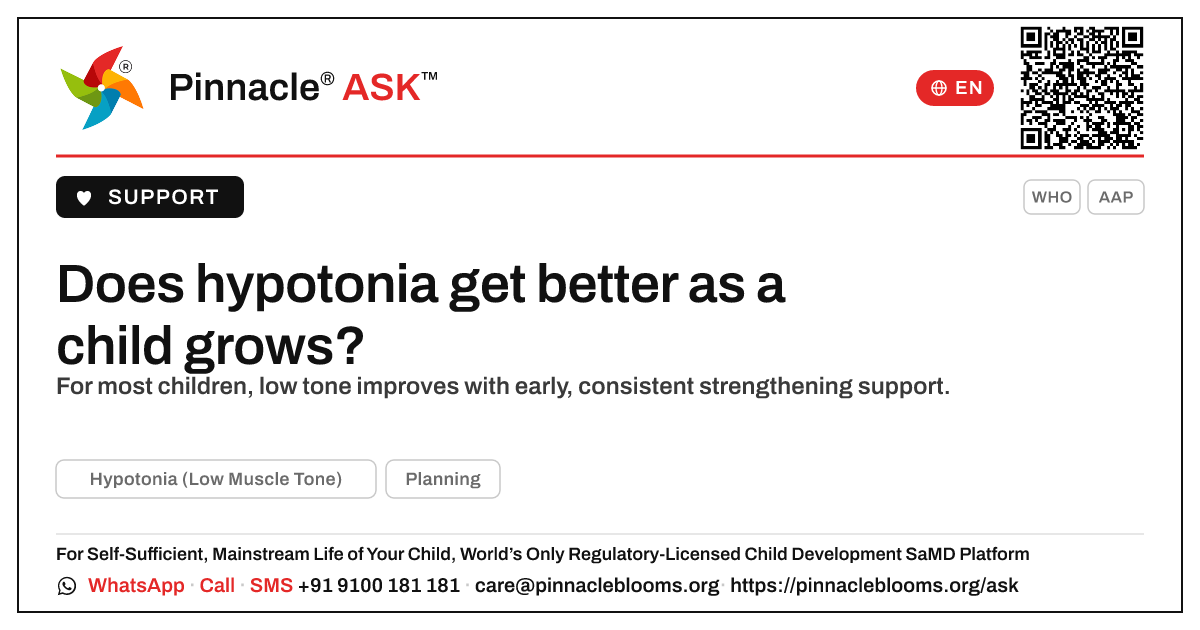
Does hypotonia get better or worse as a child grows?
For most children, hypotonia tends to improve gradually as they grow, especially with early, consistent physiotherapy and occupational therapy that build strength and motor skills — though the path depends on the underlying cause. AbilityScore® is part of Pinnacle’s developmental assessment. Diagnosis, where needed, requires an appropriately qualified healthcare professional.
In this answer 5 sections
When you first hear the word hypotonia, it can feel frightening — but for most children, low muscle tone is a starting point, not a life sentence, and the trajectory is usually upward.
In short
For most children, hypotonia tends to improve gradually as they grow — especially with early, consistent therapy that builds strength, stability and motor skills. Whether it gets better, stays steady or needs ongoing support depends largely on the underlying cause, which is why understanding the 'why' matters as much as the tone itself. Many children with mild, non-progressive hypotonia catch up beautifully over time; others make steady, meaningful progress with the right support around them.
What shapes the path ahead
Hypotonia is a sign, not a single condition — it describes muscles that feel floppy or offer less resistance, and what happens next depends on its root cause:
- Benign or non-progressive hypotonia — many infants with low tone and no underlying serious cause make excellent gains, gradually developing the head control, sitting, crawling and walking skills that strengthen muscles further. Movement builds tone, and tone enables more movement.
- Hypotonia linked to a developmental or genetic condition — here progress is real but often gentler and ongoing; the focus shifts to building function, independence and participation rather than 'curing' the tone.
- The growing-body factor — as children grow taller and heavier, weaker muscles work harder against gravity, so periods of plateau can appear. This is exactly why ongoing strengthening and posture support matter through the growing years.
The single biggest lever you control is early, regular therapy. Physiotherapy builds core and limb strength; occupational therapy supports fine-motor skills, posture and daily living; and a graded play-based programme keeps muscles active so that strength compounds over time.
When to seek a check
Seek a prompt review if you notice your child losing skills they once had, increasing floppiness, feeding or breathing difficulty, or no progress over a long period — these point to causes that need medical investigation rather than therapy alone. Early assessment also means support starts during the window when young muscles and the developing brain respond most readily.
The Pinnacle way
AbilityScore® is part of Pinnacle’s developmental assessment. Diagnosis, where needed, requires an appropriately qualified healthcare professional — never from an app or online form. Our clinicians map your child's strength, posture and motor milestones through a structured AbilityScore® assessment, then shape a strengthening plan delivered through occupational therapy and physiotherapy. You can explore how support works and what early help can mean for your child's path ahead.
Trusted sources
WHO ICD-11 framing of hypotonia as a sign with multiple underlying causes; American Academy of Pediatrics (HealthyChildren.org) guidance on motor development and early intervention; American Physical Therapy / paediatric rehabilitation principles on strengthening and motor skill building in low tone.
Next step — Want to understand your child's muscle strength and the path ahead? Book an assessment with a Pinnacle clinician.
This is general information, not a diagnosis — individual assessment and diagnosis require an appropriately qualified healthcare professional.
CONNECT THE ANSWER TO YOUR CHILD’S DAY
Something to notice. Something to discuss.
What to notice
Watch for losing skills once gained, increasing floppiness, feeding or breathing difficulty, or no progress over a long period — these need prompt medical review rather than therapy alone.
In everyday life
Build strength through play — encourage tummy time, reaching, pushing and pulling against gentle resistance, and short active bursts through the day, since every bit of movement helps low-tone muscles get stronger.
Bring your observations and questions to your child’s professional. Choose activities that suit your child’s comfort, abilities and agreed plan.
Bring your questions to a first visitQuestions families ask
Will my child's hypotonia go away completely?
For many children with mild, non-progressive low tone, strength and motor skills improve so much that hypotonia becomes barely noticeable. When it is linked to an underlying condition, progress is still real and meaningful but support often continues — the goal becomes building function and independence rather than 'curing' the tone.
Does therapy actually change muscle tone?
Therapy builds strength, stability and motor skill, which lets a child use their muscles more effectively. Movement strengthens muscles, and stronger muscles enable more movement — so early, regular physiotherapy and occupational therapy make a real difference to how a child functions as they grow.
Can hypotonia get worse over time?
Most non-progressive hypotonia does not worsen, but children may plateau as they grow taller and heavier and their muscles work harder against gravity. If a child is genuinely losing skills they once had, that needs prompt medical review to investigate the cause.
How early should we start support?
As early as possible. Young muscles and the developing brain respond most readily in the early years, so an early assessment and a play-based strengthening plan give your child the best foundation for the years ahead.
FOLLOW THE SOURCE
References behind this answer.
- Organisation website · further readingWHO ICD-11 reference
- Organisation website · further readingAAP HealthyChildren — motor development & early intervention
References are supplied with this answer. An organisation homepage offers further reading; it does not establish an independent review of this page.
Content attribution: SETU Consortium · Pinnacle Blooms Network.
PEOPLE, TOPICS & DEVELOPMENT
See the connections.
Browse the wider question collections connected with this answer’s audience, developmental area and stage.
FROM UNDERSTANDING TO PURPOSEFUL SUPPORT
One question. Your child’s whole life.
Your child’s self-sufficient, mainstream-included life is the purpose from the beginning. At Pinnacle, that purpose shapes what we understand, the goals we choose, the people we bring together, everyday practice and review.
Connect this question with the right support.
Start with your child’s strengths, your observations and what you want everyday life to become.
Make the next conversation useful.
Bring the situations you notice at home or school. We’ll explain a suitable service, centre and first visit, including availability and fees, before you decide.
How PinnacleAI® connects the journeyExplore the seven stages
- 1Understand abilities
A starting picture of your child’s capabilities.
- 2Choose meaningful goals
Readiness and a plan shaped around the child.
- 3Bring the right support together
Suitable therapies and people for those goals.
- 4Carry practice into everyday life
Guidance for family, home and school.
- 5Track and correct
Use observations to adjust the plan.
- 6Reassess and review
Decide what to continue, change or do next.
- 7Grow independence and participation
The child’s life gives each step its purpose.
Explore the whole PinnacleAI® system → · Participation at school and in the community →
PINNACLE’S EVIDENCE, OPEN TO YOU
Look at the evidence behind our work.
Read our research, inspect the original regulatory documents and check what each institutional measure means.
General information supports a conversation with an appropriately qualified professional. Advice, goals and support depend on the individual child.