
YOUR QUESTION. A CLEARER NEXT STEP.
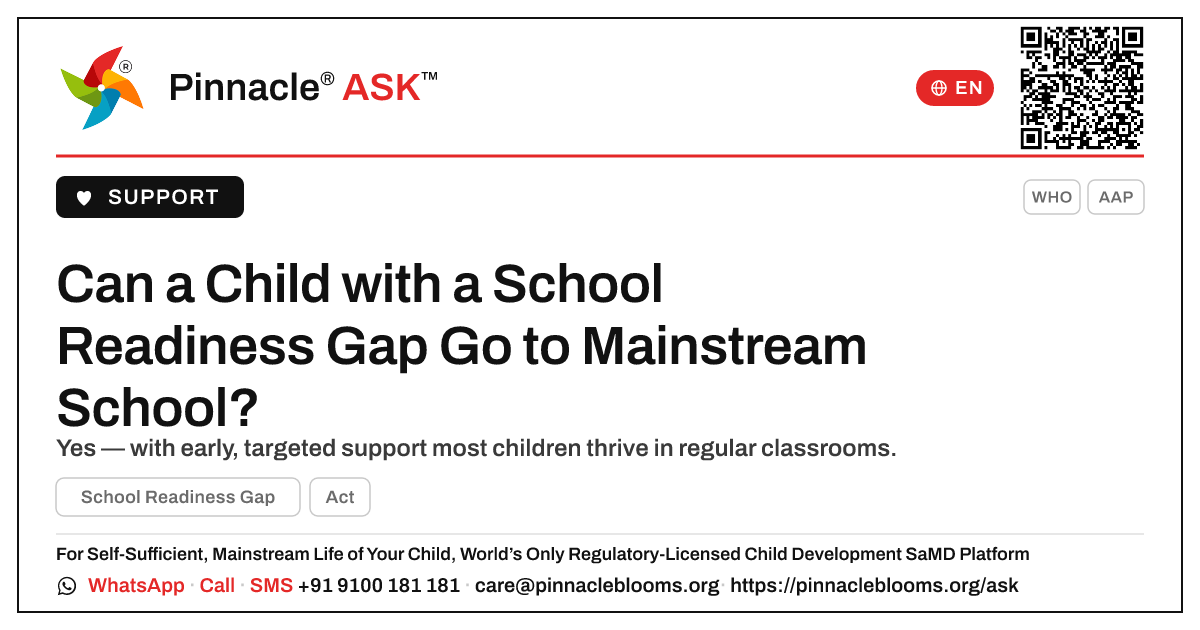
Can a Child with a School Readiness Gap Attend Mainstream School?
Yes. A School Readiness Gap describes skills that need a little more support, not a barrier to mainstream school. With early groundwork and targeted help, most children attend regular schools and thrive. Developmental measurement supports care planning; diagnosis requires an appropriately qualified healthcare professional., under clinician care.
In this answer 5 sections
Yes — and for most children, mainstream school is exactly where they thrive with the right early support.
In short
Absolutely yes. A School Readiness Gap simply means a child needs a little more time or targeted support to build the skills that help them settle into a classroom — it is not a barrier to mainstream school. With the right groundwork in the months before and during the early school years, the vast majority of these children attend regular schools and flourish alongside their peers. The gap describes where support helps most today — not a ceiling on what your child can do.
What "readiness" really means
School readiness is a blend of skills that develop at their own pace: listening and following simple instructions, sitting and attending for short stretches, holding a crayon, separating calmly from you, taking turns and using words to ask for help. A gap in one or two of these areas is common and very workable. Most can be strengthened through everyday play, predictable routines, and — where helpful — short bursts of focused therapy in speech, occupational or behaviour support.
How mainstream school can work for your child
- Share your child's profile early with the class teacher so support is in place from day one.
- Look for small, practical adjustments — a visual timetable, a quiet corner, a buddy at break.
- Build foundation skills before term begins: turn-taking games, picture books, simple chores.
- Keep the bridge open between home, school and therapist so everyone pulls in one direction.
The Pinnacle way
AbilityScore® is part of Pinnacle’s developmental assessment. Diagnosis, where needed, requires an appropriately qualified healthcare professional — never from an online form. Our team can map exactly which readiness skills to strengthen and pace the support around your child. Explore the School Readiness Gap pathway, see how an AbilityScore® is established, and how occupational therapy builds classroom-ready skills.
Trusted sources
WHO Nurturing Care Framework on early childhood development; American Academy of Pediatrics guidance on school readiness via HealthyChildren.
Next step — Book a readiness check at your nearest Pinnacle centre and walk into the school year with a clear plan. Begin here.
This is general information, not a diagnosis — individual assessment and diagnosis require an appropriately qualified healthcare professional.
CONNECT THE ANSWER TO YOUR CHILD’S DAY
Something to notice. Something to discuss.
What to notice
Watch how your child copes with short waits, following two-step instructions, separating from you, and using words to ask for help. Persistent struggle across home and pre-school in these areas is worth a readiness check.
In everyday life
Practise school rhythms gently at home — a picture timetable, turn-taking games, and 'first this, then that' routines build attention and confidence without pressure.
Bring your observations and questions to your child’s professional. Choose activities that suit your child’s comfort, abilities and agreed plan.
Bring your questions to a first visitQuestions families ask
Does a School Readiness Gap mean my child needs a special school?
Not usually. A readiness gap describes skills that need strengthening, not a fixed limitation. With early support most children attend mainstream schools comfortably; a clinician can advise on the right setting for your child.
How early should we start preparing for school?
The months before school begins are ideal, but it is never too late. Simple daily routines, play-based turn-taking and short focused therapy where needed all help your child settle in confidently.
Will the school know how to support my child?
Sharing a clear profile early helps. Small adjustments — a visual timetable, a quiet space, a buddy — go a long way, and an open link between home, school and therapist keeps support consistent.
FOLLOW THE SOURCE
References behind this answer.
- Organisation website · further readingWHO Nurturing Care Framework for early childhood development
- Organisation website · further readingAAP HealthyChildren: school readiness guidance
References are supplied with this answer. An organisation homepage offers further reading; it does not establish an independent review of this page.
Content attribution: SETU Consortium · Pinnacle Blooms Network.
PEOPLE, TOPICS & DEVELOPMENT
See the connections.
Browse the wider question collections connected with this answer’s audience, developmental area and stage.
FROM UNDERSTANDING TO PURPOSEFUL SUPPORT
One question. Your child’s whole life.
Your child’s self-sufficient, mainstream-included life is the purpose from the beginning. At Pinnacle, that purpose shapes what we understand, the goals we choose, the people we bring together, everyday practice and review.
Connect this question with the right support.
Explore how the relevant service contributes to everyday abilities, then speak with us about your child.
Make the next conversation useful.
Bring the situations you notice at home or school. We’ll explain a suitable service, centre and first visit, including availability and fees, before you decide.
How PinnacleAI® connects the journeyExplore the seven stages
- 1Understand abilities
A starting picture of your child’s capabilities.
- 2Choose meaningful goals
Readiness and a plan shaped around the child.
- 3Bring the right support together
Suitable therapies and people for those goals.
- 4Carry practice into everyday life
Guidance for family, home and school.
- 5Track and correct
Use observations to adjust the plan.
- 6Reassess and review
Decide what to continue, change or do next.
- 7Grow independence and participation
The child’s life gives each step its purpose.
Explore the whole PinnacleAI® system → · Participation at school and in the community →
PINNACLE’S EVIDENCE, OPEN TO YOU
Look at the evidence behind our work.
Read our research, inspect the original regulatory documents and check what each institutional measure means.
General information supports a conversation with an appropriately qualified professional. Advice, goals and support depend on the individual child.