
YOUR QUESTION. A CLEARER NEXT STEP.
At what age is the ADOS-2 used for a child?
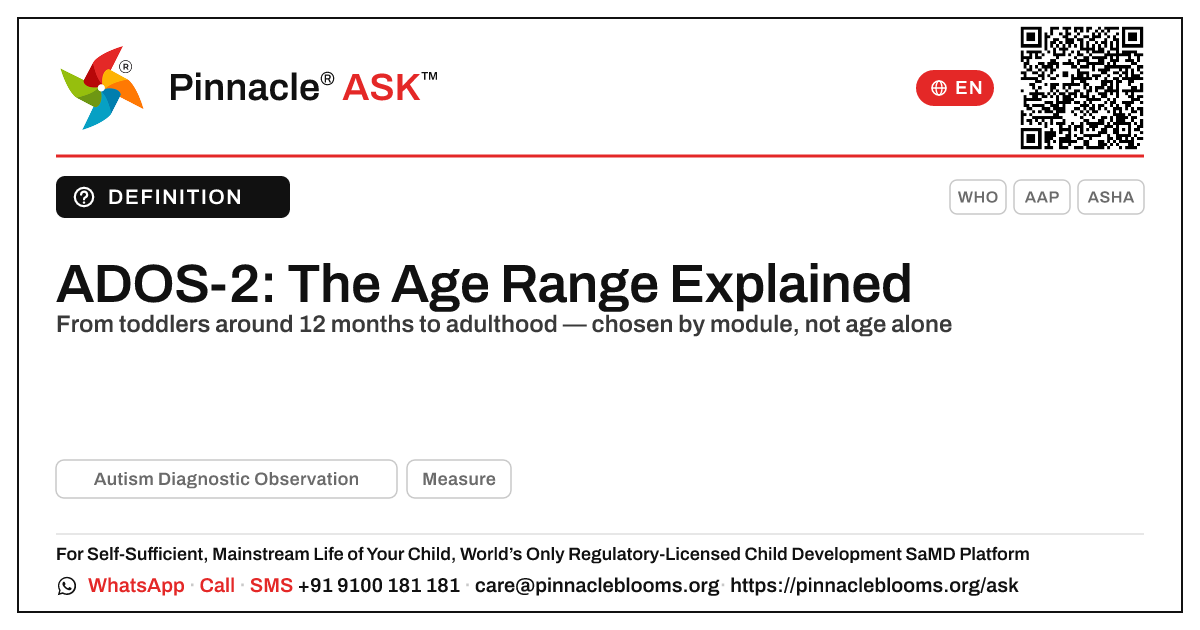
The ADOS-2 is a clinician-administered, play-based assessment used across a very wide age range — from toddlers around 12 months through childhood, adolescence and into adulthood. It is not one fixed test but five modules; a clinician selects the right one based on the child's age and language level. A dedicated Toddler Module covers very young children of roughly 12–30 months who are not yet using regular phrases.
In this answer 5 sections
The ADOS-2 flexes to a child's age and language — from babies as young as a year right through to adulthood.
In short
The ADOS-2 (Autism Diagnostic Observation Schedule, 2nd edition) is a clinician-administered, play-based assessment used across a very wide age range — from toddlers around 12 months through childhood, adolescence and into adulthood. Rather than one fixed test, it has five different modules, and a clinician chooses the right module based on your child's age and how they communicate, not their age alone. There is also a dedicated Toddler Module for very young children (roughly 12–30 months) who are not yet using regular phrases.
How the ADOS-2 fits the child
The ADOS-2 is built around the idea that the assessment should meet the child where they are. A clinician selects from five modules:
- Toddler Module — for children roughly 12–30 months who are not yet using consistent phrase speech.
- Module 1 — for children 31 months and older who use few or no words.
- Module 2 — for children of any age who use phrase speech but are not yet verbally fluent.
- Module 3 — for verbally fluent children and younger adolescents.
- Module 4 — for verbally fluent older adolescents and adults.
Because the choice depends on expressive language level as well as chronological age, two children of the same age may be assessed with different modules. The session itself is a series of warm, structured play and conversation activities that give the clinician planned opportunities to observe social communication, interaction, play and behaviour. It is never used alone — it forms one part of a fuller developmental picture alongside history, parent interview and other observations.
When it is used
The ADOS-2 is most often used when a structured, observation-based look at social communication is helpful — typically as part of an autism assessment from the toddler years onward. For very young infants below about a year, it is not the tool used; at that stage a clinician focuses on general developmental observation and milestone review instead.
The Pinnacle way
This is general information, not a diagnosis — a clinical AbilityScore® and any diagnosis are formed only at a Pinnacle Blooms Network centre, under qualified clinician care, never from an app or form. Our clinicians may draw on structured tools like the ADOS-2 within a broader assessment, and pair findings with supports such as speech therapy where helpful.
Trusted sources
WHO ICD-11 framing of autism spectrum disorder; the American Academy of Pediatrics and HealthyChildren guidance on developmental screening and assessment; ASHA on the role of communication assessment in autism evaluation.
Next step — If you'd like a clear, caring picture of your child's development, book a developmental assessment with a Pinnacle clinician who can choose the right tools for your child's age and communication.
CONNECT THE ANSWER TO YOUR CHILD’S DAY
Something to notice. Something to discuss.
What to notice
Remember the right ADOS-2 module depends on your child's language level as well as their age — a clinician chooses it, so two same-age children may be assessed differently.
In everyday life
Before any assessment, jot down a few everyday notes — how your child communicates, plays and responds at home — so the clinician can build a fuller, fairer picture.
Bring your observations and questions to your child’s professional. Choose activities that suit your child’s comfort, abilities and agreed plan.
Bring your questions to a first visitQuestions families ask
Is there a minimum age for the ADOS-2?
The ADOS-2 can be used from around 12 months of age, using its dedicated Toddler Module for very young children who are not yet using regular phrase speech. Below about a year, clinicians rely on general developmental observation rather than the ADOS-2.
Can adults take the ADOS-2?
Yes. Module 4 is designed for verbally fluent older adolescents and adults, so the ADOS-2 spans toddlerhood right through to adulthood.
Why are there different ADOS-2 modules?
Each module is matched to a person's expressive language level as well as their age, so the activities are appropriate and observations are fair. A clinician selects the most suitable module for your child.
Does an ADOS-2 result mean a diagnosis?
No. The ADOS-2 is one observation tool within a wider assessment. A diagnosis is only ever formed by a qualified clinician who considers the full developmental picture, never from a single test.
FOLLOW THE SOURCE
References behind this answer.
- Organisation website · further readingWHO ICD-11: autism spectrum disorder
- Organisation website · further readingAAP HealthyChildren: developmental screening & assessment
- Organisation website · further readingASHA: communication assessment in autism
References are supplied with this answer. An organisation homepage offers further reading; it does not establish an independent review of this page.
Content attribution: SETU Consortium · Pinnacle Blooms Network.
PEOPLE, TOPICS & DEVELOPMENT
See the connections.
Browse the wider question collections connected with this answer’s audience, developmental area and stage.
FROM UNDERSTANDING TO PURPOSEFUL SUPPORT
One question. Your child’s whole life.
Your child’s self-sufficient, mainstream-included life is the purpose from the beginning. At Pinnacle, that purpose shapes what we understand, the goals we choose, the people we bring together, everyday practice and review.
Connect this question with the right support.
Explore how the relevant service contributes to everyday abilities, then speak with us about your child.
Make the next conversation useful.
Bring the situations you notice at home or school. We’ll explain a suitable service, centre and first visit, including availability and fees, before you decide.
How PinnacleAI® connects the journeyExplore the seven stages
- 1Understand abilities
A starting picture of your child’s capabilities.
- 2Choose meaningful goals
Readiness and a plan shaped around the child.
- 3Bring the right support together
Suitable therapies and people for those goals.
- 4Carry practice into everyday life
Guidance for family, home and school.
- 5Track and correct
Use observations to adjust the plan.
- 6Reassess and review
Decide what to continue, change or do next.
- 7Grow independence and participation
The child’s life gives each step its purpose.
Explore the whole PinnacleAI® system → · Participation at school and in the community →
PINNACLE’S EVIDENCE, OPEN TO YOU
Look at the evidence behind our work.
Read our research, inspect the original regulatory documents and check what each institutional measure means.
General information supports a conversation with an appropriately qualified professional. Advice, goals and support depend on the individual child.