
YOUR QUESTION. A CLEARER NEXT STEP.
At what age can a child start sensory integration therapy?
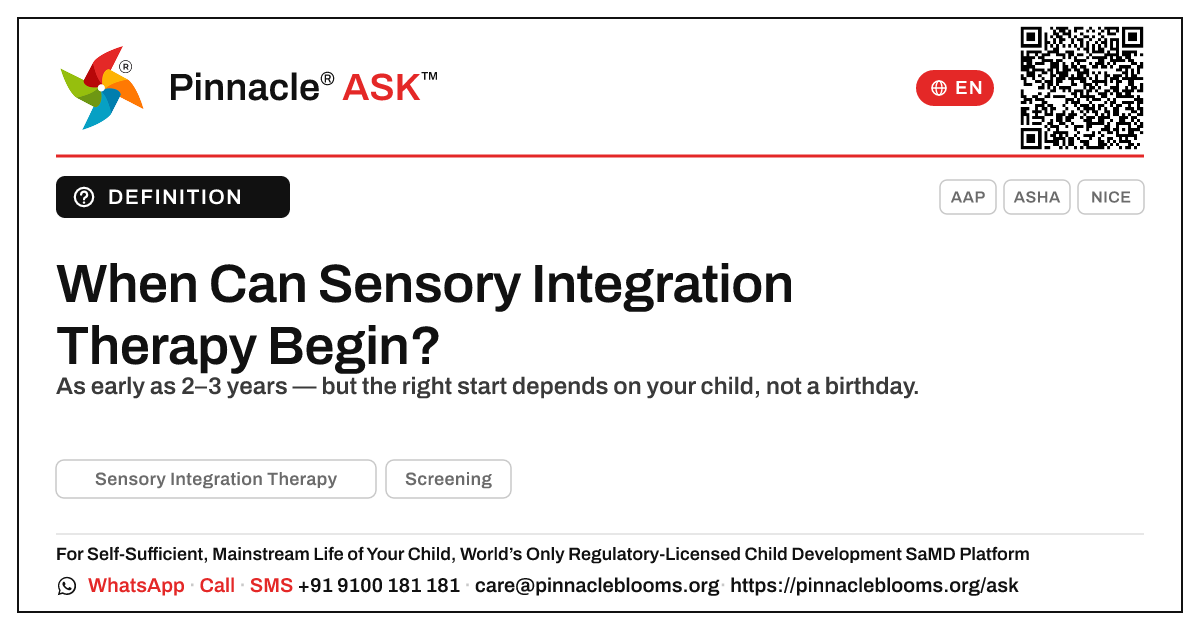
Sensory integration therapy can begin as early as toddlerhood — around 2 to 3 years — and is most commonly delivered between roughly 3 and 12 years, when play-based, child-led activity is the natural way children learn. There is no single fixed starting age; what matters is that a qualified occupational therapist identifies genuine sensory-processing differences affecting daily life. Even before formal therapy, sensory-rich play at home supports development.
In this answer 5 sections
"When can we start helping?" is one of the most hopeful questions a parent can ask — and with sensory integration therapy, the answer is reassuringly early.
In short
Sensory integration therapy can begin as early as toddlerhood — around 2 to 3 years — and is most commonly delivered to children between roughly 3 and 12 years, when play-based, child-led activity is the natural way they learn. There is no single fixed starting age: what matters is that a qualified occupational therapist sees genuine sensory-processing differences affecting your child's everyday life. Even before formal therapy, sensory-rich play at home supports every young child's development.
How the timing works
Sensory integration therapy, usually delivered by an occupational therapist, helps a child's brain organise and respond to everyday sensations — touch, movement, sound, sight, balance and body awareness — so they can play, learn and settle more comfortably. Because the approach is rooted in active, playful movement (swings, climbing, textured play, deep pressure), a child needs to be old enough to take part in guided play — which is why around age 2–3 is a typical earliest start.
The early childhood years are a wonderful window because young brains are highly adaptable, and difficulties with sensations are often becoming noticeable in daily routines — dressing, eating, sleeping, messy play, or coping with busy, noisy places. That said, older children, and even teenagers, can also benefit when sensory differences affect attention, self-regulation or daily participation. The right starting point is decided not by a birthday but by a careful look at your individual child.
When to seek a look-see
Consider an occupational therapy review if your child consistently seems over- or under-sensitive to everyday input — strongly avoiding or craving messy textures, covering ears at ordinary sounds, constantly on the move or unusually still, struggling with clothing tags, food textures, or transitions, or appearing clumsy and unsure on their feet. These patterns, when they affect daily life, are well worth a gentle, knowledgeable assessment at any age from toddlerhood onwards.
The Pinnacle way
This is general information, not a diagnosis — a clinical AbilityScore® and any diagnosis are formed only at a Pinnacle Blooms Network centre, under qualified clinician care, never from an app or form. Our occupational therapists observe how your child takes in and responds to sensation, then shape an individualised, play-led plan through our occupational therapy pathway. Explore more about how we support families at Pinnacle Blooms Network.
Trusted sources
The American Occupational Therapy guidance via ASHA and AAP on sensory processing and early intervention; HealthyChildren on how young children develop through play and senses; NICE guidance on assessing developmental concerns in children.
Next step — If your child shows sensory differences that affect daily play, eating, sleep or comfort, book an occupational therapy screen for a warm, individualised assessment.
CONNECT THE ANSWER TO YOUR CHILD’S DAY
Something to notice. Something to discuss.
What to notice
Over- or under-sensitivity to everyday input — avoiding or craving messy textures, covering ears at ordinary sounds, constant movement or unusual stillness, distress with clothing tags, food textures or transitions, or appearing clumsy and unsure on their feet, when these affect daily life.
In everyday life
Build sensory-rich play into ordinary days: barefoot walks on grass and sand, squashing and stretching dough, swinging at the park, and gentle 'bear hug' deep pressure — playful input that supports any young child's developing senses without pressure.
Bring your observations and questions to your child’s professional. Choose activities that suit your child’s comfort, abilities and agreed plan.
Bring your questions to a first visitQuestions families ask
What is the earliest age for sensory integration therapy?
It can typically begin around 2 to 3 years, once a child is old enough to take part in guided, playful movement activities. The exact start depends on your individual child, decided by a qualified occupational therapist.
Is sensory integration therapy only for young children?
No. While the early childhood years (roughly 3–12) are a wonderful window because young brains are highly adaptable, older children and even teenagers can benefit when sensory differences affect attention, self-regulation or daily participation.
Does my child need a diagnosis before starting?
Not necessarily — what matters is that a qualified clinician sees genuine sensory-processing differences affecting daily life. At Pinnacle Blooms Network, any clinical assessment and AbilityScore® are formed only at a centre under qualified clinician care.
FOLLOW THE SOURCE
References behind this answer.
- Organisation website · further readingHealthyChildren (AAP) — how young children develop through senses and play
- Organisation website · further readingASHA — sensory processing and developmental support
- Organisation website · further readingNICE — assessing developmental concerns in children
References are supplied with this answer. An organisation homepage offers further reading; it does not establish an independent review of this page.
Content attribution: SETU Consortium · Pinnacle Blooms Network.
PEOPLE, TOPICS & DEVELOPMENT
See the connections.
Browse the wider question collections connected with this answer’s audience, developmental area and stage.
FROM UNDERSTANDING TO PURPOSEFUL SUPPORT
One question. Your child’s whole life.
Your child’s self-sufficient, mainstream-included life is the purpose from the beginning. At Pinnacle, that purpose shapes what we understand, the goals we choose, the people we bring together, everyday practice and review.
Connect this question with the right support.
Explore how the relevant service contributes to everyday abilities, then speak with us about your child.
Make the next conversation useful.
Bring the situations you notice at home or school. We’ll explain a suitable service, centre and first visit, including availability and fees, before you decide.
How PinnacleAI® connects the journeyExplore the seven stages
- 1Understand abilities
A starting picture of your child’s capabilities.
- 2Choose meaningful goals
Readiness and a plan shaped around the child.
- 3Bring the right support together
Suitable therapies and people for those goals.
- 4Carry practice into everyday life
Guidance for family, home and school.
- 5Track and correct
Use observations to adjust the plan.
- 6Reassess and review
Decide what to continue, change or do next.
- 7Grow independence and participation
The child’s life gives each step its purpose.
Explore the whole PinnacleAI® system → · Participation at school and in the community →
PINNACLE’S EVIDENCE, OPEN TO YOU
Look at the evidence behind our work.
Read our research, inspect the original regulatory documents and check what each institutional measure means.
General information supports a conversation with an appropriately qualified professional. Advice, goals and support depend on the individual child.