
YOUR QUESTION. A CLEARER NEXT STEP.
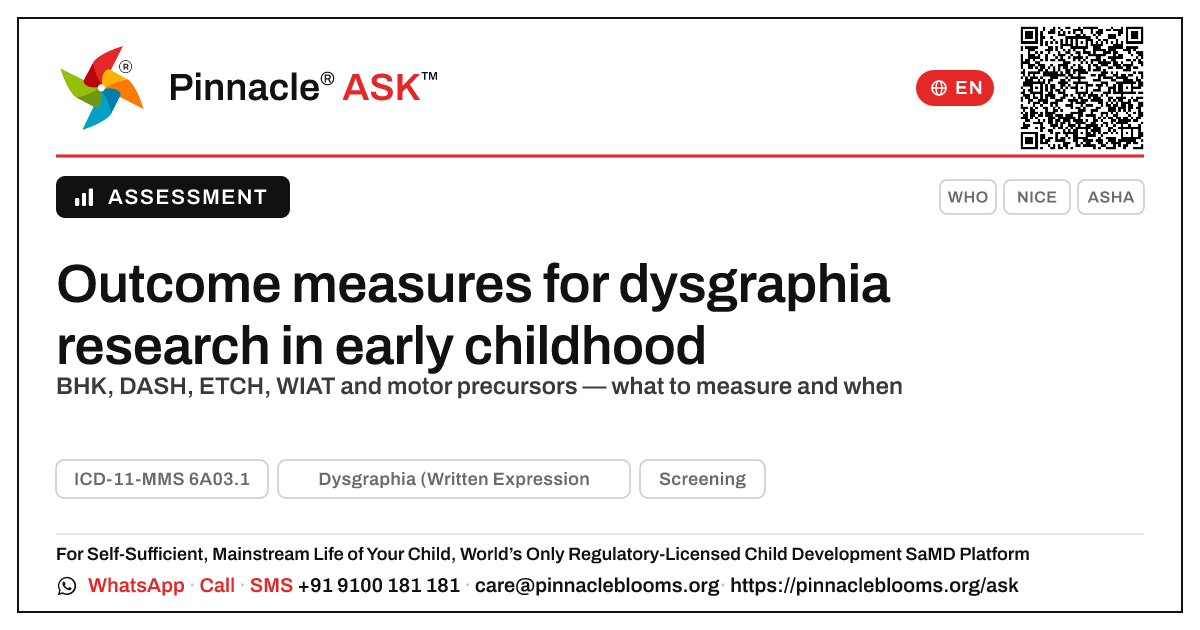
Validated outcome measures for studying dysgraphia in early childhood
No single gold standard exists for dysgraphia in early childhood; researchers combine handwriting-product scales (BHK, ETCH, MHA), speed and kinematic measures (DASH, tablet-based), written-expression batteries (WIAT, WJ, TOWL), and motor/visual-motor precursors (Beery VMI). Below ~6–7 years, measures index risk and precursors rather than confirmed diagnosis.
In this answer 5 sections
Before a child writes a sentence, the foundations of written expression are already observable — and measurable.
In short
There is no single gold-standard instrument for dysgraphia in early childhood; researchers triangulate across handwriting-product measures, process-based kinematic tools, and norm-referenced written-language batteries. The most widely cited validated measures include the BHK (Concise Assessment Scale for Children's Handwriting) and its BHK-Brief, the DASH (Detailed Assessment of Speed of Handwriting), the ETCH (Evaluation Tool of Children's Handwriting), and broader academic-achievement batteries such as the WIAT and WJ written-expression subtests. Because ICD-11 6A03.1 is typically confirmed only once formal instruction has begun (~age 6–7), early-childhood research leans heavily on pre-writing, fine-motor and graphomotor precursors rather than diagnostic confirmation.
The measurement landscape
Handwriting-product and legibility scales
- BHK / BHK-Brief — quality and speed of handwriting; widely validated across European and Indian cohorts for screening dysgraphic profiles.
- ETCH — manuscript and cursive legibility, letter/word/number formation; useful in school-age samples.
- Minnesota Handwriting Assessment (MHA) — legibility, form, alignment, size, spacing.
Speed and process measures
- DASH / DASH-17+ — handwriting speed across copying and free-writing tasks, normed for fatigue effects.
- Digitised tablet kinematics — pen pressure, velocity, in-air time and stroke fluency; increasingly used in early-childhood research to detect graphomotor immaturity before legible writing emerges.
Written-expression and composition batteries
- WIAT and WJ written-expression subtests, and the TOWL (Test of Written Language) for composition, syntax and spelling once a child writes connected text.
Precursor and motor foundations (most relevant under ~6 years)
- Fine-motor and visual-motor integration tools such as the Beery VMI, plus Movement ABC motor screens, capture the graphomotor substrate that predicts later writing difficulty.
A note on age and construct validity
Written-expression impairment is a learning disorder — its diagnostic criteria assume sustained, formal instruction. In children below roughly 6–7 years, outcome measures index risk and precursor skills, not the disorder itself. Research designs should therefore pair developmental motor/visual-motor measures with longitudinal follow-up into the early school years, and report instrument norms, reliability and the population on which validation was established.
The Pinnacle way
Developmental measurement supports care planning; diagnosis requires an appropriately qualified healthcare professional., under qualified clinician care — never from a single questionnaire or online tool. For research partners, our occupational therapy and graphomotor programmes generate structured, longitudinal outcome data; see dysgraphia for our clinical framing and how the AbilityScore is calculated as a clinician-administered structured measure that complements published instruments.
Trusted sources
WHO ICD-11 classification of developmental learning disorder with impairment in written expression (6A03.1); NICE guidance on supporting children with learning difficulties; AAP/HealthyChildren guidance on developmental monitoring; ASHA resources on written-language assessment.
Next step — Research teams seeking validated, longitudinal written-expression outcome data can partner with Pinnacle.
This is general information, not a diagnosis — individual assessment and diagnosis require an appropriately qualified healthcare professional.
CONNECT THE ANSWER TO YOUR CHILD’S DAY
Something to notice. Something to discuss.
What to notice
Whether a chosen instrument is normed for the child's age and population, its reliability data, and whether it measures the disorder itself or precursor graphomotor skills below ~6–7 years.
In everyday life
Pair a product measure (legibility) with a process measure (speed or kinematics) — single-instrument designs underestimate the graphomotor component of written-expression difficulty.
Bring your observations and questions to your child’s professional. Choose activities that suit your child’s comfort, abilities and agreed plan.
Bring your questions to a first visitQuestions families ask
Is there one gold-standard test for dysgraphia in young children?
No. Researchers triangulate handwriting-product scales (BHK, ETCH), speed/kinematic measures (DASH, tablet-based), written-expression batteries (WIAT, WJ, TOWL) and motor precursors (Beery VMI), choosing instruments validated for the relevant age and population.
Can dysgraphia be confirmed before age 6?
Written-expression impairment assumes sustained formal instruction, so diagnosis is typically not meaningful before roughly 6–7 years. Below that age, measures index risk and graphomotor precursors, and longitudinal follow-up into early school years is recommended.
Which measures capture graphomotor precursors?
Visual-motor integration tools such as the Beery VMI, fine-motor and movement screens (e.g. Movement ABC), and digitised tablet kinematics capturing pen pressure, velocity and stroke fluency are commonly used precursor measures.
FOLLOW THE SOURCE
References behind this answer.
- Organisation website · further readingNICE guidance on supporting children with learning difficulties
- Organisation website · further readingASHA resources on written-language assessment
References are supplied with this answer. An organisation homepage offers further reading; it does not establish an independent review of this page.
Content attribution: SETU Consortium · Pinnacle Blooms Network.
PEOPLE, TOPICS & DEVELOPMENT
See the connections.
Browse the wider question collections connected with this answer’s audience, developmental area and stage.
FROM UNDERSTANDING TO PURPOSEFUL SUPPORT
One question. Your child’s whole life.
Your child’s self-sufficient, mainstream-included life is the purpose from the beginning. At Pinnacle, that purpose shapes what we understand, the goals we choose, the people we bring together, everyday practice and review.
Connect this question with the right support.
Start with your child’s strengths, your observations and what you want everyday life to become.
Make the next conversation useful.
Bring the situations you notice at home or school. We’ll explain a suitable service, centre and first visit, including availability and fees, before you decide.
How PinnacleAI® connects the journeyExplore the seven stages
- 1Understand abilities
A starting picture of your child’s capabilities.
- 2Choose meaningful goals
Readiness and a plan shaped around the child.
- 3Bring the right support together
Suitable therapies and people for those goals.
- 4Carry practice into everyday life
Guidance for family, home and school.
- 5Track and correct
Use observations to adjust the plan.
- 6Reassess and review
Decide what to continue, change or do next.
- 7Grow independence and participation
The child’s life gives each step its purpose.
Explore the whole PinnacleAI® system → · Participation at school and in the community →
PINNACLE’S EVIDENCE, OPEN TO YOU
Look at the evidence behind our work.
Read our research, inspect the original regulatory documents and check what each institutional measure means.
General information supports a conversation with an appropriately qualified professional. Advice, goals and support depend on the individual child.