
YOUR QUESTION. A CLEARER NEXT STEP.
Quantitative Reasoning and the ICF: which functioning domain?
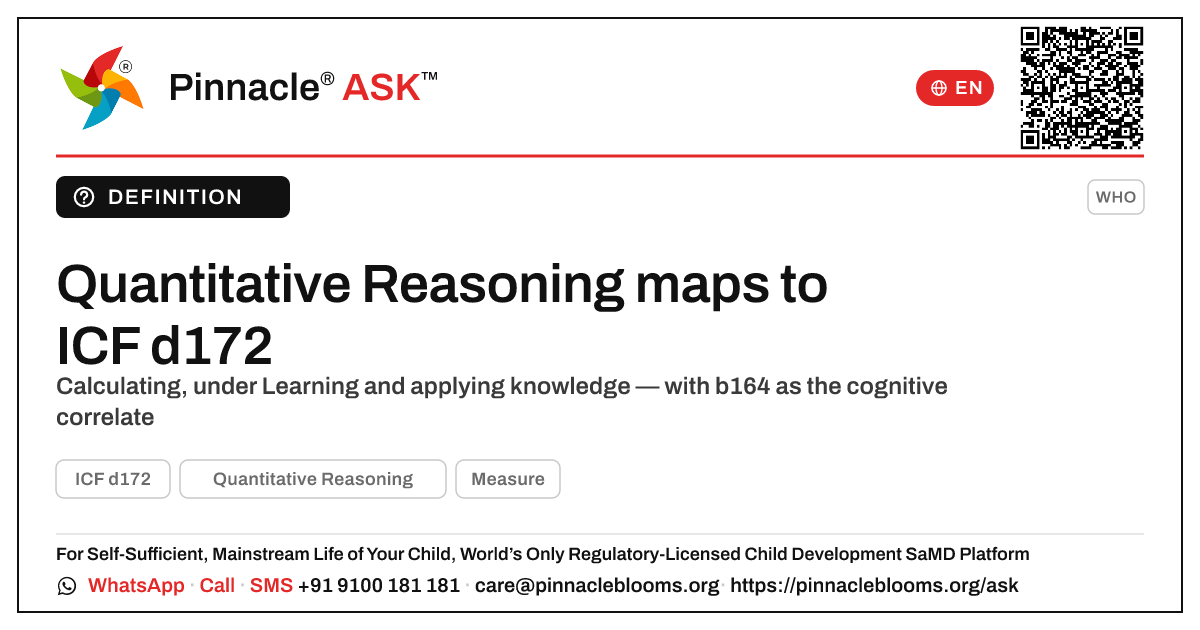
In the ICF, Quantitative Reasoning in early childhood maps primarily to d172 (Calculating), within Chapter 1 on Learning and applying knowledge in the Activities and Participation classification. It is an observed activity — comparing, ordering and manipulating quantities — supported upstream by the Body-Function code b164, higher-level cognitive functions. For young children the same code captures foundational number sense that precedes formal arithmetic, letting clinicians describe both cognitive substrate and functional expression.
In this answer 4 sections
Where does a child's emerging sense of number and quantity sit within the ICF map of functioning? In early childhood, it lives within the higher-order cognitive functions of calculation and applying knowledge.
In short
In the International Classification of Functioning, Disability and Health (ICF), Quantitative Reasoning in early childhood maps most directly to d172 — Calculating, within the Activities and Participation chapter on Learning and applying knowledge (Chapter 1, d1). It describes a child's emerging capacity to perform operations on numbers and quantities — comparing, ordering, adding and manipulating — using the symbols and procedures of mathematics. For very young children this is a developmental precursor activity rather than formal arithmetic, and it is supported upstream by body-function codes for higher-level cognitive functions (b164).
The science: mapping ability to ICF
The ICF separates what a body system does (Body Functions, the b codes) from what a person does in real life (Activities and Participation, the d codes). Quantitative Reasoning as a measurable ability sits in the activity domain because it is observed through what a child does — sorting by quantity, recognising "more" and "fewer", subitising small sets, one-to-one correspondence — rather than through an isolated capacity.
- d172 Calculating is the primary mapping: performing computations by applying mathematical principles to solve problems and describe or display results.
- b164 Higher-level cognitive functions is the supporting Body-Function correlate (abstraction, organisation of ideas, judgement), which underpins the observable activity.
- In early childhood, qualifiers are interpreted developmentally: the same code captures the foundational number sense that precedes school arithmetic.
This dual mapping matters methodologically: it lets clinicians and researchers describe both the underlying cognitive substrate and the functional, participation-relevant expression of quantitative ability — the distinction the ICF was designed to preserve.
The Pinnacle way
This is general academic information for mapping and measurement, not a diagnosis — a clinical AbilityScore®, a clinician-administered structured assessment, and any diagnosis are formed only at a Pinnacle Blooms Network centre under qualified clinician care. Our cognitive teams align observable quantitative reasoning milestones with ICF activity codes and weave support through occupational therapy and play-based learning. Explore more at our home resource hub.
Trusted sources
WHO ICF browser entry for d172 (Calculating) within Chapter 1, Learning and applying knowledge; WHO ICF framework distinguishing Body Functions (b codes) from Activities and Participation (d codes); WHO Nurturing Care Framework on early cognitive development.
Next step — If you are mapping cognitive ability data to ICF for research or clinical use, partner with our consortium team to align quantitative-reasoning constructs with d172 coding.
CONNECT THE ANSWER TO YOUR CHILD’S DAY
Something to notice. Something to discuss.
What to notice
Whether quantitative-reasoning items are coded as an activity (d172, Calculating) versus a body function (b164), and whether developmental qualifiers are applied appropriately for the child's age band rather than against formal-arithmetic expectations.
In everyday life
When observing early number sense, note real activities — sharing snacks equally, lining up toys by size, picking the bowl with 'more' — these participation moments are exactly what the d172 activity code is designed to capture.
Bring your observations and questions to your child’s professional. Choose activities that suit your child’s comfort, abilities and agreed plan.
Bring your questions to a first visitQuestions families ask
Which ICF code does Quantitative Reasoning map to?
Primarily d172 (Calculating), within Chapter 1, Learning and applying knowledge, in the Activities and Participation classification. The supporting Body-Function correlate is b164, higher-level cognitive functions.
Why is it an activity (d) code rather than a body-function (b) code?
The ICF places Quantitative Reasoning in the d domain because it is observed through what a child does — comparing, ordering and manipulating quantities — rather than as an isolated internal capacity. The cognitive substrate is captured separately by b164.
Does d172 apply to young children who cannot yet do arithmetic?
Yes. In early childhood the code is read developmentally, capturing foundational number sense such as subitising, one-to-one correspondence and 'more versus fewer' that precedes formal arithmetic.
FOLLOW THE SOURCE
References behind this answer.
- Organisation website · further readingWHO ICF browser — d172 Calculating
- Organisation website · further readingWHO ICF framework: Body Functions vs Activities and Participation
- Organisation website · further readingWHO Nurturing Care Framework — early cognitive development
References are supplied with this answer. An organisation homepage offers further reading; it does not establish an independent review of this page.
Content attribution: SETU Consortium · Pinnacle Blooms Network.
PEOPLE, TOPICS & DEVELOPMENT
See the connections.
Browse the wider question collections connected with this answer’s audience, developmental area and stage.
FROM UNDERSTANDING TO PURPOSEFUL SUPPORT
One question. Your child’s whole life.
Your child’s self-sufficient, mainstream-included life is the purpose from the beginning. At Pinnacle, that purpose shapes what we understand, the goals we choose, the people we bring together, everyday practice and review.
Connect this question with the right support.
Start with your child’s strengths, your observations and what you want everyday life to become.
Make the next conversation useful.
Bring the situations you notice at home or school. We’ll explain a suitable service, centre and first visit, including availability and fees, before you decide.
How PinnacleAI® connects the journeyExplore the seven stages
- 1Understand abilities
A starting picture of your child’s capabilities.
- 2Choose meaningful goals
Readiness and a plan shaped around the child.
- 3Bring the right support together
Suitable therapies and people for those goals.
- 4Carry practice into everyday life
Guidance for family, home and school.
- 5Track and correct
Use observations to adjust the plan.
- 6Reassess and review
Decide what to continue, change or do next.
- 7Grow independence and participation
The child’s life gives each step its purpose.
Explore the whole PinnacleAI® system → · Participation at school and in the community →
PINNACLE’S EVIDENCE, OPEN TO YOU
Look at the evidence behind our work.
Read our research, inspect the original regulatory documents and check what each institutional measure means.
General information supports a conversation with an appropriately qualified professional. Advice, goals and support depend on the individual child.