
YOUR QUESTION. A CLEARER NEXT STEP.
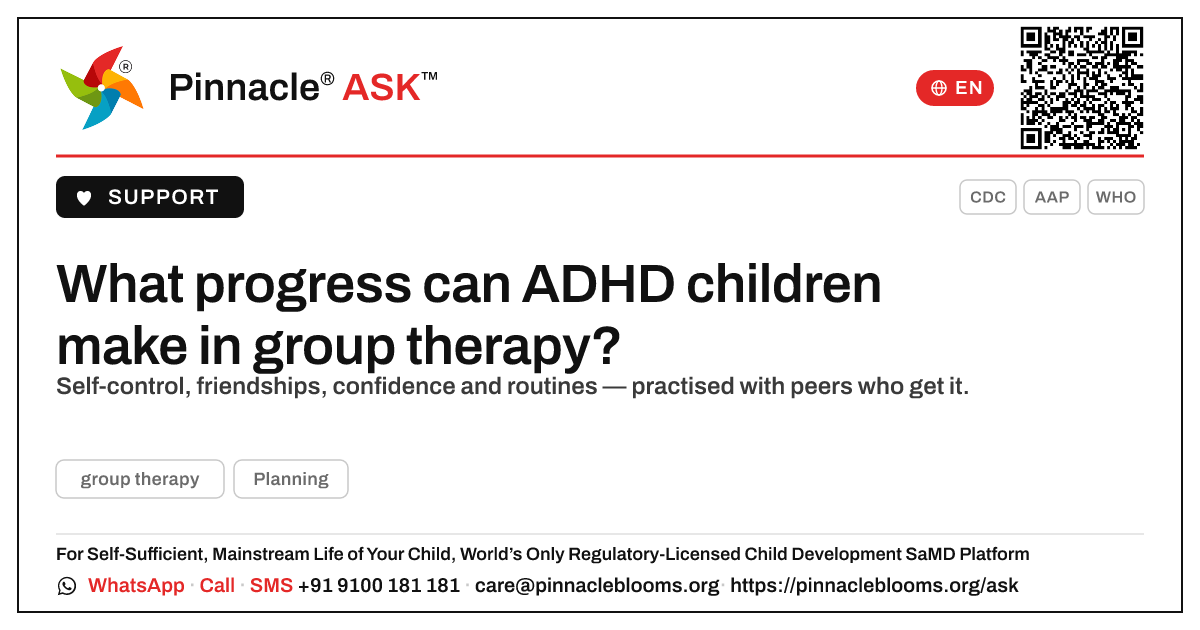
What progress can a child with ADHD make with group therapy?
Group therapy helps children with ADHD make real progress in self-regulation, turn-taking, social skills, confidence and following routines by practising with supportive peers in real time. It works best alongside parent coaching and any medical care. AbilityScore® is part of Pinnacle’s developmental assessment. Diagnosis, where needed, requires an appropriately qualified healthcare professional.
In this answer 5 sections
When a child with ADHD practises focus, patience and friendship alongside peers who truly get them, growth stops feeling lonely — and starts feeling possible.
In short
Group therapy gives a child with ADHD a safe, supportive space to practise the very skills that classrooms and playgrounds demand all at once — turn-taking, listening, waiting, managing big feelings, and reading social cues. Children often make real progress in self-control, friendships, confidence and following routines, because they learn by doing with peers rather than just being told. It works best as part of a wider plan, alongside parent coaching and, where needed, medical care.
The progress children often make
- Stronger self-regulation — group games and structured activities give repeated, low-pressure practice in pausing before acting, waiting a turn and calming down — the everyday building blocks of impulse control.
- Better social skills — children learn to read tone, share, lose gracefully and join in, with gentle real-time coaching from therapists and natural feedback from peers.
- Growing confidence and self-esteem — succeeding among children who face similar challenges reduces the shame many ADHD children carry, and replaces "I'm always in trouble" with "I can do this".
- Skills that transfer to school and home — attention strategies, sticking with a task and following multi-step instructions practised in the group begin to show up in the classroom and at the dinner table.
- Friendship and belonging — meeting peers who understand eases isolation for both child and parent.
Progress is gradual, not overnight, and varies child to child — but with consistent attendance, many families see steadier behaviour, calmer transitions and warmer friendships over a few months.
When group therapy fits best
Group therapy works wonderfully alongside other support rather than alone. A child who is very dysregulated may first need individual sessions or parent-coaching to settle, then join a group. If your child also has significant anxiety, learning difficulty or possible co-occurring conditions, a clinician can advise the right mix. ADHD support is most effective when therapy, school strategies, parent guidance and any medical review work together.
The Pinnacle way
AbilityScore® is part of Pinnacle’s developmental assessment. Diagnosis, where needed, requires an appropriately qualified healthcare professional — never from an app or online form. From there your child receives a precise developmental profile through our clinician-administered AbilityScore® assessment, and a plan that may combine group and individual behavioural and developmental therapy shaped around your child's strengths. Explore how we support children across India within 70+ centres and 700+ therapists.
Trusted sources
CDC guidance on ADHD treatment and behavioural therapy for children; American Academy of Pediatrics (HealthyChildren.org) on behavioural approaches and parent training; WHO ICD-11 framing of attention-deficit hyperactivity disorder.
Next step — Want to know whether a group is the right fit for your child? Book an assessment with a Pinnacle clinician.
This is general information, not a diagnosis — individual assessment and diagnosis require an appropriately qualified healthcare professional.
CONNECT THE ANSWER TO YOUR CHILD’S DAY
Something to notice. Something to discuss.
What to notice
Watch for whether your child manages turn-taking and waiting, joins and sustains play with peers, follows multi-step instructions, and carries calmer behaviour from the group into school and home — and note if heavy dysregulation means individual support is needed first.
In everyday life
Practise tiny turn-taking moments at home — short board games or 'my turn, your turn' play — and warmly name the skill when you see it: 'You waited so patiently!'
Bring your observations and questions to your child’s professional. Choose activities that suit your child’s comfort, abilities and agreed plan.
Bring your questions to a first visitQuestions families ask
How long before we see progress from group therapy?
Progress is gradual and varies by child, but with consistent attendance many families notice steadier behaviour, calmer transitions and warmer friendships over a few months. Skills are practised repeatedly, so steady attendance matters more than speed.
Is group therapy enough on its own for ADHD?
It works best as part of a wider plan. Group therapy builds social and self-regulation skills beautifully, but is usually combined with parent coaching, school strategies and, where a clinician advises, medical review.
Will my child manage in a group if they are very impulsive?
A very dysregulated child may benefit from individual sessions or parent-coaching first to build foundational calm, then join a group when ready. A Pinnacle clinician can advise the right starting point after assessment.
What skills does group therapy actually target for ADHD?
Turn-taking, waiting, listening, reading social cues, managing big feelings, joining play, and following multi-step instructions — the everyday skills that classrooms and friendships demand all at once.
FOLLOW THE SOURCE
References behind this answer.
- Source referenceCDC — ADHD treatment and behaviour therapy
- Source referenceAAP HealthyChildren.org — ADHD
- Organisation website · further readingWHO ICD-11 — ADHD classification
References are supplied with this answer. An organisation homepage offers further reading; it does not establish an independent review of this page.
Content attribution: SETU Consortium · Pinnacle Blooms Network.
PEOPLE, TOPICS & DEVELOPMENT
See the connections.
Browse the wider question collections connected with this answer’s audience, developmental area and stage.
FROM UNDERSTANDING TO PURPOSEFUL SUPPORT
One question. Your child’s whole life.
Your child’s self-sufficient, mainstream-included life is the purpose from the beginning. At Pinnacle, that purpose shapes what we understand, the goals we choose, the people we bring together, everyday practice and review.
Connect this question with the right support.
Start with your child’s strengths, your observations and what you want everyday life to become.
Make the next conversation useful.
Bring the situations you notice at home or school. We’ll explain a suitable service, centre and first visit, including availability and fees, before you decide.
How PinnacleAI® connects the journeyExplore the seven stages
- 1Understand abilities
A starting picture of your child’s capabilities.
- 2Choose meaningful goals
Readiness and a plan shaped around the child.
- 3Bring the right support together
Suitable therapies and people for those goals.
- 4Carry practice into everyday life
Guidance for family, home and school.
- 5Track and correct
Use observations to adjust the plan.
- 6Reassess and review
Decide what to continue, change or do next.
- 7Grow independence and participation
The child’s life gives each step its purpose.
Explore the whole PinnacleAI® system → · Participation at school and in the community →
PINNACLE’S EVIDENCE, OPEN TO YOU
Look at the evidence behind our work.
Read our research, inspect the original regulatory documents and check what each institutional measure means.
General information supports a conversation with an appropriately qualified professional. Advice, goals and support depend on the individual child.