
YOUR QUESTION. A CLEARER NEXT STEP.
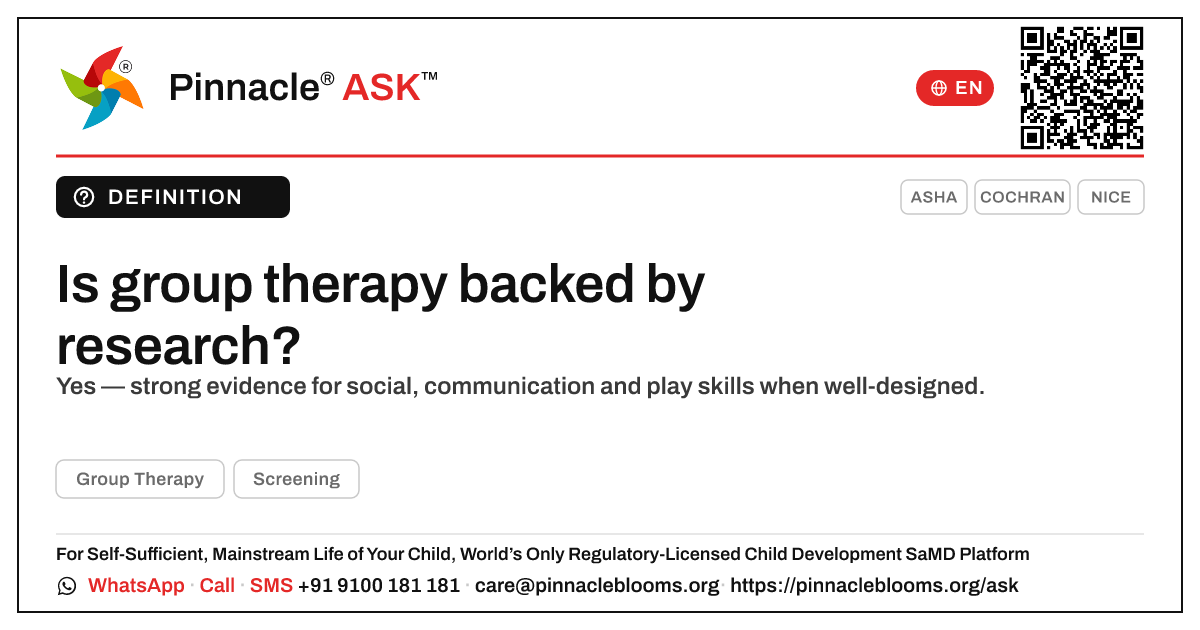
Is group therapy backed by research evidence?
Yes — group therapy is backed by solid research evidence, particularly for social communication, peer interaction, play and confidence. When groups are small, goal-led and ability-matched, the gains can match or complement one-to-one therapy because children practise real-life social skills with real peers. It is not a budget substitute for individual work but a purposeful, different tool, best chosen with a clinician and often used alongside individual sessions.
In this answer 5 sections
Wondering whether learning alongside other children is a sound choice — not just a friendly one? It is, and the research agrees.
In short
Yes — group therapy is well supported by research evidence across communication, social and behavioural development. Studies show that, for the right goals, practising new skills with peers can be as effective as one-to-one work — and sometimes better for the very skills that only show up around other children, such as turn-taking, conversation and play. It is not a cheaper substitute for individual therapy; it is a different, purposeful tool, often used alongside it.
What the science says
Group therapy creates a small, supported social world where a child can rehearse real-life skills with real peers. Research in speech-language and developmental therapy shows meaningful gains in social communication, peer interaction, play skills and confidence when groups are well-designed — meaning they are small, goal-led, age- and ability-matched, and run by trained therapists. The strength comes from naturalistic practice: a child waits for a turn, reads another child's cues, shares attention and recovers from small social bumps, all in the moment. These are precisely the abilities that are hard to build in isolation and easiest to generalise when practised with others. Evidence is strongest when group work targets clearly defined social and communication goals, and when families reinforce the same skills at home.
How it is used well
Group therapy works best as part of a thoughtful plan rather than a stand-alone fix. Many children benefit from individual sessions to build a foundational skill, then a group to practise and generalise it. The fit depends on each child's goals, temperament and current stage — which is why the decision is made with a clinician, not by default. Quality matters far more than the format itself: the size of the group, the matching of children, the training of the therapist and the clarity of the goals all shape the outcome.
The Pinnacle way
This is general information, not a diagnosis — a clinical AbilityScore® and any diagnosis are formed only at a Pinnacle Blooms Network centre, under qualified clinician care, never from an app or form. Across 70+ centres and 25 million+ therapy sessions, our team decides whether group work, speech therapy one-to-one, or a blend best fits your child's goals, and reviews the plan as they grow.
Trusted sources
ASHA on evidence-based and group intervention approaches in speech-language therapy; Cochrane reviews on social and communication interventions; NICE guidance on developmental support planning.
Next step — Book a developmental screen to find out whether group therapy, individual sessions, or a combination is the right next step for your child.
CONNECT THE ANSWER TO YOUR CHILD’S DAY
Something to notice. Something to discuss.
What to notice
Whether your child is gaining real social skills — taking turns, joining play, starting conversations — that they then use outside the group. Watch that the group is small, well-matched in age and ability, and led by a trained therapist with clear goals, and that progress is reviewed regularly rather than the format being assumed to suit every child.
In everyday life
Bring the group's goals home: set up simple turn-taking games with siblings or at the park — rolling a ball back and forth, a shared puzzle, or 'your turn, my turn' — so the social skills practised in therapy get rehearsed in everyday life.
Bring your observations and questions to your child’s professional. Choose activities that suit your child’s comfort, abilities and agreed plan.
Bring your questions to a first visitQuestions families ask
Is group therapy as effective as one-to-one therapy?
For certain goals — especially social communication, turn-taking, play and peer interaction — well-designed group therapy can be as effective as one-to-one work, and sometimes better, because those skills only truly show up around other children. For building a brand-new foundational skill, individual sessions are often the starting point. The two are frequently combined, and the right balance is decided with a clinician based on your child's goals.
Is group therapy just a cheaper option?
No. Group therapy is a distinct, purposeful approach chosen for the skills it builds — practising real social and communication skills with real peers — not a budget substitute for individual therapy. Many children do best with a thoughtful blend of both.
What makes a group therapy session effective?
Quality matters more than the format. The strongest results come when groups are small, children are matched by age and ability, goals are clear and specific, the therapist is trained, and families reinforce the same skills at home.
FOLLOW THE SOURCE
References behind this answer.
- Source referenceASHA — evidence-based and group intervention approaches
- Organisation website · further readingCochrane — reviews of social and communication interventions
- Organisation website · further readingNICE — guidance on developmental support planning
References are supplied with this answer. An organisation homepage offers further reading; it does not establish an independent review of this page.
Content attribution: SETU Consortium · Pinnacle Blooms Network.
PEOPLE, TOPICS & DEVELOPMENT
See the connections.
Browse the wider question collections connected with this answer’s audience, developmental area and stage.
FROM UNDERSTANDING TO PURPOSEFUL SUPPORT
One question. Your child’s whole life.
Your child’s self-sufficient, mainstream-included life is the purpose from the beginning. At Pinnacle, that purpose shapes what we understand, the goals we choose, the people we bring together, everyday practice and review.
Connect this question with the right support.
Start with your child’s strengths, your observations and what you want everyday life to become.
Make the next conversation useful.
Bring the situations you notice at home or school. We’ll explain a suitable service, centre and first visit, including availability and fees, before you decide.
How PinnacleAI® connects the journeyExplore the seven stages
- 1Understand abilities
A starting picture of your child’s capabilities.
- 2Choose meaningful goals
Readiness and a plan shaped around the child.
- 3Bring the right support together
Suitable therapies and people for those goals.
- 4Carry practice into everyday life
Guidance for family, home and school.
- 5Track and correct
Use observations to adjust the plan.
- 6Reassess and review
Decide what to continue, change or do next.
- 7Grow independence and participation
The child’s life gives each step its purpose.
Explore the whole PinnacleAI® system → · Participation at school and in the community →
PINNACLE’S EVIDENCE, OPEN TO YOU
Look at the evidence behind our work.
Read our research, inspect the original regulatory documents and check what each institutional measure means.
General information supports a conversation with an appropriately qualified professional. Advice, goals and support depend on the individual child.