
YOUR QUESTION. A CLEARER NEXT STEP.
Down Syndrome vs Hearing Impairment in Young Children
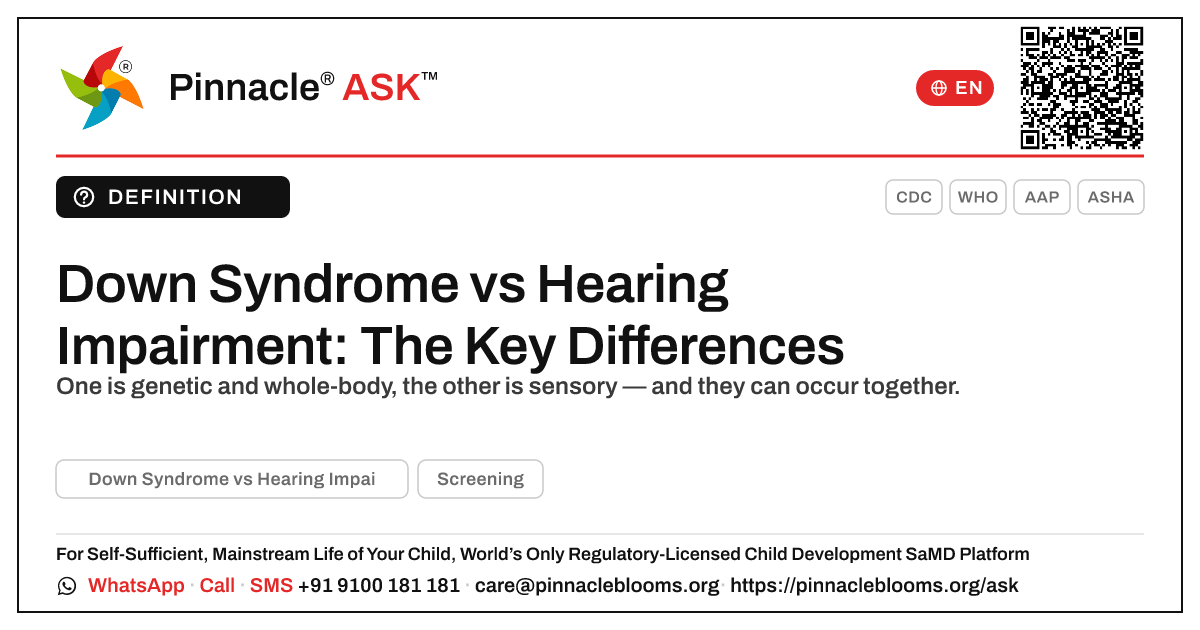
Down syndrome is a genetic condition present from birth that affects a child's overall development, learning and physical features, while hearing impairment is a sensory difference in how well a child can hear, ranging from mild to profound. They are distinct, but children with Down syndrome are more likely to also have hearing difficulties, so both can occur together. Down syndrome needs broad developmental support; hearing impairment is supported through the ear and listening pathway, with regular hearing checks vital for children with Down syndrome.
In this answer 4 sections
Two very different things that can sometimes appear together — knowing them apart helps a child get exactly the right support.
In short
Down syndrome is a genetic condition present from birth, caused by an extra copy of chromosome 21, and it affects a child's overall development, learning and physical features. Hearing impairment is a difference in how well a child can hear — it may be mild or profound, present at birth or acquired, and it mainly affects listening, speech and language. They are not the same: one is genetic and whole-body, the other is sensory. Importantly, children with Down syndrome are more likely to also have hearing difficulties, so both can be present at once.
How they differ — and overlap
Down syndrome is usually recognised at or soon after birth and is confirmed by a genetic test; it touches many areas of development together, often with low muscle tone and slower-to-emerge milestones. Hearing impairment is identified through newborn hearing screening and audiology testing, and a child may otherwise develop typically. The two can be confused because both can delay speech and language. The key difference: hearing impairment is corrected or supported through the ear and listening pathway (hearing aids, cochlear implants, listening therapy), while Down syndrome calls for broad developmental support — and, because ear infections and hearing loss are common alongside it, regular hearing checks matter greatly.
The Pinnacle way
This is general information, not a diagnosis — a clinical AbilityScore® and any diagnosis are formed only at a Pinnacle Blooms Network centre, under qualified clinician care. We assess the whole child, including hearing, and may draw on speech therapy and individualised support for children with Down syndrome.
Trusted sources
WHO and CDC guidance on Down syndrome and childhood hearing; the American Academy of Pediatrics on newborn hearing screening; ASHA on hearing and early communication.
Next step — If you have questions about your child's hearing or development, book a developmental review so the right checks and support can begin early.
CONNECT THE ANSWER TO YOUR CHILD’S DAY
Something to notice. Something to discuss.
What to notice
Slower-to-emerge milestones and low muscle tone (more typical of Down syndrome); not turning to sounds or voices, delayed babble or speech, and frequent ear infections (more typical of hearing impairment) — and remember both can be present together.
In everyday life
Talk, sing and read to your child face-to-face every day, and watch how they respond to your voice and to everyday sounds — this gentle observation helps you notice both communication and hearing differences early.
Bring your observations and questions to your child’s professional. Choose activities that suit your child’s comfort, abilities and agreed plan.
Bring your questions to a first visitQuestions families ask
Can a child have both Down syndrome and hearing impairment?
Yes. Children with Down syndrome are more likely to have hearing difficulties, often linked to the shape of their ears and frequent ear infections, so regular hearing checks are an important part of their care.
How is each condition identified?
Down syndrome is usually recognised at or soon after birth and confirmed by a genetic test. Hearing impairment is picked up through newborn hearing screening and audiology testing. Both are best confirmed by qualified professionals.
Do both affect speech and language?
Both can delay speech and language, which is why they are sometimes confused. The support differs — hearing impairment is helped through the listening pathway, while Down syndrome needs broad developmental support.
FOLLOW THE SOURCE
References behind this answer.
- Source referenceCDC — About Down Syndrome
- Source referenceWHO — Deafness and Hearing Loss
- Source referenceAAP HealthyChildren — Newborn Hearing Screening
- Source referenceASHA — Hearing and Communication
References are supplied with this answer. An organisation homepage offers further reading; it does not establish an independent review of this page.
Content attribution: SETU Consortium · Pinnacle Blooms Network.
PEOPLE, TOPICS & DEVELOPMENT
See the connections.
Browse the wider question collections connected with this answer’s audience, developmental area and stage.
FROM UNDERSTANDING TO PURPOSEFUL SUPPORT
One question. Your child’s whole life.
Your child’s self-sufficient, mainstream-included life is the purpose from the beginning. At Pinnacle, that purpose shapes what we understand, the goals we choose, the people we bring together, everyday practice and review.
Connect this question with the right support.
Start with your child’s strengths, your observations and what you want everyday life to become.
Make the next conversation useful.
Bring the situations you notice at home or school. We’ll explain a suitable service, centre and first visit, including availability and fees, before you decide.
How PinnacleAI® connects the journeyExplore the seven stages
- 1Understand abilities
A starting picture of your child’s capabilities.
- 2Choose meaningful goals
Readiness and a plan shaped around the child.
- 3Bring the right support together
Suitable therapies and people for those goals.
- 4Carry practice into everyday life
Guidance for family, home and school.
- 5Track and correct
Use observations to adjust the plan.
- 6Reassess and review
Decide what to continue, change or do next.
- 7Grow independence and participation
The child’s life gives each step its purpose.
Explore the whole PinnacleAI® system → · Participation at school and in the community →
PINNACLE’S EVIDENCE, OPEN TO YOU
Look at the evidence behind our work.
Read our research, inspect the original regulatory documents and check what each institutional measure means.
General information supports a conversation with an appropriately qualified professional. Advice, goals and support depend on the individual child.