
YOUR QUESTION. A CLEARER NEXT STEP.
What is the Communication area of child development?
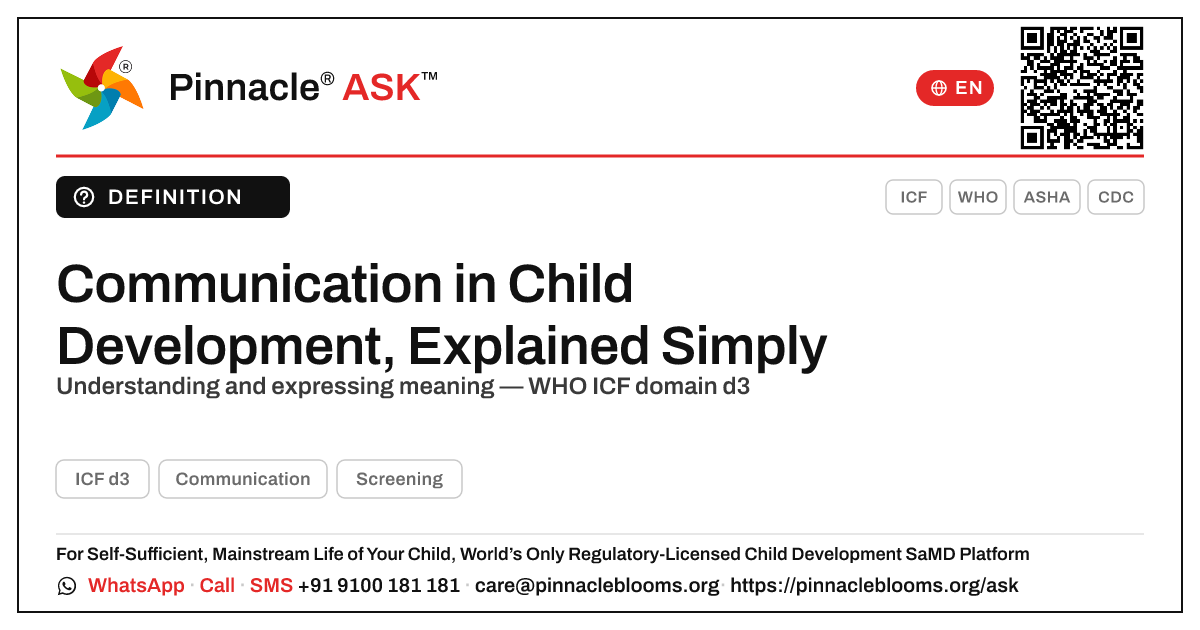
The Communication area of child development covers all the ways a child takes in and shares meaning — understanding others (receiving) and expressing themselves (expressing) through listening, gestures, expressions, speech and later reading and writing. In the WHO ICF framework it is domain d3 · Communication. It begins long before a child's first word, with eye contact, smiles, babble and pointing, and grows into conversation. It is far broader than talking, and early back-and-forth exchanges build the foundation for language, learning and friendships.
In this answer 5 sections
Every wave, babble, pointed finger and first word is your child reaching out to connect — that whole world of connecting is the Communication area of development.
In short
The Communication area of child development is all the ways a child takes in and shares meaning with others — listening and understanding, gestures and expressions, speaking, and later reading and writing. In the World Health Organization's ICF framework it sits within domain d3 · Communication. It is far broader than talking: it begins long before a child's first word, with eye contact, smiles, babble and pointing, and it grows steadily into conversation and storytelling.
What this area includes
Communication has two woven threads. Receiving is understanding — turning to a voice, responding to a name, following simple instructions, grasping the meaning of words and signs. Expressing is sharing — babbling, gesturing, using facial expressions, saying words, then joining words into sentences and conversations. Both grow together from birth. A baby who gazes, smiles and coos is already communicating; a toddler who points to ask, then names objects, is building the same skill. These early back-and-forth exchanges — sometimes called serve and return — are the foundation for language, learning, friendships and confidence later on.
When to seek a review
Consider a developmental check if, by the expected age, a child is not responding to their name, not babbling or gesturing, losing words they once had, or showing a noticeable gap in understanding or speaking compared with peers. Early, playful support is gentle and effective — noticing a difference is simply an invitation to help, never a label.
The Pinnacle way
This is general information, not a diagnosis — a clinical AbilityScore® and any diagnosis are formed only at a Pinnacle Blooms Network centre, under qualified clinician care, never from an app or form. Our team looks at the whole picture of communication and, where helpful, builds an individualised plan that may draw on speech therapy.
Trusted sources
WHO International Classification of Functioning, Disability and Health (ICF), Activity and Participation domain d3 · Communication; ASHA guidance on speech, language and communication development; CDC developmental milestone resources.
Next step — If you would like to understand your child's communication strengths, book a developmental review to map where they are and start any helpful support early.
CONNECT THE ANSWER TO YOUR CHILD’S DAY
Something to notice. Something to discuss.
What to notice
Not responding to their name, not babbling or gesturing by the expected age, losing words once used, or a noticeable gap in understanding or speaking compared with peers.
In everyday life
Make everyday moments a two-way chat — name what you see, pause and wait for your child's babble, gesture or word, then respond warmly. This 'serve and return' play builds communication naturally.
Bring your observations and questions to your child’s professional. Choose activities that suit your child’s comfort, abilities and agreed plan.
Bring your questions to a first visitQuestions families ask
Is communication the same as talking?
No. Talking is one part of it. Communication also includes understanding words, listening, eye contact, facial expressions, gestures like pointing and waving, and later reading and writing. A baby who smiles and babbles is already communicating before any words appear.
When does communication development begin?
From birth. Early communication shows in gazing, smiling, cooing and babbling, and in turning towards voices. These back-and-forth exchanges build the foundation for words, conversation and learning later on.
What is the difference between receptive and expressive communication?
Receptive (receiving) is understanding — responding to a name, following instructions, grasping word meaning. Expressive (expressing) is sharing — gestures, babble, words and sentences. Both grow together, and noticing a gap in either is a reason for a gentle developmental check.
FOLLOW THE SOURCE
References behind this answer.
- Source referenceICF d3
- Source referenceWHO · ICF Activity & Participation (d3 Communication)
- Organisation website · further readingASHA · Speech, language and communication development
- Organisation website · further readingCDC · Developmental milestone resources
References are supplied with this answer. An organisation homepage offers further reading; it does not establish an independent review of this page.
Content attribution: SETU Consortium · Pinnacle Blooms Network.
Reviewer field in the source record: VII.
PEOPLE, TOPICS & DEVELOPMENT
See the connections.
Browse the wider question collections connected with this answer’s audience, developmental area and stage.
FROM UNDERSTANDING TO PURPOSEFUL SUPPORT
One question. Your child’s whole life.
Your child’s self-sufficient, mainstream-included life is the purpose from the beginning. At Pinnacle, that purpose shapes what we understand, the goals we choose, the people we bring together, everyday practice and review.
Connect this question with the right support.
Explore how the relevant service contributes to everyday abilities, then speak with us about your child.
Make the next conversation useful.
Bring the situations you notice at home or school. We’ll explain a suitable service, centre and first visit, including availability and fees, before you decide.
How PinnacleAI® connects the journeyExplore the seven stages
- 1Understand abilities
A starting picture of your child’s capabilities.
- 2Choose meaningful goals
Readiness and a plan shaped around the child.
- 3Bring the right support together
Suitable therapies and people for those goals.
- 4Carry practice into everyday life
Guidance for family, home and school.
- 5Track and correct
Use observations to adjust the plan.
- 6Reassess and review
Decide what to continue, change or do next.
- 7Grow independence and participation
The child’s life gives each step its purpose.
Explore the whole PinnacleAI® system → · Participation at school and in the community →
PINNACLE’S EVIDENCE, OPEN TO YOU
Look at the evidence behind our work.
Read our research, inspect the original regulatory documents and check what each institutional measure means.
General information supports a conversation with an appropriately qualified professional. Advice, goals and support depend on the individual child.