
YOUR QUESTION. A CLEARER NEXT STEP.
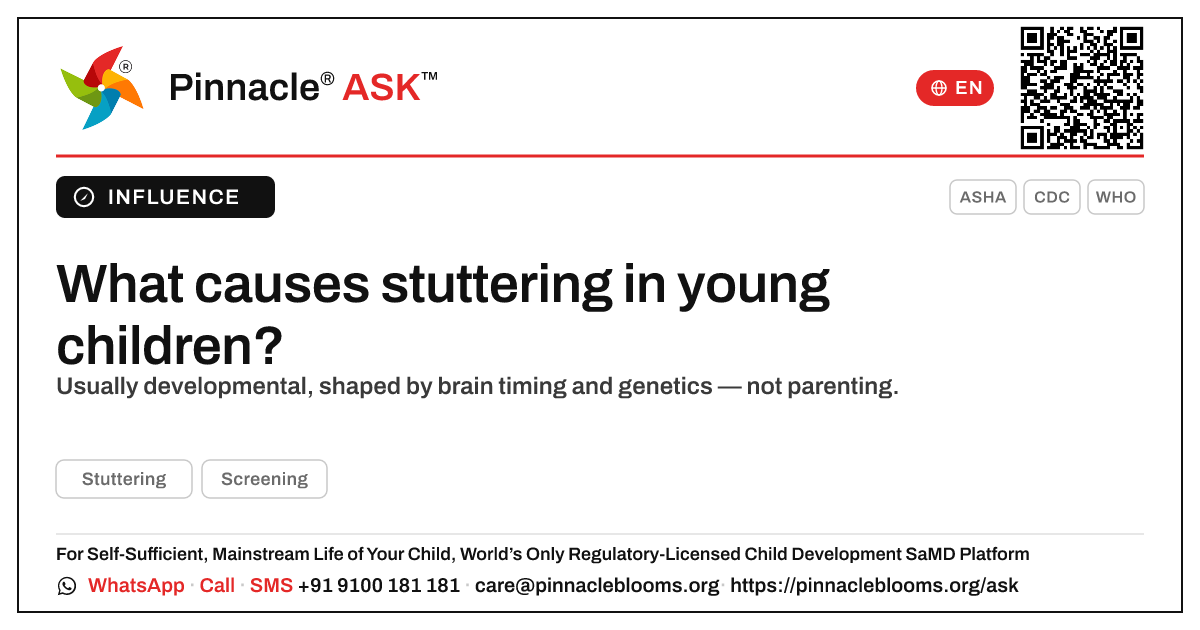
What causes stuttering in young children?
Stuttering in young children is usually a normal part of learning to talk, emerging between ages 2 and 5. The strongest causes are neurological and genetic — differences in how the speaking brain coordinates language and movement, often running in families — not parenting, anxiety or intelligence. A clinical assessment is formed only at a Pinnacle centre.
In this answer 5 sections
When a little one's words start to trip and repeat, the first thing every parent wants to know is — why?
In short
Stuttering in young children is, in most cases, a normal and very common part of learning to talk — not something a parent caused. It tends to emerge between 2 and 5 years when a child's ideas race ahead of their still-developing speech machinery. The strongest known factors are neurological and genetic — differences in how the speaking brain coordinates language and movement, often running in families — rather than anything to do with parenting, anxiety or intelligence. Many children outgrow it; some benefit from early support.
What we understand about the causes
Stuttering is best thought of as a difference in the brain's timing and coordination of speech, not an emotional fault or a habit. The picture usually involves several threads woven together:
- Genetics — stuttering frequently runs in families; a child with a close relative who stutters is more likely to.
- Brain and speech development — subtle differences in how regions that plan language and control the muscles of speech work together.
- Language surge — the toddler and preschool years bring an explosion of vocabulary and longer sentences; disfluencies often appear simply because the system is under heavy load.
- Temperament and environment — these don't cause stuttering, but a fast-paced or pressured talking environment can make moments of stuttering more frequent.
What does not cause stuttering: bad parenting, copying another child, nervousness, or being told off. Reassuring to know, and important to repeat.
When to look more closely
Most early disfluency is developmental and eases on its own. Consider a speech-language check if you notice: stuttering lasting more than 6 months, starting after age 3½, visible struggle or tension (eyes blinking, words getting "stuck"), your child avoiding talking, or a family history of persistent stuttering. Earlier support tends to work best.
The Pinnacle way
AbilityScore® is part of Pinnacle’s developmental assessment. Diagnosis, where needed, requires an appropriately qualified healthcare professional — never from an app or an online form. Our speech therapy team supports fluency with warm, play-based methods, and an AbilityScore® gives your family a clear starting point. Begin wherever you are — we'll walk it with you.
Trusted sources
American Speech-Language-Hearing Association (ASHA) guidance on childhood fluency disorders; CDC developmental milestones; WHO ICD-11 framework for speech fluency conditions.
Next step — If your child's stuttering has lasted beyond six months or comes with visible effort, book a gentle speech screen with a Pinnacle clinician.
This is general information, not a diagnosis — individual assessment and diagnosis require an appropriately qualified healthcare professional.
CONNECT THE ANSWER TO YOUR CHILD’S DAY
Something to notice. Something to discuss.
What to notice
Watch for stuttering lasting beyond 6 months, starting after age 3½, visible struggle or facial tension, your child avoiding talking, or a family history of persistent stuttering.
In everyday life
Slow your own speech down and give your child unhurried time to finish their thought — model calm, easy talking rather than telling them to 'slow down' or 'start again'.
Bring your observations and questions to your child’s professional. Choose activities that suit your child’s comfort, abilities and agreed plan.
Bring your questions to a first visitQuestions families ask
Did I cause my child's stuttering?
No. Stuttering is not caused by parenting, by anxiety, or by anything you did. The main factors are neurological and genetic — differences in how the speaking brain coordinates language and movement, often running in families.
Will my child grow out of stuttering?
Many young children do outgrow early disfluency, especially when it appears during the big language surge between 2 and 5 years. Some children benefit from early speech support, which is why a check is worthwhile if it persists beyond six months.
When should I seek help for stuttering?
Consider a speech-language check if stuttering lasts more than six months, starts after age 3½, comes with visible struggle or tension, leads your child to avoid talking, or there's a family history of persistent stuttering.
FOLLOW THE SOURCE
References behind this answer.
- Source referenceASHA — Stuttering in children
- Source referenceCDC — Developmental milestones
- Organisation website · further readingWHO ICD-11
References are supplied with this answer. An organisation homepage offers further reading; it does not establish an independent review of this page.
Content attribution: SETU Consortium · Pinnacle Blooms Network.
PEOPLE, TOPICS & DEVELOPMENT
See the connections.
Browse the wider question collections connected with this answer’s audience, developmental area and stage.
FROM UNDERSTANDING TO PURPOSEFUL SUPPORT
One question. Your child’s whole life.
Your child’s self-sufficient, mainstream-included life is the purpose from the beginning. At Pinnacle, that purpose shapes what we understand, the goals we choose, the people we bring together, everyday practice and review.
Connect this question with the right support.
Start with your child’s strengths, your observations and what you want everyday life to become.
Make the next conversation useful.
Bring the situations you notice at home or school. We’ll explain a suitable service, centre and first visit, including availability and fees, before you decide.
How PinnacleAI® connects the journeyExplore the seven stages
- 1Understand abilities
A starting picture of your child’s capabilities.
- 2Choose meaningful goals
Readiness and a plan shaped around the child.
- 3Bring the right support together
Suitable therapies and people for those goals.
- 4Carry practice into everyday life
Guidance for family, home and school.
- 5Track and correct
Use observations to adjust the plan.
- 6Reassess and review
Decide what to continue, change or do next.
- 7Grow independence and participation
The child’s life gives each step its purpose.
Explore the whole PinnacleAI® system → · Participation at school and in the community →
PINNACLE’S EVIDENCE, OPEN TO YOU
Look at the evidence behind our work.
Read our research, inspect the original regulatory documents and check what each institutional measure means.
General information supports a conversation with an appropriately qualified professional. Advice, goals and support depend on the individual child.