
YOUR QUESTION. A CLEARER NEXT STEP.
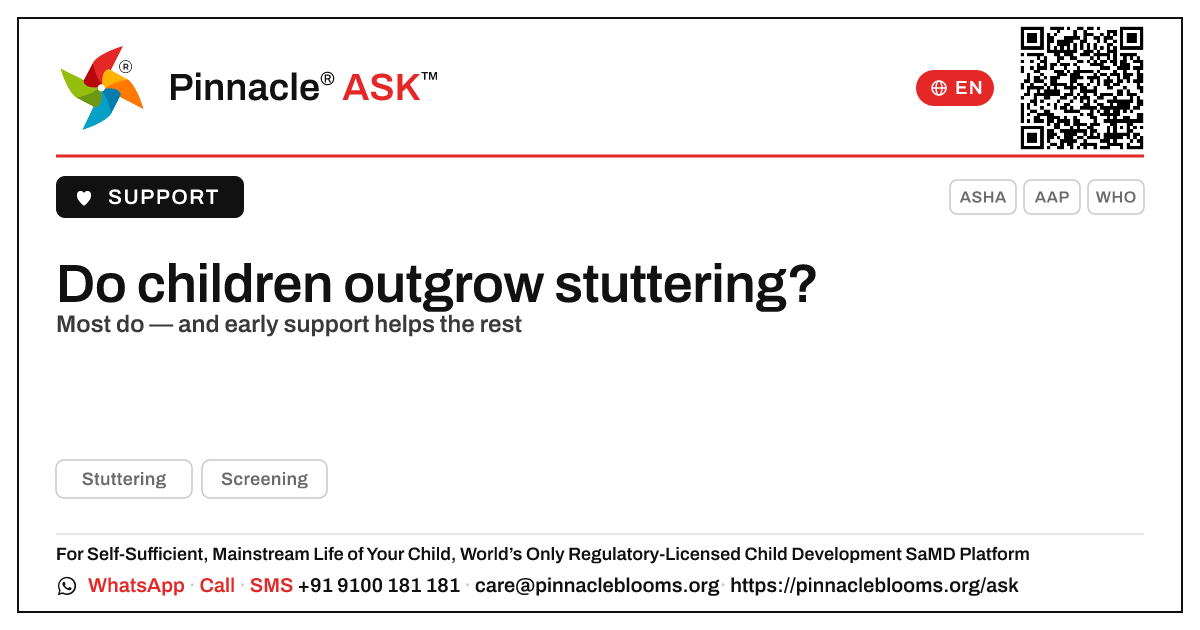
Do children usually outgrow stuttering?
Most young children who begin to stutter outgrow it, often within months, as a normal phase of preschool disfluency between about 2 and 5 years. A smaller number continue, and early speech-language support is highly effective when stuttering lasts beyond 6 months, shows visible effort, or runs in the family. AbilityScore® is part of Pinnacle’s developmental assessment. Diagnosis, where needed, requires an appropriately qualified healthcare professional.
In this answer 5 sections
Many little ones stumble over their words as they learn to talk — and for a great many, those bumps smooth out all on their own.
In short
Yes — most young children who begin to stutter do outgrow it. Many preschoolers go through a normal phase of disfluency between roughly 2 and 5 years as their ideas race ahead of their speech, and a large share recover naturally, often within months. A smaller number continue to stutter, and that is exactly when early speech-language support makes the biggest difference. The encouraging news is that early help works well, so there is never harm in checking sooner rather than waiting.
What we know about recovery
- A common phase, not a flaw. Repeating sounds, syllables or whole words ("I-I-I want") is very common as toddlers' language explodes. It often comes and goes.
- Natural recovery is the norm. A majority of children who start to stutter recover without lasting difficulty, frequently within one to two years of onset.
- Some signs suggest extra support helps. Stuttering that has lasted more than 6–12 months, a family history of stuttering, visible effort or tension when speaking, avoiding words or talking, or stuttering that starts after age 3.5–4 are all good reasons for a speech-language check.
- Early help is highly effective. Speech-language therapy at preschool age has strong outcomes, so a timely assessment is a gentle, low-pressure step — not a sign anything is seriously wrong.
When to seek a check
Reach out to a speech-language professional if the stuttering has continued beyond about 6 months, if your child seems frustrated or avoids speaking, if there is visible struggle (blinking, head movement, tension), or if you simply feel unsure. Trusting your instinct and checking early means support can begin while it works best — and often reassures you that all is well.
The Pinnacle way
This is general information, not a diagnosis — a clinical AbilityScore® and any diagnosis are formed only at a Pinnacle Blooms Network centre, under qualified clinician care. Our speech therapists gently assess your child's fluency and shape a playful, pressure-free plan, while our structured AbilityScore® assessment maps their communication strengths. Explore more on our home resources.
Trusted sources
WHO ICD-11 guidance on developmental speech fluency disorder; American Speech-Language-Hearing Association (ASHA) resources on childhood fluency and stuttering; American Academy of Pediatrics (HealthyChildren.org) guidance on speech and language development.
Next step — Wondering whether your child's stutter is a passing phase? Book a gentle speech and language assessment with a Pinnacle clinician.
CONNECT THE ANSWER TO YOUR CHILD’S DAY
Something to notice. Something to discuss.
What to notice
Watch for stuttering lasting beyond about 6 months, starting after age 3.5–4, visible tension or struggle when speaking, avoiding words or talking, or a family history of stuttering.
In everyday life
Slow your own speech, pause often, and give your child unhurried time to finish — relaxed, gentle conversation eases word-flow far more than correcting or finishing their sentences.
Bring your observations and questions to your child’s professional. Choose activities that suit your child’s comfort, abilities and agreed plan.
Bring your questions to a first visitQuestions families ask
At what age do children usually start stuttering?
Stuttering most often appears between about 2 and 5 years, when a child's ideas and vocabulary grow faster than their speech can keep up. This phase of disfluency is very common and frequently passes on its own.
How long should I wait before getting a check?
If stuttering continues beyond about 6 months, or if you notice visible effort, frustration or word-avoidance, it's wise to see a speech-language professional. Early support is gentle, effective and often simply reassures you.
Does stuttering mean my child has a serious problem?
Usually not. Most children who stutter recover naturally, and stuttering is not linked to intelligence. A check helps tell a passing phase from one that benefits from support — both outcomes are reassuring.
Can therapy help if my child keeps stuttering?
Yes. Speech-language therapy at preschool age has strong outcomes, using playful, pressure-free strategies that build smooth, confident speech.
FOLLOW THE SOURCE
References behind this answer.
- Source referenceASHA — Stuttering in children
- Organisation website · further readingAAP HealthyChildren — speech & language
- Organisation website · further readingWHO ICD-11
References are supplied with this answer. An organisation homepage offers further reading; it does not establish an independent review of this page.
Content attribution: SETU Consortium · Pinnacle Blooms Network.
PEOPLE, TOPICS & DEVELOPMENT
See the connections.
Browse the wider question collections connected with this answer’s audience, developmental area and stage.
FROM UNDERSTANDING TO PURPOSEFUL SUPPORT
One question. Your child’s whole life.
Your child’s self-sufficient, mainstream-included life is the purpose from the beginning. At Pinnacle, that purpose shapes what we understand, the goals we choose, the people we bring together, everyday practice and review.
Connect this question with the right support.
Start with your child’s strengths, your observations and what you want everyday life to become.
Make the next conversation useful.
Bring the situations you notice at home or school. We’ll explain a suitable service, centre and first visit, including availability and fees, before you decide.
How PinnacleAI® connects the journeyExplore the seven stages
- 1Understand abilities
A starting picture of your child’s capabilities.
- 2Choose meaningful goals
Readiness and a plan shaped around the child.
- 3Bring the right support together
Suitable therapies and people for those goals.
- 4Carry practice into everyday life
Guidance for family, home and school.
- 5Track and correct
Use observations to adjust the plan.
- 6Reassess and review
Decide what to continue, change or do next.
- 7Grow independence and participation
The child’s life gives each step its purpose.
Explore the whole PinnacleAI® system → · Participation at school and in the community →
PINNACLE’S EVIDENCE, OPEN TO YOU
Look at the evidence behind our work.
Read our research, inspect the original regulatory documents and check what each institutional measure means.
General information supports a conversation with an appropriately qualified professional. Advice, goals and support depend on the individual child.