
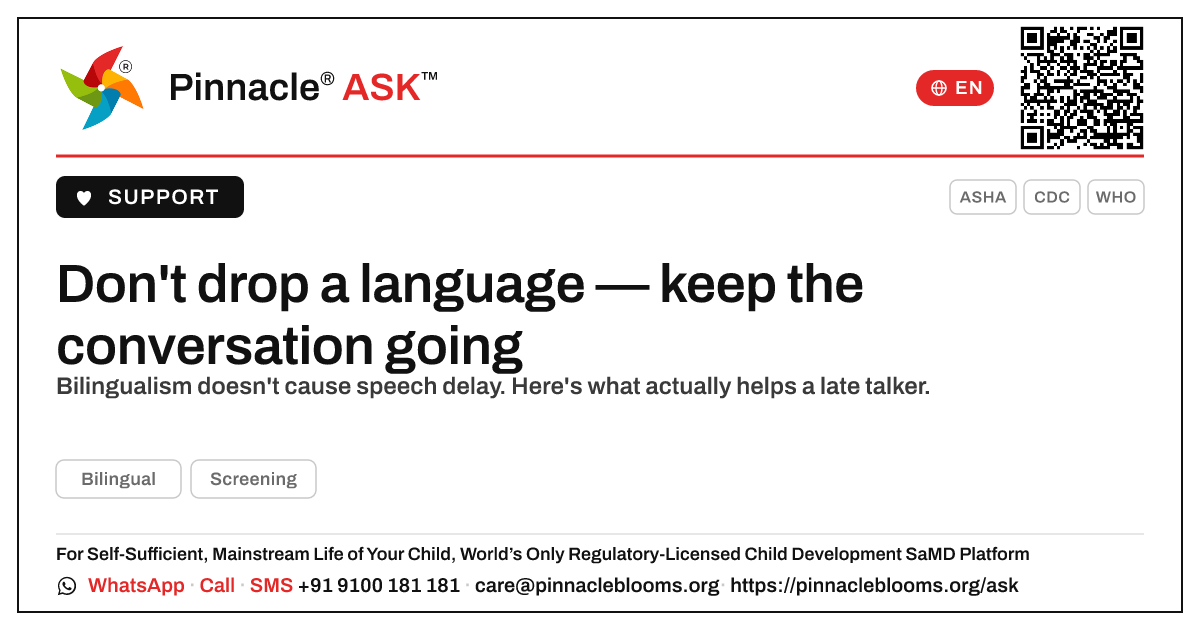
YOUR QUESTION. A CLEARER NEXT STEP.
Should I stop one language if my child isn't talking?
No — do not drop a language because your child is not talking. Bilingualism does not cause or worsen speech delay, and removing a home language usually means less communication, not more. Keep both languages rich, and have the delay itself assessed across both languages together.
In this answer 5 sections
One of the most common worries from bilingual families: is speaking two languages confusing my late-talking child? The reassuring answer is no.
In short
No — you should not drop a language because your child is not yet talking. Decades of evidence are clear: growing up with two or more languages does not cause speech delay, and it does not make an existing delay worse. If your child is a late talker, dropping a home language usually removes warm, natural communication and connection without helping speech at all. Keep both languages rich and joyful — and have the delay itself looked at.
Why keeping both languages matters
Bilingual children sometimes reach certain milestones on a slightly different timeline, but they hit the key communication markers within the same broad windows as monolingual children. A child can be a late talker in two languages just as easily as in one — bilingualism is not the cause.
The home language is where the deepest bonding, play and back-and-forth conversation happen. Switching to a language you are less fluent or comfortable in often means less talking, less storytelling, fewer songs — exactly the input a late talker needs more of, not less.
So the goal is not fewer languages; it is more communication. Speak each language naturally — one parent one language, or one language at home and another outside — and flood your child's day with narration, naming, singing and turn-taking.
When to have it checked
Bilingualism is not the question to investigate — the delay is. Consider a developmental check if your child:
- Has no babble or gesture (pointing, waving) by around 12 months
- Has no single meaningful words in any language by 16–18 months
- Is not combining two words by around 24 months
- Seems not to understand simple everyday requests, or rarely responds to their name
A professional will assess across both languages together, because that is your child's true vocabulary.
The Pinnacle way
Developmental measurement supports care planning; diagnosis requires an appropriately qualified healthcare professional., under qualified clinician care — never from an app or an online form, and never by simply counting words in one language. Our clinicians assess across all the languages your child hears, so nothing is missed. Explore how we support communication through speech therapy, understand your child's starting point with the AbilityScore, or begin here.
Trusted sources
American Speech-Language-Hearing Association guidance on bilingual language development; CDC developmental milestone resources; WHO ICD-11 framework for communication functioning.
Next step — Keep both languages warm and talkative, and let a Pinnacle clinician check the delay itself. Book a developmental assessment.
This is general information, not a diagnosis — individual assessment and diagnosis require an appropriately qualified healthcare professional.
CONNECT THE ANSWER TO YOUR CHILD’S DAY
Something to notice. Something to discuss.
What to notice
No babble or gesture by 12 months, no single words in any language by 16–18 months, no two-word combinations by 24 months, or little understanding of simple requests — these warrant a developmental check, regardless of how many languages are spoken.
In everyday life
Pick the language you feel most fluent and playful in for each setting, then talk, sing and narrate constantly. Rich back-and-forth conversation in any language helps far more than dropping one.
Bring your observations and questions to your child’s professional. Choose activities that suit your child’s comfort, abilities and agreed plan.
Bring your questions to a first visitQuestions families ask
Does being bilingual cause speech delay?
No. Research consistently shows bilingualism does not cause speech or language delay, nor does it worsen an existing one. A bilingual late talker would very likely have been a late talker in one language too.
Will my child get confused by two languages?
No. Mixing words from two languages is a normal, healthy stage of bilingual development, not a sign of confusion. Children naturally sort the languages out over time.
Should I switch only to the school language to help?
Usually not, especially if you are less fluent in it. That often reduces the amount of warm, natural conversation your child hears — the opposite of what a late talker needs.
How will the delay be assessed if my child speaks two languages?
A qualified clinician assesses across all the languages your child hears and combines them, because a bilingual child's true vocabulary is spread across both languages.
FOLLOW THE SOURCE
References behind this answer.
- Source referenceASHA: Learning two languages
- Source referenceCDC developmental milestones
- Organisation website · further readingWHO ICD-11
References are supplied with this answer. An organisation homepage offers further reading; it does not establish an independent review of this page.
Content attribution: SETU Consortium · Pinnacle Blooms Network.
PEOPLE, TOPICS & DEVELOPMENT
See the connections.
Browse the wider question collections connected with this answer’s audience, developmental area and stage.
FROM UNDERSTANDING TO PURPOSEFUL SUPPORT
One question. Your child’s whole life.
Your child’s self-sufficient, mainstream-included life is the purpose from the beginning. At Pinnacle, that purpose shapes what we understand, the goals we choose, the people we bring together, everyday practice and review.
Connect this question with the right support.
Explore how the relevant service contributes to everyday abilities, then speak with us about your child.
Make the next conversation useful.
Bring the situations you notice at home or school. We’ll explain a suitable service, centre and first visit, including availability and fees, before you decide.
How PinnacleAI® connects the journeyExplore the seven stages
- 1Understand abilities
A starting picture of your child’s capabilities.
- 2Choose meaningful goals
Readiness and a plan shaped around the child.
- 3Bring the right support together
Suitable therapies and people for those goals.
- 4Carry practice into everyday life
Guidance for family, home and school.
- 5Track and correct
Use observations to adjust the plan.
- 6Reassess and review
Decide what to continue, change or do next.
- 7Grow independence and participation
The child’s life gives each step its purpose.
Explore the whole PinnacleAI® system → · Participation at school and in the community →
PINNACLE’S EVIDENCE, OPEN TO YOU
Look at the evidence behind our work.
Read our research, inspect the original regulatory documents and check what each institutional measure means.
General information supports a conversation with an appropriately qualified professional. Advice, goals and support depend on the individual child.