
YOUR QUESTION. A CLEARER NEXT STEP.
Should a frontline worker refer a child with separation anxiety?
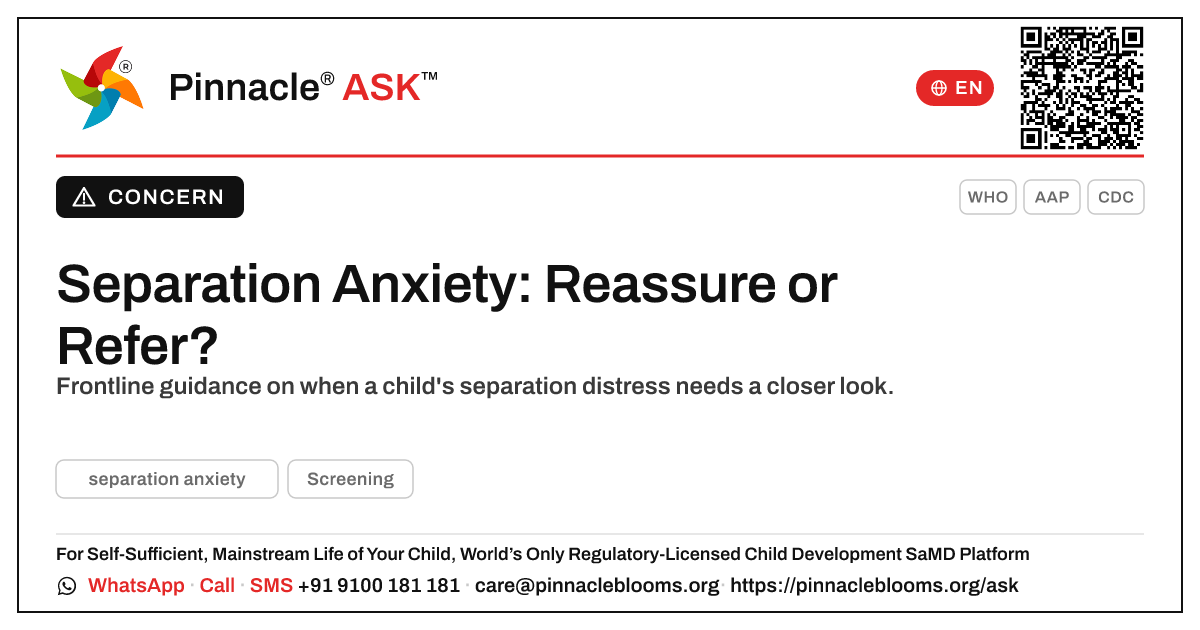
Separation anxiety is usually a normal, healthy stage of attachment, not a disorder, so a frontline worker should reassure and educate families in most cases. Refer onward only when the distress is unusually severe, persists well beyond the expected age, disrupts feeding, sleep, school or play, brings physical symptoms, or travels with other developmental, mood or medical concerns. The aim is to reassure the many and route the few who need a closer look — not to label a normal developmental phase.
In this answer 5 sections
Separation distress is one of the most universal — and most reassuring — signs of healthy attachment in a young child.
In short
In most children, separation anxiety is a normal, expected stage of emotional development, not a disorder. A frontline worker should reassure and educate the family rather than refer in the majority of cases. Refer onward only when the distress is unusually severe, persists well beyond the expected age, blocks the child's eating, sleeping, schooling or play, or arrives alongside other developmental or medical concerns.
What separation anxiety usually means
From around 8 months and through the toddler years, children protest at being parted from a trusted caregiver. This is healthy — it shows the child has formed a secure bond and understands that the caregiver still exists when out of sight. It typically peaks in the second year and eases naturally as the child grows in confidence and language.
For an ASHA or PHC worker, the everyday message to families is calm and practical: short, predictable goodbyes; a familiar comfort object; a warm, confident return; and never sneaking away. These usually settle the child over weeks.
When a frontline worker should refer
Route the child for a developmental or medical review — do not simply reassure — when you observe:
- Severity out of proportion — inconsolable, prolonged distress that disrupts feeding, sleep or daily life.
- Persistence beyond the expected stage — intense fear of separation continuing strongly into school age, or refusing to attend anganwadi/school.
- Physical symptoms — repeated stomach aches, headaches or vomiting tied to separation, once medical causes are checked.
- Travelling with other concerns — delays in talking, social connection or play; loss of a skill; or any sign of low mood, withdrawal or harm.
- Family distress — a caregiver who is overwhelmed, unwell or unable to cope.
In these situations, route to the medical officer or a developmental assessment rather than waiting.
The Pinnacle way
A clinical AbilityScore® and any diagnosis are formed only at a Pinnacle Blooms Network centre, under qualified clinician care — never from a checklist in the field. Across 70+ centres our clinicians distinguish ordinary separation distress from anxiety that needs support, and our child psychology and behavioural therapy team works with both child and family. A frontline worker's role is to reassure, observe and refer the few who need a closer look.
Trusted sources
WHO ICD-11 framework for separation anxiety disorder of childhood; American Academy of Pediatrics (healthychildren.org) guidance on normal separation anxiety and when it signals concern; CDC "Learn the Signs, Act Early" developmental and social-emotional monitoring resources.
Next step — Reassure the family first. If the distress is severe, persistent or paired with other concerns, refer for a developmental assessment with a Pinnacle clinician.
This is general information, not a diagnosis — individual assessment and diagnosis require an appropriately qualified healthcare professional.
CONNECT THE ANSWER TO YOUR CHILD’S DAY
Something to notice. Something to discuss.
What to notice
Refer when separation distress is severe and inconsolable, persists strongly into school age, causes school refusal, brings repeated stomach aches or headaches, or travels with delays in talking, social connection, play, low mood or withdrawal. Reassure and educate in ordinary cases; route the family if the caregiver is overwhelmed or unable to cope.
In everyday life
Coach families on short, predictable goodbyes with a warm, confident return — and never sneaking away. A familiar comfort object helps, and most children settle over a few weeks.
Bring your observations and questions to your child’s professional. Choose activities that suit your child’s comfort, abilities and agreed plan.
Bring your questions to a first visitQuestions families ask
Is separation anxiety a disorder?
Usually not. From around 8 months through the toddler years, distress at being parted from a trusted caregiver is a normal, healthy sign of secure attachment that eases as the child grows. It is only a concern when severe, persistent beyond the expected stage, or disrupting daily life.
When should a frontline worker refer rather than reassure?
Refer when the distress is inconsolable and disrupts feeding, sleep or play; persists intensely into school age or causes school refusal; brings repeated physical complaints; or travels with developmental delays, low mood or a caregiver who cannot cope.
What can a family do in the meantime?
Use short, predictable goodbyes; offer a familiar comfort object; return warmly and confidently; and avoid sneaking away. Most ordinary separation anxiety settles within a few weeks with this steady, reassuring approach.
FOLLOW THE SOURCE
References behind this answer.
- Organisation website · further readingWHO ICD-11: separation anxiety disorder of childhood
- Organisation website · further readingAAP healthychildren.org: normal separation anxiety in young children
- Organisation website · further readingCDC Learn the Signs, Act Early: social-emotional monitoring
References are supplied with this answer. An organisation homepage offers further reading; it does not establish an independent review of this page.
Content attribution: SETU Consortium · Pinnacle Blooms Network.
PEOPLE, TOPICS & DEVELOPMENT
See the connections.
Browse the wider question collections connected with this answer’s audience, developmental area and stage.
FROM UNDERSTANDING TO PURPOSEFUL SUPPORT
One question. Your child’s whole life.
Your child’s self-sufficient, mainstream-included life is the purpose from the beginning. At Pinnacle, that purpose shapes what we understand, the goals we choose, the people we bring together, everyday practice and review.
Connect this question with the right support.
Start with your child’s strengths, your observations and what you want everyday life to become.
Make the next conversation useful.
Bring the situations you notice at home or school. We’ll explain a suitable service, centre and first visit, including availability and fees, before you decide.
How PinnacleAI® connects the journeyExplore the seven stages
- 1Understand abilities
A starting picture of your child’s capabilities.
- 2Choose meaningful goals
Readiness and a plan shaped around the child.
- 3Bring the right support together
Suitable therapies and people for those goals.
- 4Carry practice into everyday life
Guidance for family, home and school.
- 5Track and correct
Use observations to adjust the plan.
- 6Reassess and review
Decide what to continue, change or do next.
- 7Grow independence and participation
The child’s life gives each step its purpose.
Explore the whole PinnacleAI® system → · Participation at school and in the community →
PINNACLE’S EVIDENCE, OPEN TO YOU
Look at the evidence behind our work.
Read our research, inspect the original regulatory documents and check what each institutional measure means.
General information supports a conversation with an appropriately qualified professional. Advice, goals and support depend on the individual child.