
YOUR QUESTION. A CLEARER NEXT STEP.
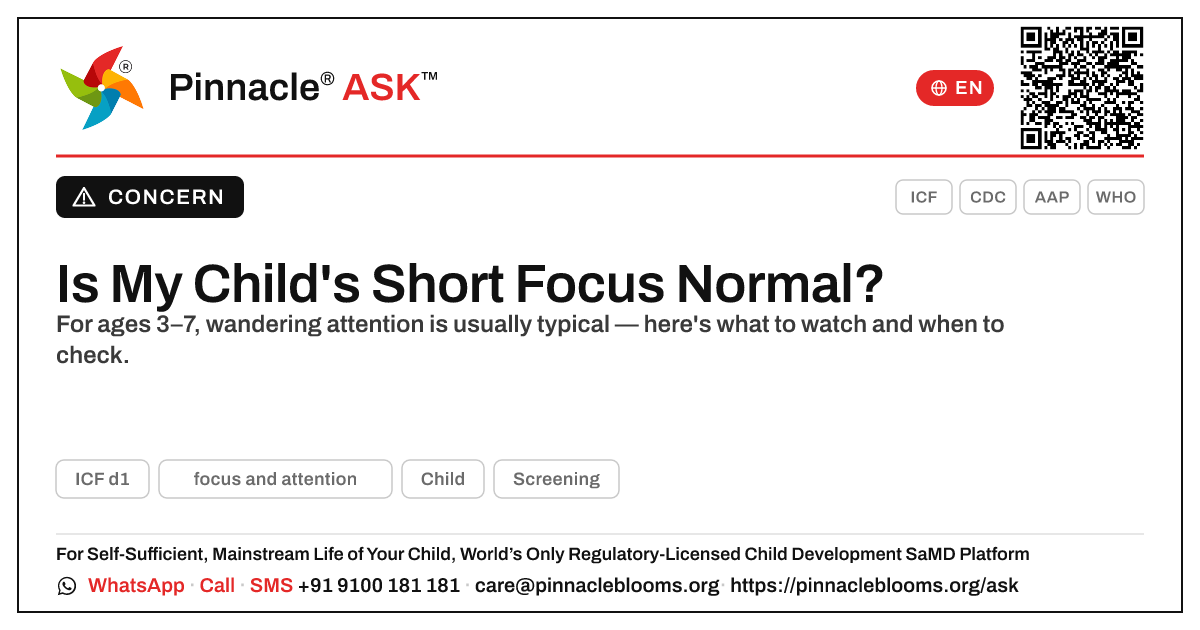
Is it normal my child isn't showing focus and attention yet?
For most children aged 3–7, short and wandering attention is normal — focus grows slowly, and young children are meant to be curious and distractible. A useful guide is roughly 2–5 minutes of focus per year of age on set tasks, and far longer on loved play. Seek a developmental check only if attention is well behind same-age peers across home and nursery, or if it disrupts learning and play. This is reason to assess, not a diagnosis.
In this answer 5 sections
Watching your child flit from one thing to the next and wondering if their focus will catch up — that careful noticing is exactly the kind of attention they need from you.
In short
For most children between 3 and 7 years, short and wandering attention is completely normal — focus is a skill that grows slowly, and young children are meant to be busy, curious and easily distracted. A rough guide many clinicians use is roughly 2–5 minutes of focused attention per year of age on a task they didn't choose, and much longer on play they love. So a 4-year-old who concentrates for only a few minutes on a set task, yet plays happily for ages, is usually right on track. A developmental check is wise only when focus is far behind same-age peers across home and nursery, or it's getting in the way of learning and play.
What to watch
These are reasons for a gentle review — not a diagnosis:
- Across settings — both you and the teacher notice attention is well behind other children of the same age, not just at home.
- Can't settle to anything — even favourite, self-chosen play is fleeting and they move constantly from thing to thing.
- Not following simple steps — struggles with one- or two-step instructions appropriate for their age.
- Frustration or distress — gets overwhelmed, gives up quickly, or learning and friendships are being affected.
- Any loss of a skill they clearly had before — always worth prompt review.
Remember: sleep, hunger, screen habits and a noisy environment all shrink a young child's focus. Often the answer is simpler than we fear.
The science
Attention and task initiation are executive function skills, seated in the slowly-maturing frontal networks of the brain. They develop unevenly through early childhood, which is why structured, playful practice — short tasks, clear steps, gentle wins — builds focus far better than pressure ever can.
The Pinnacle way
This is general information, not a diagnosis — a clinical AbilityScore® and any diagnosis are formed only at a Pinnacle Blooms Network centre, under qualified clinician care. Our team builds a personal baseline of your child's focus and attention and shapes playful support through special education when it's helpful — always around strengths.
Trusted sources
CDC "Learn the Signs, Act Early" milestones and the American Academy of Pediatrics (healthychildren.org) on attention and behaviour in young children; WHO Nurturing Care framework on early childhood development.
Next step — Trust what you've noticed. Book a developmental check so your child's focus is reviewed by a Pinnacle clinician, with clarity and care.
CONNECT THE ANSWER TO YOUR CHILD’S DAY
Something to notice. Something to discuss.
What to notice
Seek a gentle review if both you and the teacher notice attention is well behind same-age peers, your child can't settle even to favourite play, struggles with simple one- or two-step instructions for their age, is frequently frustrated or affected in learning and friendships, or has lost a skill they once had. Check sleep, hunger and screen habits first.
In everyday life
Try short, playful 'focus games' — finishing a 4–6 piece puzzle, building a small tower, or 'I spy' — and celebrate finishing rather than perfection. Keep tasks brief, give one clear step at a time, and cut background noise and screens to help focus grow naturally.
Bring your observations and questions to your child’s professional. Choose activities that suit your child’s comfort, abilities and agreed plan.
Bring your questions to a first visitQuestions families ask
How long should my 4-year-old be able to focus?
A rough guide is about 2–5 minutes of focused attention per year of age on a task they didn't choose, so a few minutes for a 4-year-old — and much longer on play they love. Short, wandering attention at this age is normal.
Could short attention mean ADHD?
Not on its own. Distractibility is typical in young children, and attention difficulties are only meaningfully assessed when they're well beyond same-age peers across home and nursery and affect daily life. A clinician, not a checklist, would explore this.
What everyday things shrink a child's focus?
Tiredness, hunger, too much screen time and a noisy or busy environment all reduce a young child's attention. Improving sleep and reducing distractions often makes a real difference before anything else is needed.
FOLLOW THE SOURCE
References behind this answer.
- Source referenceICF d1
- Source referenceCDC: Developmental Milestones & Learn the Signs, Act Early
- Source referenceAAP HealthyChildren: Ages & Stages
- Organisation website · further readingWHO Nurturing Care Framework
References are supplied with this answer. An organisation homepage offers further reading; it does not establish an independent review of this page.
Content attribution: SETU Consortium · Pinnacle Blooms Network.
PEOPLE, TOPICS & DEVELOPMENT
See the connections.
Browse the wider question collections connected with this answer’s audience, developmental area and stage.
FROM UNDERSTANDING TO PURPOSEFUL SUPPORT
One question. Your child’s whole life.
Your child’s self-sufficient, mainstream-included life is the purpose from the beginning. At Pinnacle, that purpose shapes what we understand, the goals we choose, the people we bring together, everyday practice and review.
Connect this question with the right support.
Start with your child’s strengths, your observations and what you want everyday life to become.
Make the next conversation useful.
Bring the situations you notice at home or school. We’ll explain a suitable service, centre and first visit, including availability and fees, before you decide.
How PinnacleAI® connects the journeyExplore the seven stages
- 1Understand abilities
A starting picture of your child’s capabilities.
- 2Choose meaningful goals
Readiness and a plan shaped around the child.
- 3Bring the right support together
Suitable therapies and people for those goals.
- 4Carry practice into everyday life
Guidance for family, home and school.
- 5Track and correct
Use observations to adjust the plan.
- 6Reassess and review
Decide what to continue, change or do next.
- 7Grow independence and participation
The child’s life gives each step its purpose.
Explore the whole PinnacleAI® system → · Participation at school and in the community →
PINNACLE’S EVIDENCE, OPEN TO YOU
Look at the evidence behind our work.
Read our research, inspect the original regulatory documents and check what each institutional measure means.
General information supports a conversation with an appropriately qualified professional. Advice, goals and support depend on the individual child.