
YOUR QUESTION. A CLEARER NEXT STEP.
Handling Low Frustration Tolerance in a 4-Year-Old
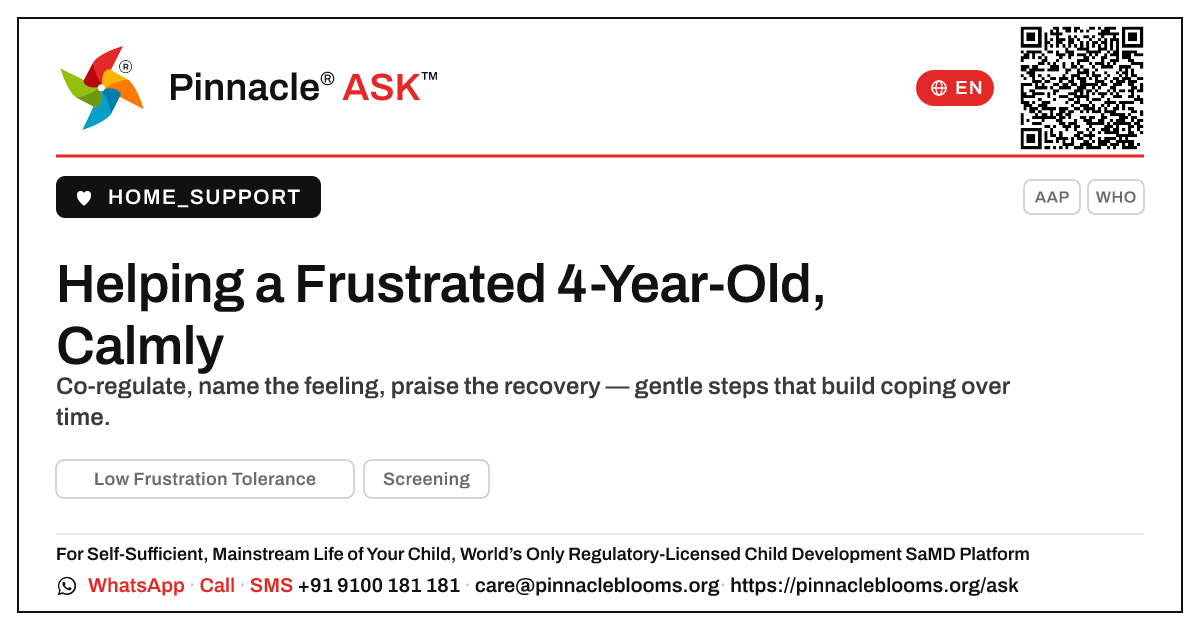
Low frustration tolerance is normal at four as self-control is still developing. Coach your child through it: stay calm, name the feeling, keep tasks at a 'just-right' challenge, build a calm-down routine, and praise recovery. Look closer if it is intense and daily across settings, or comes with speech, attention or social concerns.
In this answer 5 sections
A four-year-old who melts down over a broken biscuit or a too-tight sock isn't being difficult — they're showing you a brain still learning to wait, cope and recover. You can teach this, gently, day by day.
In short
Low frustration tolerance is developmentally normal at four — the part of the brain that manages impulse and disappointment is still maturing. Your job is not to remove frustration but to coach your child through it: name the feeling, stay calm yourself, keep tasks at a 'just-right' challenge, and praise the effort to recover. Most children grow steadily calmer with consistent, warm support over weeks and months.
What helps at home
Co-regulate before you teach. A child in full meltdown cannot hear logic. Lower your voice, get to their eye level, and offer calm presence first. Your steady nervous system is what theirs borrows.
Name it to tame it. Put words to the feeling: "You're so cross the tower fell. That's really frustrating." Naming an emotion helps the brain settle it.
Set the challenge just right. Tasks that are far too hard guarantee frustration. Break puzzles, dressing or drawing into smaller steps so success comes often, then stretch the difficulty slowly.
Build a 'calm-down' routine together. Practise simple tools when your child is calm — three slow breaths, squeezing a cushion, a quiet corner — so they're familiar when feelings rise.
Praise the recovery, not just the result. "You were really angry and you took a breath and tried again — that's so hard to do." This teaches that bouncing back is the win.
Plan around the hard moments. Warn before transitions ("two more minutes, then we tidy up"), keep predictable routines, and protect sleep and snacks — a tired or hungry child has almost no reserve.
When to look a little closer
Most four-year-olds improve with consistent coaching. Consider a developmental check if frustration is intense and daily across many settings, if meltdowns are frequent and very hard to recover from, if there is little or no language to express needs, or if it comes alongside concerns about speech, attention, sensory sensitivity or social play. These patterns are worth understanding — not to label your child, but to give them the right support early.
The Pinnacle way
A clinical AbilityScore® and any diagnosis are formed only at a Pinnacle Blooms Network centre, under the care of a qualified clinician — never from an online read or a screen. Our behaviour and emotional-regulation therapy helps children build coping skills with warm, structured coaching, and if expressing needs is part of the struggle, speech therapy can ease the frustration of not being understood. Begin where it suits you — even just here.
Trusted sources
Guidance here reflects the American Academy of Pediatrics' HealthyChildren parenting resources on emotional development and managing tantrums, and WHO Nurturing Care guidance on responsive caregiving in the early years.
Next step — if frustration feels overwhelming for your child or your family, book a gentle developmental check with the Pinnacle team on WhatsApp: +91 91001 81181.
This is general information, not a diagnosis — individual assessment and diagnosis require an appropriately qualified healthcare professional.
CONNECT THE ANSWER TO YOUR CHILD’S DAY
Something to notice. Something to discuss.
What to notice
Look closer if meltdowns are intense and daily across many settings, very hard to recover from, paired with little language to express needs, or alongside concerns about attention, sensory sensitivity or social play.
In everyday life
Warn before transitions — "two more minutes, then we tidy up" — and protect sleep and snacks. A tired or hungry four-year-old has almost no frustration reserve.
Bring your observations and questions to your child’s professional. Choose activities that suit your child’s comfort, abilities and agreed plan.
Bring your questions to a first visitQuestions families ask
Is low frustration tolerance normal at four?
Yes. At four, the brain regions that manage impulse, waiting and disappointment are still maturing, so big reactions to small setbacks are common. With calm, consistent coaching most children steadily improve over weeks and months.
Should I give in to stop the meltdown?
Giving in to end a meltdown teaches that big reactions get results. Instead, stay calm and present, acknowledge the feeling, and hold gentle, predictable limits. Praise your child warmly once they recover.
When should I seek a developmental check?
Consider a check if frustration is intense and daily across many settings, very hard to recover from, paired with limited language, or alongside concerns about attention, sensory sensitivity or social play. This helps give the right support early — not to label your child.
FOLLOW THE SOURCE
References behind this answer.
- Organisation website · further readingAAP HealthyChildren — emotional development and tantrums
- Organisation website · further readingWHO Nurturing Care — responsive caregiving in early childhood
References are supplied with this answer. An organisation homepage offers further reading; it does not establish an independent review of this page.
Content attribution: SETU Consortium · Pinnacle Blooms Network.
PEOPLE, TOPICS & DEVELOPMENT
See the connections.
Browse the wider question collections connected with this answer’s audience, developmental area and stage.
FROM UNDERSTANDING TO PURPOSEFUL SUPPORT
One question. Your child’s whole life.
Your child’s self-sufficient, mainstream-included life is the purpose from the beginning. At Pinnacle, that purpose shapes what we understand, the goals we choose, the people we bring together, everyday practice and review.
Connect this question with the right support.
Start with your child’s strengths, your observations and what you want everyday life to become.
Make the next conversation useful.
Bring the situations you notice at home or school. We’ll explain a suitable service, centre and first visit, including availability and fees, before you decide.
How PinnacleAI® connects the journeyExplore the seven stages
- 1Understand abilities
A starting picture of your child’s capabilities.
- 2Choose meaningful goals
Readiness and a plan shaped around the child.
- 3Bring the right support together
Suitable therapies and people for those goals.
- 4Carry practice into everyday life
Guidance for family, home and school.
- 5Track and correct
Use observations to adjust the plan.
- 6Reassess and review
Decide what to continue, change or do next.
- 7Grow independence and participation
The child’s life gives each step its purpose.
Explore the whole PinnacleAI® system → · Participation at school and in the community →
PINNACLE’S EVIDENCE, OPEN TO YOU
Look at the evidence behind our work.
Read our research, inspect the original regulatory documents and check what each institutional measure means.
General information supports a conversation with an appropriately qualified professional. Advice, goals and support depend on the individual child.