
YOUR QUESTION. A CLEARER NEXT STEP.
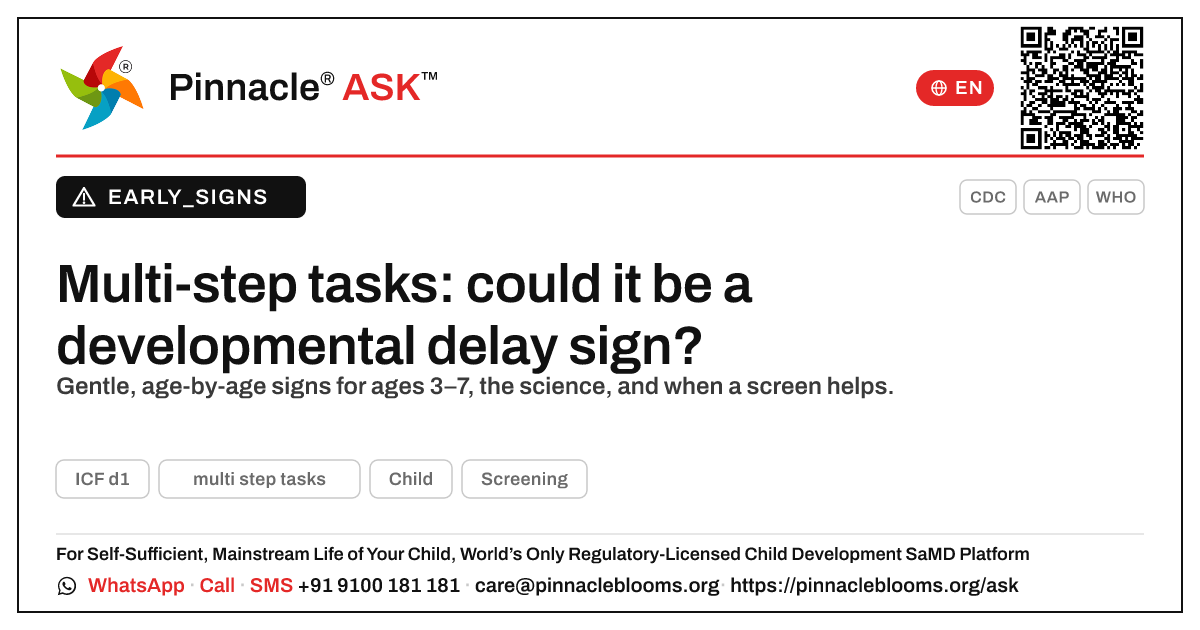
Could difficulty with multi-step tasks be a sign of a developmental delay?
Ongoing difficulty with multi-step tasks can be one early sign that a child needs support with executive sequencing — the skill of holding and ordering steps. On its own it is rarely a diagnosis, especially between ages 3 and 7 when this skill is still maturing. It is worth a gentle check when the difficulty is clearly behind peers, shows up across home and school, and comes with other concerns. This is a screen-and-support stance, not an alarm — early, playful support never needs to wait for a label.
In this answer 5 sections
When a child loses their way between "put your shoes on" and "come to the door", it can feel puzzling — so when is it just being little, and when is it worth a closer, kinder look?
In short
Yes — ongoing difficulty following multi-step tasks ("pick up the blocks, then put them in the box") can be one early sign that a child needs a little support with executive sequencing — the brain's skill of holding and ordering steps. But on its own it is rarely a diagnosis, especially between 3 and 7 years when this skill is still maturing. It becomes worth a gentle check when the difficulty is well behind same-age peers, shows up across home and school, and is paired with other concerns.
Early signs to watch (ages 3–7)
Multi-step skills grow gradually — most 3-year-olds manage two simple steps, while 6–7-year-olds handle three or more. Watch for a pattern rather than a single off-day:
- Regularly loses track after the first step, even with familiar routines
- Needs every step repeated or physically guided, far more than peers
- Struggles to start, or jumps straight to the last step
- Gets easily distracted mid-task and rarely returns to finish
- Strong frustration, avoidance or "I can't" with anything sequenced
- Difficulty spans dressing, tidying, simple games and classroom instructions
What shifts this towards a check is difficulty that persists across several months, appears in more than one setting, or comes alongside speech, attention or learning concerns.
When to seek a check
This is a screen-and-support stance, not an alarm. If the pattern above sounds familiar, raise it at a routine developmental review or with your paediatrician. A hearing check is often a sensible first step, since missed instructions can simply mean missed sounds. Early, playful support never needs to wait for a label.
The Pinnacle way
At Pinnacle Blooms Network, we begin with what your child can already sequence and build step by step, through warm, play-based occupational therapy and everyday coaching for parents. You can explore more about multi step tasks and how we support them. A clinical AbilityScore® and any diagnosis are formed only at a Pinnacle Blooms Network centre under qualified clinician care — nothing here is a diagnosis. Across 70+ centres in 4 states and 4.95 lakh+ families served, our aim is steady, strengths-first progress.
Trusted sources
Aligned with CDC developmental-milestone resources, American Academy of Pediatrics and HealthyChildren.org guidance on attention and following directions, and the WHO ICF framework for everyday activity skills.
Next step — if multi-step tasks feel like a daily struggle, book a developmental screen with our clinical team on WhatsApp at +91 91001 81181, and let's understand your child together.
This is general information, not a diagnosis — individual assessment and diagnosis require an appropriately qualified healthcare professional.
CONNECT THE ANSWER TO YOUR CHILD’S DAY
Something to notice. Something to discuss.
What to notice
A persistent pattern (over several months) of losing track after the first step, needing every step repeated far more than peers, trouble starting or finishing sequenced tasks, frustration or avoidance with sequenced activities, and difficulty across home, play and classroom — especially alongside speech, attention or learning concerns.
In everyday life
Turn daily routines into gentle 'first… then…' games: say two simple steps, then build to three as your child succeeds — and praise each finished step, not just the result.
Bring your observations and questions to your child’s professional. Choose activities that suit your child’s comfort, abilities and agreed plan.
Bring your questions to a first visitQuestions families ask
At what age should my child manage multi-step instructions?
It grows gradually: most 3-year-olds follow two simple steps, while 6–7-year-olds manage three or more. Look at the pattern over time rather than a single off-day, and remember tired, hungry or distracted children often manage fewer steps.
Does difficulty with multi-step tasks always mean a delay?
No. On its own it is rarely a diagnosis, especially between 3 and 7 years when executive sequencing is still maturing. It is worth a check only when difficulty persists across months, appears in more than one setting, or comes with other concerns.
What should I do first if I'm worried?
Raise it at a routine developmental review or with your paediatrician, and consider a hearing check, since missed instructions can simply mean missed sounds. Early, playful support can begin without waiting for a label.
FOLLOW THE SOURCE
References behind this answer.
- Source referenceCDC — Developmental milestones
- Organisation website · further readingAAP HealthyChildren — Following directions & attention
- Organisation website · further readingWHO ICF — Activity & participation framework
References are supplied with this answer. An organisation homepage offers further reading; it does not establish an independent review of this page.
Content attribution: SETU Consortium · Pinnacle Blooms Network.
PEOPLE, TOPICS & DEVELOPMENT
See the connections.
Browse the wider question collections connected with this answer’s audience, developmental area and stage.
FROM UNDERSTANDING TO PURPOSEFUL SUPPORT
One question. Your child’s whole life.
Your child’s self-sufficient, mainstream-included life is the purpose from the beginning. At Pinnacle, that purpose shapes what we understand, the goals we choose, the people we bring together, everyday practice and review.
Connect this question with the right support.
Explore how the relevant service contributes to everyday abilities, then speak with us about your child.
Make the next conversation useful.
Bring the situations you notice at home or school. We’ll explain a suitable service, centre and first visit, including availability and fees, before you decide.
How PinnacleAI® connects the journeyExplore the seven stages
- 1Understand abilities
A starting picture of your child’s capabilities.
- 2Choose meaningful goals
Readiness and a plan shaped around the child.
- 3Bring the right support together
Suitable therapies and people for those goals.
- 4Carry practice into everyday life
Guidance for family, home and school.
- 5Track and correct
Use observations to adjust the plan.
- 6Reassess and review
Decide what to continue, change or do next.
- 7Grow independence and participation
The child’s life gives each step its purpose.
Explore the whole PinnacleAI® system → · Participation at school and in the community →
PINNACLE’S EVIDENCE, OPEN TO YOU
Look at the evidence behind our work.
Read our research, inspect the original regulatory documents and check what each institutional measure means.
General information supports a conversation with an appropriately qualified professional. Advice, goals and support depend on the individual child.