
YOUR QUESTION. A CLEARER NEXT STEP.
At What Age Should a Child Understand Spatial Concepts?
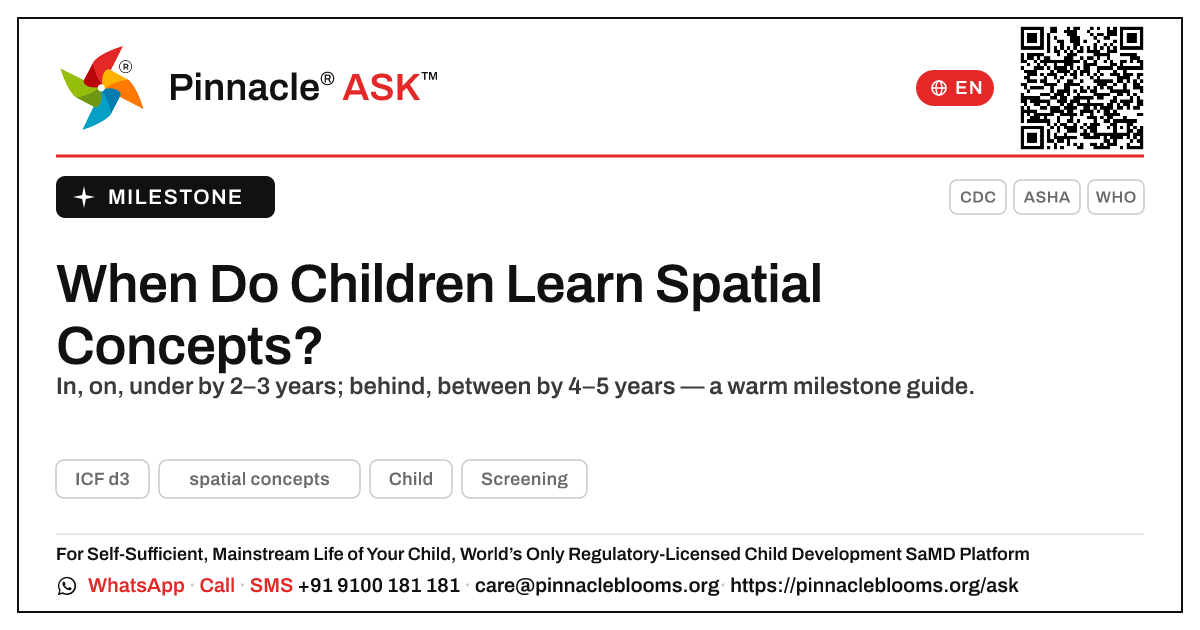
Children typically understand early spatial words (in, on, under) between 2 and 3 years, and master harder ones (behind, between, in front of) by 4 to 5 years. Understanding precedes spoken use. A gentle check is sensible if a child can't follow simple spatial directions by age 4, despite good hearing.
In this answer 5 sections
Up, under, behind, between — the little words that map your child's world arrive gently, one playful moment at a time.
In short
Most children begin grasping early spatial concepts — in, on, under — between 2 and 3 years, and steadily master harder ones like behind, between, in front of and beside by around 4 to 5 years. By age 5–6, children typically follow two-step directions that combine spatial words ("put the cup behind the box"). These are part of receptive language, so understanding usually comes before a child uses the words aloud.
How spatial concepts grow
Spatial words are a bridge between language and thinking — your child has to picture the relationship and match it to a word. A rough guide:
- 2–3 years — understands in, on, out, up, down
- 3–4 years — under, next to, top, bottom
- 4–5 years — behind, in front of, between, around
- 5–6 years — combines concepts in longer instructions
Children learn these at different paces, and bilingual little ones may show them across two languages — that is typical, not a delay.
When to check in
If, by around age 4, your child consistently struggles to follow simple spatial directions ("sit on the chair", "it's under the table") despite good hearing, a gentle developmental check is worthwhile. This is monitoring, not alarm — early support through speech therapy is playful and effective.
The Pinnacle way
Developmental measurement supports care planning; diagnosis requires an appropriately qualified healthcare professional. under qualified clinician care — never from a website. Learn how our AbilityScore® maps receptive language, and explore speech therapy if you'd like a closer look.
Trusted sources
Guided by WHO ICF activity-and-participation domains, CDC developmental milestone guidance, ASHA resources on receptive language, and the AAP's healthychildren.org.
Next step — if you're curious about your child's understanding, book a free developmental screen with our team on WhatsApp: +91 91001 81181.
This is general information, not a diagnosis — individual assessment and diagnosis require an appropriately qualified healthcare professional.
CONNECT THE ANSWER TO YOUR CHILD’S DAY
Something to notice. Something to discuss.
What to notice
By around age 4, watch for consistent trouble following simple spatial directions like 'put it under the table' or 'stand behind me' despite good hearing — that's worth a gentle developmental check, not alarm.
In everyday life
Narrate space during play: 'The teddy is ON the box... now it's UNDER!' Hide-and-seek, packing toys away, and obstacle games teach in, on, under and behind naturally.
Bring your observations and questions to your child’s professional. Choose activities that suit your child’s comfort, abilities and agreed plan.
Bring your questions to a first visitQuestions families ask
At what age do children understand 'in', 'on' and 'under'?
Most children understand 'in', 'on', 'out', 'up' and 'down' between 2 and 3 years. Harder words like 'under' and 'next to' usually follow by 3 to 4 years.
When do children learn 'behind' and 'between'?
More complex spatial concepts such as 'behind', 'in front of', 'between' and 'around' typically develop between 4 and 5 years of age.
Should I worry if my 4-year-old can't follow spatial directions?
If your child consistently struggles with simple directions like 'sit on the chair' or 'it's under the table' by age 4, despite good hearing, a gentle developmental check is worthwhile. Early support is playful and effective — this is monitoring, not a diagnosis.
Do bilingual children learn spatial words later?
Bilingual children often show spatial understanding spread across both languages, which is typical and not a delay. Look at what they understand across both languages combined.
FOLLOW THE SOURCE
References behind this answer.
- Source referenceCDC developmental milestones
- Source referenceASHA speech & language development
- Organisation website · further readingWHO ICF activity & participation domains
References are supplied with this answer. An organisation homepage offers further reading; it does not establish an independent review of this page.
Content attribution: SETU Consortium · Pinnacle Blooms Network.
PEOPLE, TOPICS & DEVELOPMENT
See the connections.
Browse the wider question collections connected with this answer’s audience, developmental area and stage.
FROM UNDERSTANDING TO PURPOSEFUL SUPPORT
One question. Your child’s whole life.
Your child’s self-sufficient, mainstream-included life is the purpose from the beginning. At Pinnacle, that purpose shapes what we understand, the goals we choose, the people we bring together, everyday practice and review.
Connect this question with the right support.
Start with your child’s strengths, your observations and what you want everyday life to become.
Make the next conversation useful.
Bring the situations you notice at home or school. We’ll explain a suitable service, centre and first visit, including availability and fees, before you decide.
How PinnacleAI® connects the journeyExplore the seven stages
- 1Understand abilities
A starting picture of your child’s capabilities.
- 2Choose meaningful goals
Readiness and a plan shaped around the child.
- 3Bring the right support together
Suitable therapies and people for those goals.
- 4Carry practice into everyday life
Guidance for family, home and school.
- 5Track and correct
Use observations to adjust the plan.
- 6Reassess and review
Decide what to continue, change or do next.
- 7Grow independence and participation
The child’s life gives each step its purpose.
Explore the whole PinnacleAI® system → · Participation at school and in the community →
PINNACLE’S EVIDENCE, OPEN TO YOU
Look at the evidence behind our work.
Read our research, inspect the original regulatory documents and check what each institutional measure means.
General information supports a conversation with an appropriately qualified professional. Advice, goals and support depend on the individual child.