
YOUR QUESTION. A CLEARER NEXT STEP.
At What Age Do Decision-Making Skills Develop?
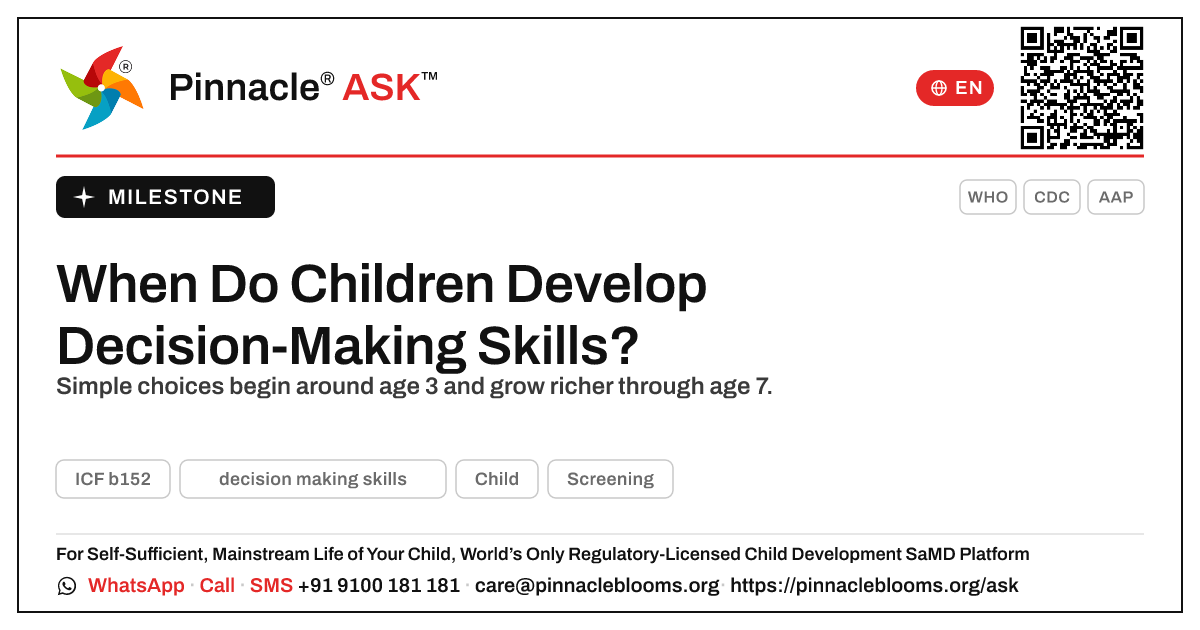
Simple decision making begins around age 3, when a child chooses between two clear options. Between 3 and 7 years choices grow richer, weighing rewards, picking activities, and anticipating consequences. It develops gradually alongside attention and impulse control, so everyday small choices are the best way to nurture it.
In this answer 5 sections
The moment your toddler picks the red cup over the blue one, a whole new skill is quietly taking shape — the ability to choose.
In short
Simple decision making begins around age 3, when a child can pick between two clear options ("apple or banana?"). Between 3 and 7 years, choices grow richer — weighing a small reward now against a bigger one later, picking friends and games, and starting to think about consequences. This is a gradual journey, not a single milestone, and lots of small everyday choices are exactly how it grows.
How the skill unfolds
Decision making (ICF b152, higher-level cognitive function) leans on attention, memory, and impulse control all working together. A rough map:
- By 3 years — chooses between two offered options and shows clear preferences.
- By 4–5 years — makes simple choices, begins to wait briefly for a better outcome, and explains a reason ("I want the big one").
- By 6–7 years — weighs two or three options, anticipates simple consequences, and recovers from a "wrong" choice without big upset.
Growing impulsivity control is part of this picture. A child who consistently struggles to pause, choose, or learn from outcomes well past these ages — across home and school — is worth a gentle, unhurried developmental check.
When to look closer
Every child decides at their own pace. But if choices feel overwhelming, impulsive, or much harder than peers by school age, a screen helps — never to label, only to understand and support.
The Pinnacle way
A clinical AbilityScore® and any diagnosis are formed only at a Pinnacle Blooms Network centre, under qualified clinician care. We map decision making skills within emotional and cognitive development and, where helpful, build them through warm, play-based behaviour therapy. With 4.95 lakh+ families served across 70+ centres, we walk this with you.
Trusted sources
Guided by WHO ICF function b152 (higher-level cognitive functions), CDC developmental guidance, and AAP/HealthyChildren resources on growing independence and choice-making in early childhood.
Next step — offer two real choices a day and notice how your child decides; if you'd like a friendly developmental screen, reach our team on WhatsApp at +91 91001 81181.
This is general information, not a diagnosis — individual assessment and diagnosis require an appropriately qualified healthcare professional.
CONNECT THE ANSWER TO YOUR CHILD’S DAY
Something to notice. Something to discuss.
What to notice
Look closer if, by school age, your child finds simple choices overwhelming, decides very impulsively, or struggles to learn from outcomes across both home and school settings.
In everyday life
Offer two real, simple choices each day — "apple or banana?", "red shirt or blue?" — and let your child decide. These small daily choices build confidence and judgement.
Bring your observations and questions to your child’s professional. Choose activities that suit your child’s comfort, abilities and agreed plan.
Bring your questions to a first visitQuestions families ask
At what age can a child start making simple decisions?
Around age 3, most children can choose between two clear options, such as picking which fruit or which toy. This is the natural start of decision making, and offering simple choices helps it grow.
How can I help my preschooler make better decisions?
Offer two real choices a day, name the options, and let your child decide and live with the small outcome. Praise the act of choosing, and gently talk through what happened afterwards.
When should I be concerned about my child's decision making?
If by school age choices feel overwhelming, very impulsive, or much harder than for peers across both home and school, a gentle developmental screen can help you understand and support your child. It is never about labelling.
FOLLOW THE SOURCE
References behind this answer.
- Organisation website · further readingWHO ICF — higher-level cognitive functions (b152)
- Source referenceCDC — Child Development Milestones
- Organisation website · further readingAAP HealthyChildren — Growing Independence
References are supplied with this answer. An organisation homepage offers further reading; it does not establish an independent review of this page.
Content attribution: SETU Consortium · Pinnacle Blooms Network.
PEOPLE, TOPICS & DEVELOPMENT
See the connections.
Browse the wider question collections connected with this answer’s audience, developmental area and stage.
FROM UNDERSTANDING TO PURPOSEFUL SUPPORT
One question. Your child’s whole life.
Your child’s self-sufficient, mainstream-included life is the purpose from the beginning. At Pinnacle, that purpose shapes what we understand, the goals we choose, the people we bring together, everyday practice and review.
Connect this question with the right support.
Start with your child’s strengths, your observations and what you want everyday life to become.
Make the next conversation useful.
Bring the situations you notice at home or school. We’ll explain a suitable service, centre and first visit, including availability and fees, before you decide.
How PinnacleAI® connects the journeyExplore the seven stages
- 1Understand abilities
A starting picture of your child’s capabilities.
- 2Choose meaningful goals
Readiness and a plan shaped around the child.
- 3Bring the right support together
Suitable therapies and people for those goals.
- 4Carry practice into everyday life
Guidance for family, home and school.
- 5Track and correct
Use observations to adjust the plan.
- 6Reassess and review
Decide what to continue, change or do next.
- 7Grow independence and participation
The child’s life gives each step its purpose.
Explore the whole PinnacleAI® system → · Participation at school and in the community →
PINNACLE’S EVIDENCE, OPEN TO YOU
Look at the evidence behind our work.
Read our research, inspect the original regulatory documents and check what each institutional measure means.
General information supports a conversation with an appropriately qualified professional. Advice, goals and support depend on the individual child.