
YOUR QUESTION. A CLEARER NEXT STEP.
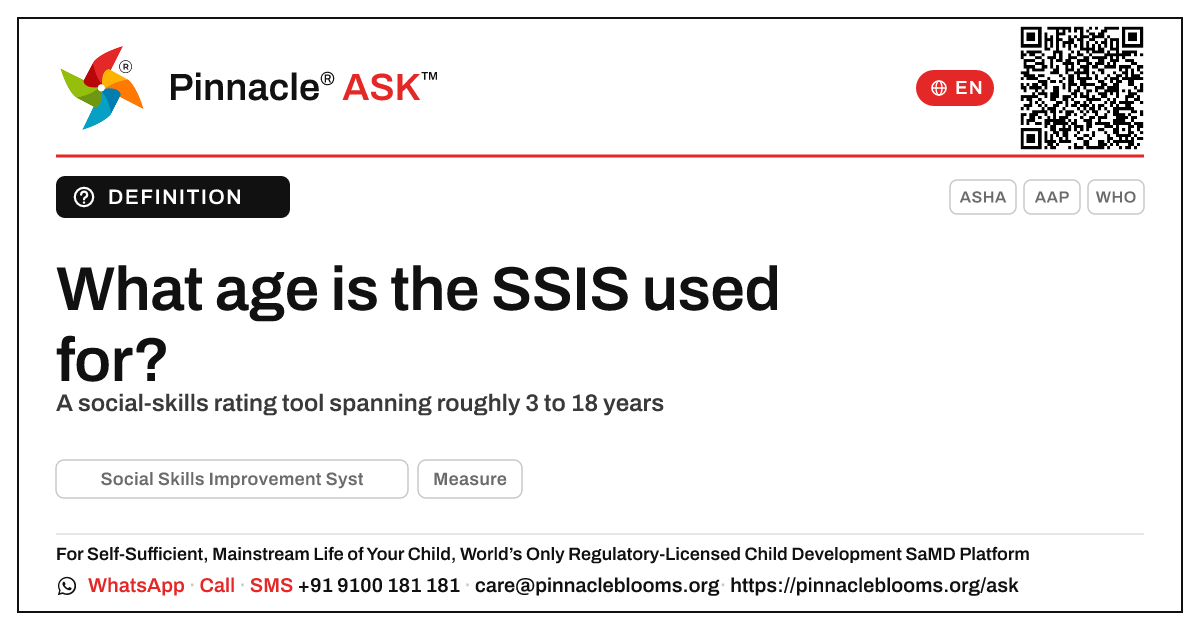
At what age is the SSIS used for a child?
The Social Skills Improvement System Rating Scales (SSIS) is used across a broad age range, typically from around 3 to 18 years. It is a family of questionnaires completed by parents, teachers and, for older children and teens, the young person themselves, looking at social skills, problem behaviours and competence. It is one tool among many and is interpreted by a qualified clinician as part of a wider developmental review — never a diagnosis on its own.
In this answer 5 sections
One questionnaire, a wide span of childhood — the SSIS grows with your child from the early years right through to the late teens.
In short
The Social Skills Improvement System Rating Scales (SSIS) is used across a broad age range — typically from around 3 years to 18 years. It is a structured questionnaire completed by parents, teachers and, for older children and teens, the young person themselves, to gather a rounded picture of social skills, problem behaviours and, in some forms, academic competence. It is one helpful tool among many — never a diagnosis on its own.
How the age bands work
The SSIS is not a single one-size form; it is a family of rating forms designed for different ages and different people in a child's life. Younger children (roughly 3–5 years, the early school and preschool stage) are usually rated by parents and teachers who see them in everyday play and group settings. School-age children (around 5–12 years) can be rated by parents and teachers, and a self-report version invites the child's own view. Adolescents (about 13–18 years) can complete a self-report alongside parent and teacher forms. Gathering more than one perspective — home, classroom and the young person themselves — gives a fuller, fairer picture of how a child relates, cooperates, shows empathy, manages feelings and handles everyday social demands.
What it is — and is not
The SSIS measures strengths to build on, not just difficulties. It looks at areas such as communication, cooperation, self-control, empathy and engagement, and notes behaviours that may be getting in the way. Because it is a questionnaire, it reflects what raters observe — so it is most useful as part of a wider developmental review, interpreted by a qualified clinician who can place the scores in the context of your whole child.
The Pinnacle way
This is general information, not a diagnosis — a clinical AbilityScore® and any diagnosis are formed only at a Pinnacle Blooms Network centre, under qualified clinician care, never from an app or form alone. Our clinicians may use structured tools such as the SSIS within a broader picture and, where helpful, support growth through behaviour therapy tailored to your child.
Trusted sources
The American Speech-Language-Hearing Association on social communication assessment; the American Academy of Pediatrics and HealthyChildren guidance on developmental and behavioural screening; WHO Nurturing Care Framework on supporting children's development.
Next step — If you would like to understand your child's social and developmental strengths, book a developmental review with a Pinnacle clinician who can choose the right tools and explain what the results mean.
CONNECT THE ANSWER TO YOUR CHILD’S DAY
Something to notice. Something to discuss.
What to notice
Differences in how your child cooperates, shares, takes turns, shows empathy or manages feelings compared with peers — and any feedback from teachers about social or behavioural patterns at school.
In everyday life
Notice social skills during ordinary play — turn-taking games, sharing snacks and naming feelings ('you look frustrated') all gently build the very skills the SSIS looks at, no pressure needed.
Bring your observations and questions to your child’s professional. Choose activities that suit your child’s comfort, abilities and agreed plan.
Bring your questions to a first visitQuestions families ask
What age range is the SSIS designed for?
The SSIS is generally used for children and young people from around 3 years up to 18 years, with different forms suited to preschool, school-age and adolescent stages.
Who completes the SSIS?
Parents and teachers complete rating forms, and for older children and teenagers there is a self-report version so the young person can share their own view. Using more than one perspective gives a fuller picture.
Is the SSIS a diagnosis?
No. The SSIS is a questionnaire that gathers information about social skills and behaviour. Any diagnosis is made only by a qualified clinician as part of a wider assessment at a Pinnacle Blooms Network centre.
FOLLOW THE SOURCE
References behind this answer.
- Organisation website · further readingASHA — social communication assessment
- Organisation website · further readingAAP HealthyChildren — developmental & behavioural screening
- Organisation website · further readingWHO Nurturing Care Framework
References are supplied with this answer. An organisation homepage offers further reading; it does not establish an independent review of this page.
Content attribution: SETU Consortium · Pinnacle Blooms Network.
PEOPLE, TOPICS & DEVELOPMENT
See the connections.
Browse the wider question collections connected with this answer’s audience, developmental area and stage.
FROM UNDERSTANDING TO PURPOSEFUL SUPPORT
One question. Your child’s whole life.
Your child’s self-sufficient, mainstream-included life is the purpose from the beginning. At Pinnacle, that purpose shapes what we understand, the goals we choose, the people we bring together, everyday practice and review.
Connect this question with the right support.
Explore how the relevant service contributes to everyday abilities, then speak with us about your child.
Make the next conversation useful.
Bring the situations you notice at home or school. We’ll explain a suitable service, centre and first visit, including availability and fees, before you decide.
How PinnacleAI® connects the journeyExplore the seven stages
- 1Understand abilities
A starting picture of your child’s capabilities.
- 2Choose meaningful goals
Readiness and a plan shaped around the child.
- 3Bring the right support together
Suitable therapies and people for those goals.
- 4Carry practice into everyday life
Guidance for family, home and school.
- 5Track and correct
Use observations to adjust the plan.
- 6Reassess and review
Decide what to continue, change or do next.
- 7Grow independence and participation
The child’s life gives each step its purpose.
Explore the whole PinnacleAI® system → · Participation at school and in the community →
PINNACLE’S EVIDENCE, OPEN TO YOU
Look at the evidence behind our work.
Read our research, inspect the original regulatory documents and check what each institutional measure means.
General information supports a conversation with an appropriately qualified professional. Advice, goals and support depend on the individual child.