
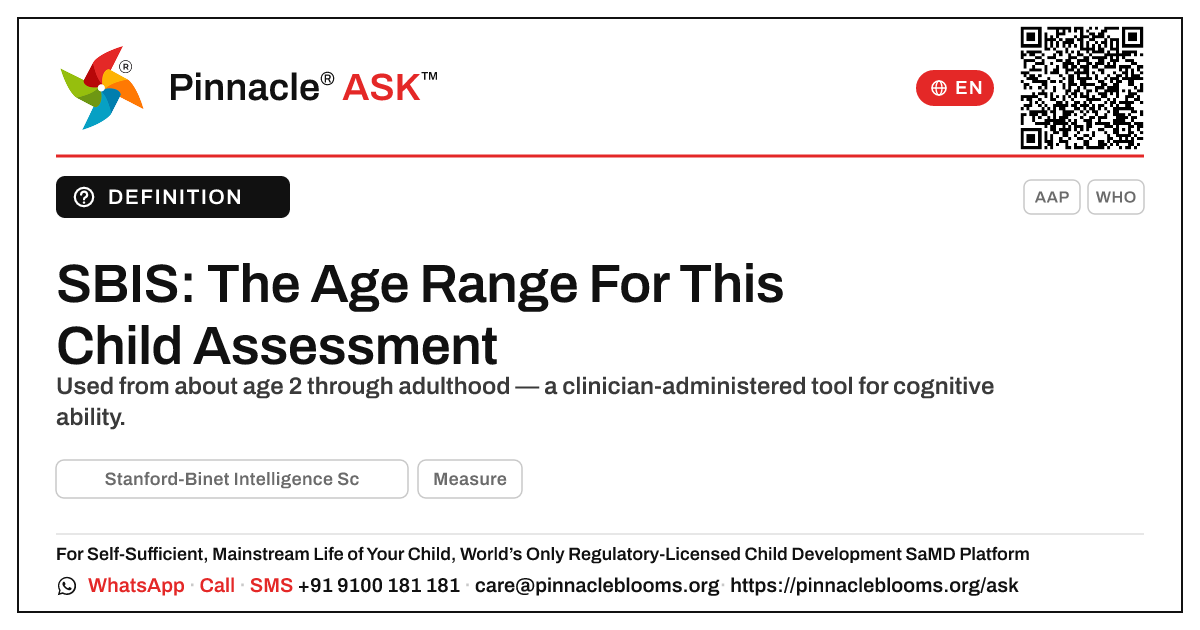
YOUR QUESTION. A CLEARER NEXT STEP.
At what age is the SBIS used for a child?
The Stanford-Binet Intelligence Scales (SBIS), in its current fifth edition, is designed for use from about 2 years of age through adulthood (roughly 2 to 85+ years), so for children it can be used from the toddler years onward. It is a clinician-administered assessment of cognitive ability — reasoning, memory, visual-spatial and early number thinking — with tasks chosen to suit the child's developmental stage. It is one tool among several, always interpreted alongside a child's history and everyday functioning, never as a standalone label.
In this answer 5 sections
One of the most widely used tools for understanding how a child learns and reasons — and it stretches across almost the whole lifespan.
In short
The Stanford-Binet Intelligence Scales (SBIS), in its current fifth edition, is designed for use from around 2 years of age right through adulthood — typically quoted as ages 2 to 85+ years. So for children, it can be administered from the toddler years onward, with age-appropriate tasks chosen to match the child's developmental stage. It is a clinician-administered assessment of cognitive ability, not a quick screen or an app-based quiz.
What the SBIS actually looks at
The SBIS is a structured, one-to-one assessment carried out by a trained professional. Rather than a single "IQ number" alone, it explores several threads of thinking together — reasoning with words and without words, working memory, the ability to solve visual and spatial puzzles, and quantitative (early number) thinking. For younger children the tasks are playful and concrete — pointing, matching, building — while older children and adults meet more abstract problems. Because it spans such a wide age range, the assessor selects a starting point suited to the child's age and ability, so a toddler and a teenager each meet tasks that are meaningful for them.
How it fits into understanding a child
The SBIS is one instrument among several a clinician may draw on to understand a child's cognitive strengths and the areas where support may help. It is most useful when interpreted alongside a child's developmental history, everyday functioning, language and play — never in isolation, and never as a label. A single test result is a snapshot, not the whole child.
The Pinnacle way
This is general information, not a diagnosis — a clinical AbilityScore® and any diagnosis are formed only at a Pinnacle Blooms Network centre, under qualified clinician care, never from an app or form. Where a tool such as the Stanford-Binet Intelligence Scales is helpful, our clinicians choose and interpret it as part of a fuller picture, drawing on child psychology support as needed.
Trusted sources
American Academy of Pediatrics and HealthyChildren guidance on developmental and cognitive assessment in childhood; WHO Nurturing Care Framework on supporting early childhood development. Always paraphrased and used to frame, never to diagnose.
Next step — If you would like to understand your child's learning and thinking strengths, book a developmental assessment so a qualified clinician can choose the right tools and build a plan together.
CONNECT THE ANSWER TO YOUR CHILD’S DAY
Something to notice. Something to discuss.
What to notice
Remember the SBIS is a clinician-administered tool, not a home test — a single score is a snapshot, so look for it being interpreted alongside your child's history, language, play and everyday functioning rather than read in isolation.
In everyday life
Before any formal assessment, simply notice and note how your child reasons in daily play — how they solve puzzles, follow instructions or use words to explain things — these everyday observations help a clinician build the fullest picture.
Bring your observations and questions to your child’s professional. Choose activities that suit your child’s comfort, abilities and agreed plan.
Bring your questions to a first visitQuestions families ask
What age range is the Stanford-Binet (SBIS) used for?
The current fifth edition is designed for ages from about 2 years through adulthood — commonly quoted as 2 to 85+ years. For children, it can be administered from the toddler years onward, with tasks matched to the child's developmental stage.
Is the SBIS a diagnosis?
No. The SBIS is a clinician-administered assessment of cognitive ability, not a diagnosis. It is interpreted alongside a child's history, language, play and everyday functioning, and any diagnosis is formed only by a qualified clinician.
Can I do the SBIS at home or online?
No. The SBIS must be administered one-to-one by a trained professional who selects an age-appropriate starting point and interprets the results in context. It is not an app or self-test.
FOLLOW THE SOURCE
References behind this answer.
- Organisation website · further readingAAP HealthyChildren: developmental and cognitive assessment
- Organisation website · further readingWHO Nurturing Care Framework: early childhood development
References are supplied with this answer. An organisation homepage offers further reading; it does not establish an independent review of this page.
Content attribution: SETU Consortium · Pinnacle Blooms Network.
PEOPLE, TOPICS & DEVELOPMENT
See the connections.
Browse the wider question collections connected with this answer’s audience, developmental area and stage.
FROM UNDERSTANDING TO PURPOSEFUL SUPPORT
One question. Your child’s whole life.
Your child’s self-sufficient, mainstream-included life is the purpose from the beginning. At Pinnacle, that purpose shapes what we understand, the goals we choose, the people we bring together, everyday practice and review.
Connect this question with the right support.
Explore how the relevant service contributes to everyday abilities, then speak with us about your child.
Make the next conversation useful.
Bring the situations you notice at home or school. We’ll explain a suitable service, centre and first visit, including availability and fees, before you decide.
How PinnacleAI® connects the journeyExplore the seven stages
- 1Understand abilities
A starting picture of your child’s capabilities.
- 2Choose meaningful goals
Readiness and a plan shaped around the child.
- 3Bring the right support together
Suitable therapies and people for those goals.
- 4Carry practice into everyday life
Guidance for family, home and school.
- 5Track and correct
Use observations to adjust the plan.
- 6Reassess and review
Decide what to continue, change or do next.
- 7Grow independence and participation
The child’s life gives each step its purpose.
Explore the whole PinnacleAI® system → · Participation at school and in the community →
PINNACLE’S EVIDENCE, OPEN TO YOU
Look at the evidence behind our work.
Read our research, inspect the original regulatory documents and check what each institutional measure means.
General information supports a conversation with an appropriately qualified professional. Advice, goals and support depend on the individual child.