
YOUR QUESTION. A CLEARER NEXT STEP.
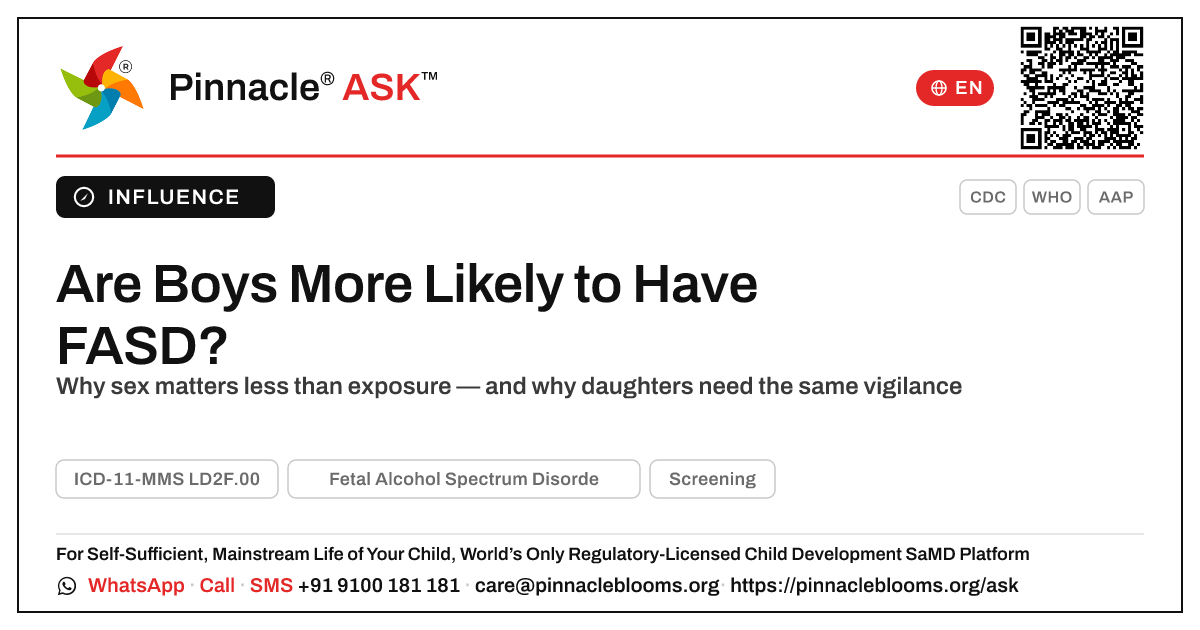
Are boys more likely to have FASD?
FASD affects boys and girls alike — there is no strong evidence boys are biologically more at risk. Apparent higher rates in boys often reflect earlier referral for behaviour, not true vulnerability. What matters most is prenatal alcohol exposure, which is fully preventable, and both sons and daughters deserve equal vigilance and a developmental check if there are concerns.
In this answer 5 sections
Many parents ask whether sons are simply more at risk — so let's separate the biology from the diagnosis story.
In short
Fetal Alcohol Spectrum Disorder (FASD) is caused by alcohol exposure during pregnancy, and it can affect a baby of any sex. Boys and girls are both vulnerable when there is prenatal alcohol exposure — the difference researchers see is mostly in how it shows up and in who tends to get identified, not in a fundamentally higher biological risk for boys. The single most important fact remains: FASD is fully preventable when pregnancy is alcohol-free, and it is never the child's or mother's fault to carry alone.
What the science actually says
FASD is not sex-specific in the way some conditions are. The prenatal alcohol that crosses the placenta affects the developing brain regardless of whether the baby is a boy or a girl. Some studies report boys being identified slightly more often, but this largely reflects referral patterns — boys' behavioural and attention difficulties tend to prompt earlier assessment, while girls' presentations can be quieter and missed. So an apparent "boy bias" in clinics is often a detection effect, not a true difference in vulnerability.
What matters far more than sex is the timing, amount and pattern of alcohol exposure during pregnancy, alongside genetics, nutrition and the overall caregiving environment. Two children with similar exposure can show very different profiles — and a girl with FASD deserves exactly the same vigilance and support as a boy.
When to seek a developmental check
If there is any known prenatal alcohol exposure — or you simply notice differences in your child's growth, attention, learning, coordination or social connection — a structured developmental check is the right next step, for sons and daughters equally. Early support reshapes outcomes more than any single risk factor.
The Pinnacle way
AbilityScore® is part of Pinnacle’s developmental assessment. Diagnosis, where needed, requires an appropriately qualified healthcare professional — never from an article or an online form. Backed by 2.5 billion+ data points and 25 million+ therapy sessions across 70+ centres, our clinicians look at the whole child, not a single label. Start with a clear picture of your child's strengths, explore therapy that supports learning and attention, or begin your family's journey here.
Trusted sources
CDC guidance on Fetal Alcohol Spectrum Disorders and prevention; WHO ICD-11 classification of FASD; American Academy of Pediatrics developmental surveillance guidance.
Next step — Whether you have a son or a daughter, book a developmental check with a Pinnacle clinician and turn worry into a clear plan.
This is general information, not a diagnosis — individual assessment and diagnosis require an appropriately qualified healthcare professional.
CONNECT THE ANSWER TO YOUR CHILD’S DAY
Something to notice. Something to discuss.
What to notice
Watch for differences in attention, learning, growth, coordination or social connection — in both sons and daughters — especially where there was any prenatal alcohol exposure. Quieter presentations in girls are easy to miss, so trust your instinct and seek a check.
In everyday life
Don't let your child's sex change how closely you watch their development. If something feels different, note specific examples — a short list of what you see helps a clinician far more than worry alone.
Bring your observations and questions to your child’s professional. Choose activities that suit your child’s comfort, abilities and agreed plan.
Bring your questions to a first visitQuestions families ask
Is FASD more common in boys than girls?
There is no strong evidence that boys are biologically more likely to have FASD. Both are affected by prenatal alcohol exposure. Boys are sometimes identified more often because their behavioural difficulties prompt earlier assessment — a detection effect, not a true difference in risk.
Why might girls with FASD be missed?
Girls' presentations can be quieter — with less obvious behavioural or attention difficulties — so they may not be referred as readily. This means a true diagnosis can be delayed, which is why equal vigilance for daughters matters.
What actually raises the risk of FASD?
The timing, amount and pattern of alcohol during pregnancy matter far more than the baby's sex, alongside genetics and nutrition. FASD is fully preventable when pregnancy is alcohol-free.
Can FASD be diagnosed from an article or online?
No. Developmental measurement supports care planning; diagnosis requires an appropriately qualified healthcare professional., under qualified clinician care, after a structured assessment of the whole child.
FOLLOW THE SOURCE
References behind this answer.
- Source referenceCDC — About Fetal Alcohol Spectrum Disorders
- Organisation website · further readingWHO ICD-11 — FASD classification
- Organisation website · further readingAAP HealthyChildren — developmental health
References are supplied with this answer. An organisation homepage offers further reading; it does not establish an independent review of this page.
Content attribution: SETU Consortium · Pinnacle Blooms Network.
PEOPLE, TOPICS & DEVELOPMENT
See the connections.
Browse the wider question collections connected with this answer’s audience, developmental area and stage.
FROM UNDERSTANDING TO PURPOSEFUL SUPPORT
One question. Your child’s whole life.
Your child’s self-sufficient, mainstream-included life is the purpose from the beginning. At Pinnacle, that purpose shapes what we understand, the goals we choose, the people we bring together, everyday practice and review.
Connect this question with the right support.
Start with your child’s strengths, your observations and what you want everyday life to become.
Make the next conversation useful.
Bring the situations you notice at home or school. We’ll explain a suitable service, centre and first visit, including availability and fees, before you decide.
How PinnacleAI® connects the journeyExplore the seven stages
- 1Understand abilities
A starting picture of your child’s capabilities.
- 2Choose meaningful goals
Readiness and a plan shaped around the child.
- 3Bring the right support together
Suitable therapies and people for those goals.
- 4Carry practice into everyday life
Guidance for family, home and school.
- 5Track and correct
Use observations to adjust the plan.
- 6Reassess and review
Decide what to continue, change or do next.
- 7Grow independence and participation
The child’s life gives each step its purpose.
Explore the whole PinnacleAI® system → · Participation at school and in the community →
PINNACLE’S EVIDENCE, OPEN TO YOU
Look at the evidence behind our work.
Read our research, inspect the original regulatory documents and check what each institutional measure means.
General information supports a conversation with an appropriately qualified professional. Advice, goals and support depend on the individual child.