
YOUR QUESTION. A CLEARER NEXT STEP.
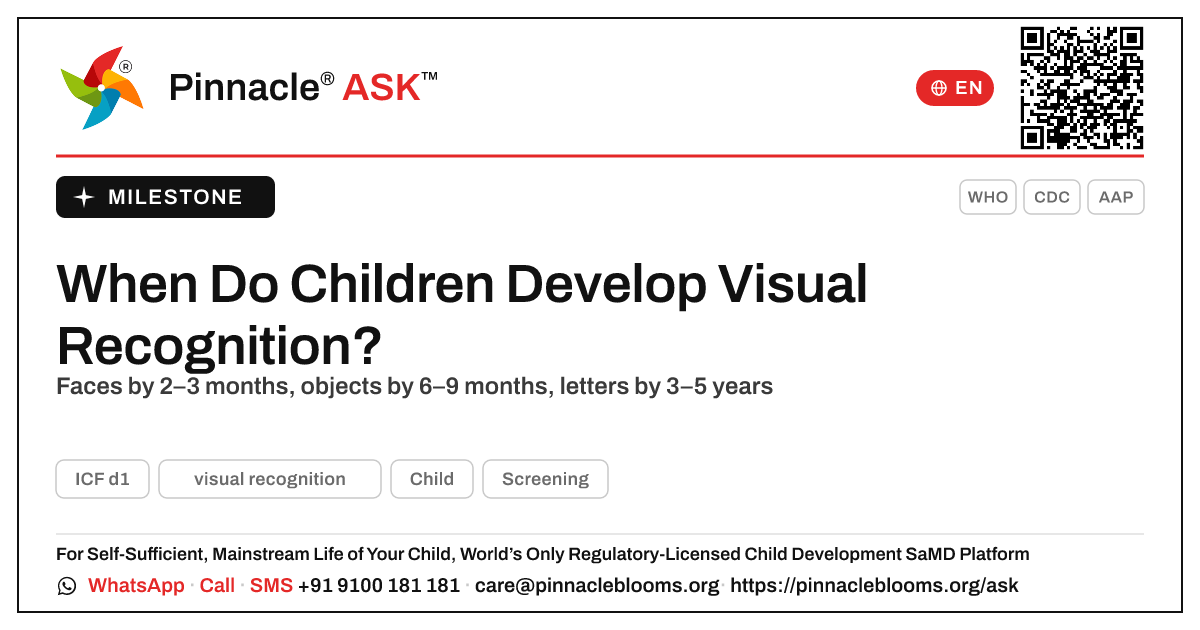
When Do Children Develop Visual Recognition?
Most babies recognise a parent's face by 2–3 months, familiar objects by 6–9 months, and pictures by their first birthday. By 3–5 years children reliably recognise letters, shapes, colours and symbols — the visual foundations for reading. Timing varies widely and a range is normal.
In this answer 5 sections
The moment your baby's face lights up at the sight of you — that flicker of recognition is one of the earliest signs of a thinking, learning mind.
In short
Visual recognition begins remarkably early: most babies recognise a parent's face by 2–3 months, familiar objects and toys by 6–9 months, and pictures in a book by their first birthday. By 3 to 5 years, children reliably recognise letters, shapes, colours and familiar symbols — the visual foundations that prepare them for reading and learning. Every child grows at their own pace, and a range of timing is perfectly normal.
How visual recognition unfolds
- 2–3 months — fixes on and recognises a caregiver's face; tracks moving faces and objects
- 6–9 months — recognises familiar toys, bottles and people; notices when something looks different
- 12–18 months — points to pictures in a book when named; recognises familiar photos
- 2–3 years — matches shapes and colours; recognises familiar logos and symbols
- 3–5 years — names colours, recognises some letters and numbers, completes simple puzzles
The science
Visual recognition is a cognitive skill (ICF d1, learning and applying knowledge) — the brain learning to make sense of what the eyes see. It builds on visual memory and attention, and is closely linked to early literacy. Tools like the Bayley-4 map these milestones in structured ways so subtle delays can be spotted early, when support works best.
The Pinnacle way
Developmental measurement supports care planning; diagnosis requires an appropriately qualified healthcare professional., under qualified clinician care — never from an online list. If you'd like a closer look at your child's visual recognition and learning skills, our team can help through special education support and a structured AbilityScore® assessment.
Trusted sources
Guided by WHO ICF (d1, learning and applying knowledge), CDC developmental milestone guidance, and the American Academy of Pediatrics' HealthyChildren resources on early cognitive growth.
Next step — if you're curious about how your child is recognising faces, pictures and letters, book a friendly developmental check with the Pinnacle team on WhatsApp: +91 91001 81181.
This is general information, not a diagnosis — individual assessment and diagnosis require an appropriately qualified healthcare professional.
CONNECT THE ANSWER TO YOUR CHILD’S DAY
Something to notice. Something to discuss.
What to notice
Gentle check-in moments: a baby who doesn't fix on faces by 3 months, doesn't recognise familiar people by 9 months, or a preschooler not recognising any colours or familiar shapes by 4 years is worth a friendly developmental review — not a cause for alarm, but a good reason to ask.
In everyday life
Share a picture book daily and pause to ask 'Where's the dog?' or 'Show me the red one' — naming and pointing builds visual recognition through warm, repeated play.
Bring your observations and questions to your child’s professional. Choose activities that suit your child’s comfort, abilities and agreed plan.
Bring your questions to a first visitQuestions families ask
At what age does a baby recognise their mother's face?
Most babies begin recognising a parent's face by 2–3 months, often greeting you with a bright smile. They learn faces through closeness, feeding and everyday gaze long before they recognise objects.
When do children recognise colours and shapes?
Many children match colours and shapes around 2–3 years and can name several colours and recognise simple shapes by 3–4 years. These skills build steadily through play and vary from child to child.
Should I worry if my 4-year-old doesn't recognise letters?
Not necessarily — letter recognition develops between 3 and 5 years and later for some children. If a preschooler also struggles to recognise colours, shapes or familiar pictures, a gentle developmental check is reassuring and worthwhile.
FOLLOW THE SOURCE
References behind this answer.
- Organisation website · further readingWHO ICF — learning and applying knowledge (d1)
- Source referenceCDC developmental milestone guidance
- Organisation website · further readingAAP HealthyChildren — early cognitive development
References are supplied with this answer. An organisation homepage offers further reading; it does not establish an independent review of this page.
Content attribution: SETU Consortium · Pinnacle Blooms Network.
PEOPLE, TOPICS & DEVELOPMENT
See the connections.
Browse the wider question collections connected with this answer’s audience, developmental area and stage.
FROM UNDERSTANDING TO PURPOSEFUL SUPPORT
One question. Your child’s whole life.
Your child’s self-sufficient, mainstream-included life is the purpose from the beginning. At Pinnacle, that purpose shapes what we understand, the goals we choose, the people we bring together, everyday practice and review.
Connect this question with the right support.
Start with your child’s strengths, your observations and what you want everyday life to become.
Make the next conversation useful.
Bring the situations you notice at home or school. We’ll explain a suitable service, centre and first visit, including availability and fees, before you decide.
How PinnacleAI® connects the journeyExplore the seven stages
- 1Understand abilities
A starting picture of your child’s capabilities.
- 2Choose meaningful goals
Readiness and a plan shaped around the child.
- 3Bring the right support together
Suitable therapies and people for those goals.
- 4Carry practice into everyday life
Guidance for family, home and school.
- 5Track and correct
Use observations to adjust the plan.
- 6Reassess and review
Decide what to continue, change or do next.
- 7Grow independence and participation
The child’s life gives each step its purpose.
Explore the whole PinnacleAI® system → · Participation at school and in the community →
PINNACLE’S EVIDENCE, OPEN TO YOU
Look at the evidence behind our work.
Read our research, inspect the original regulatory documents and check what each institutional measure means.
General information supports a conversation with an appropriately qualified professional. Advice, goals and support depend on the individual child.