
YOUR QUESTION. A CLEARER NEXT STEP.
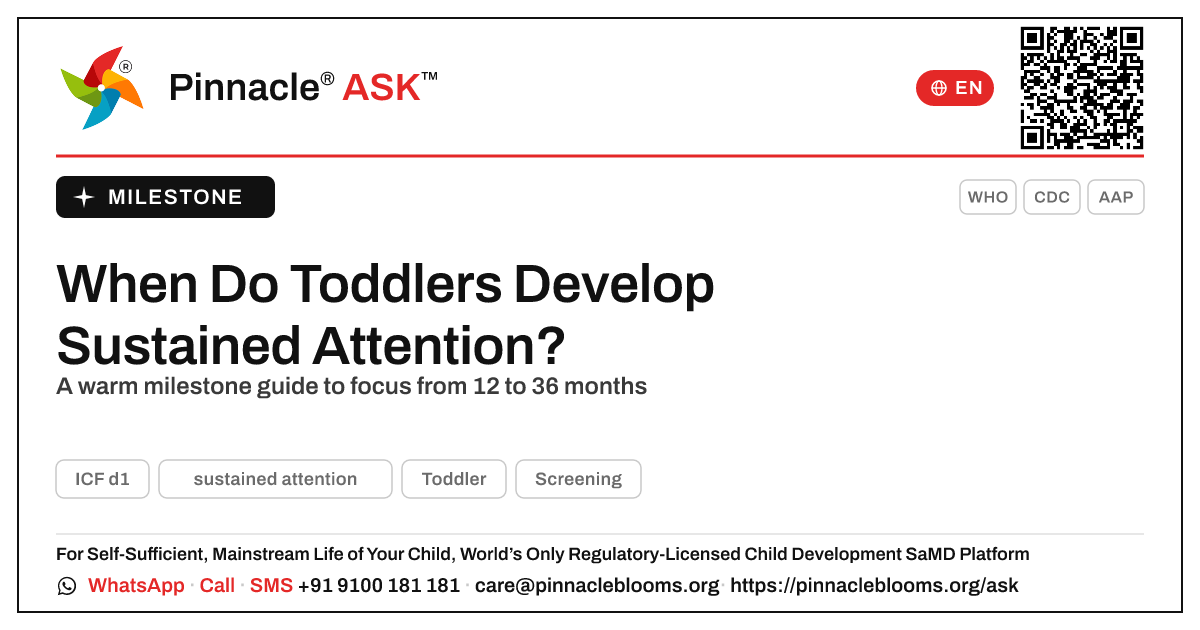
When do toddlers develop sustained attention?
Sustained attention grows gradually in toddlers: about 1–2 minutes at 12 months, 3–6 minutes by 2 years, and 5–10 minutes by 3 years, usually with an adult nearby. Short, flitting attention is normal at this age, and formal attention concerns like ADHD aren't meaningfully assessed in toddlers.
In this answer 4 sections
Attention in a toddler isn't a switch that flips on — it's a muscle that grows a little stronger every month.
In short
Sustained attention — the ability to stay focused on one activity — emerges gradually through the toddler years. Most 1-year-olds focus for only a minute or two, by 2 years many can stay with a favourite task for 3–6 minutes, and by 3 years a child may hold attention for around 5–10 minutes, often still needing an adult nearby. Short, flitting attention at this age is completely normal, not a warning sign.
The science of toddler attention
In the first years, attention is mostly captured by what's interesting — bright, novel, moving things pull a child in. Truly sustained attention, where a child chooses to stay and ignores distractions, develops slowly as the brain's control systems mature.
Rough toddler guide (ICF d1, learning and applying knowledge):
- 12–18 months — focuses briefly, easily distracted, moves often
- 18–24 months — plays with one toy for a few minutes, still flits
- 24–36 months — sticks with a favourite activity for 5–10 minutes
Ranges are wide and normal. A lively, busy toddler is not a worrying one — formal attention concerns like ADHD are not meaningfully assessed at this age, so the watch-and-monitor stance is right.
The Pinnacle way
Developmental measurement supports care planning; diagnosis requires an appropriately qualified healthcare professional. under qualified clinician care — never from a website or screen. If attention feels very different from same-age peers across home and play, a gentle developmental check gives clarity, and occupational therapy can build focus through play when needed.
Trusted sources
Guided by WHO ICF (d1, applying knowledge), CDC developmental milestones, and the American Academy of Pediatrics guidance on early attention and play.
Next step — if you're curious about your toddler's focus, message our team on WhatsApp for a warm, no-pressure developmental check.
This is general information, not a diagnosis — individual assessment and diagnosis require an appropriately qualified healthcare professional.
CONNECT THE ANSWER TO YOUR CHILD’S DAY
Something to notice. Something to discuss.
What to notice
Watch for attention that is far shorter than same-age peers across many settings, paired with very limited play, no interest in shared activities, or loss of skills — these point to a general developmental check rather than worry about attention alone.
In everyday life
Build focus in tiny doses: sit with your toddler for one short activity — stacking blocks or a picture book — follow their interest, and stop before they get restless. A minute of shared, joyful focus today becomes longer focus over months.
Bring your observations and questions to your child’s professional. Choose activities that suit your child’s comfort, abilities and agreed plan.
Bring your questions to a first visitQuestions families ask
How long can a 2-year-old focus on one thing?
Many 2-year-olds can stay with a favourite activity for about 3–6 minutes, often still glancing around or moving between toys. Wide variation is normal.
Is it normal for my toddler to flit between toys constantly?
Yes. Short, shifting attention is typical in the toddler years — attention is still 'captured' by novelty more than chosen. Focus lengthens gradually as the brain matures.
Can ADHD be diagnosed in a toddler?
ADHD is not meaningfully assessed in toddlers. Brief, busy attention is age-appropriate. If attention seems very different across all settings, a general developmental check is the right step.
FOLLOW THE SOURCE
References behind this answer.
- Organisation website · further readingWHO ICF — applying knowledge and attention (d1)
- Source referenceCDC developmental milestones
- Organisation website · further readingAAP HealthyChildren — early play and attention
References are supplied with this answer. An organisation homepage offers further reading; it does not establish an independent review of this page.
Content attribution: SETU Consortium · Pinnacle Blooms Network.
PEOPLE, TOPICS & DEVELOPMENT
See the connections.
Browse the wider question collections connected with this answer’s audience, developmental area and stage.
FROM UNDERSTANDING TO PURPOSEFUL SUPPORT
One question. Your child’s whole life.
Your child’s self-sufficient, mainstream-included life is the purpose from the beginning. At Pinnacle, that purpose shapes what we understand, the goals we choose, the people we bring together, everyday practice and review.
Connect this question with the right support.
Start with your child’s strengths, your observations and what you want everyday life to become.
Make the next conversation useful.
Bring the situations you notice at home or school. We’ll explain a suitable service, centre and first visit, including availability and fees, before you decide.
How PinnacleAI® connects the journeyExplore the seven stages
- 1Understand abilities
A starting picture of your child’s capabilities.
- 2Choose meaningful goals
Readiness and a plan shaped around the child.
- 3Bring the right support together
Suitable therapies and people for those goals.
- 4Carry practice into everyday life
Guidance for family, home and school.
- 5Track and correct
Use observations to adjust the plan.
- 6Reassess and review
Decide what to continue, change or do next.
- 7Grow independence and participation
The child’s life gives each step its purpose.
Explore the whole PinnacleAI® system → · Participation at school and in the community →
PINNACLE’S EVIDENCE, OPEN TO YOU
Look at the evidence behind our work.
Read our research, inspect the original regulatory documents and check what each institutional measure means.
General information supports a conversation with an appropriately qualified professional. Advice, goals and support depend on the individual child.