
YOUR QUESTION. A CLEARER NEXT STEP.
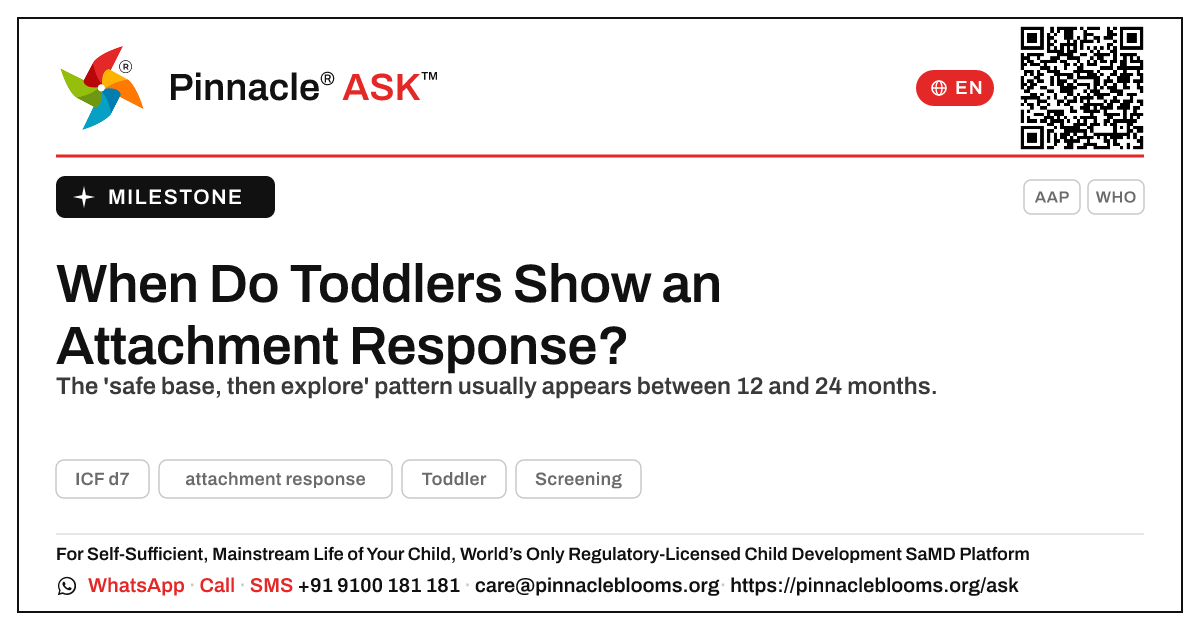
When do children usually show an attachment response?
Babies show early preference for familiar caregivers from 6–9 months, but a clear attachment response — seeking comfort, protesting separation, and using a caregiver as a safe base to explore — usually becomes obvious between 12 and 24 months, settling further by age 2 to 3. Every child's pace differs.
In this answer 5 sections
The first time your toddler runs to you for comfort and then back out to explore — that is attachment in action, quietly building.
In short
The first signs of attachment appear in early infancy, but a clear, organised attachment response — seeking out a familiar caregiver for comfort, protesting brief separations, and using you as a 'safe base' to explore from — usually becomes obvious between 12 and 24 months. By around 2 to 3 years most toddlers comfort more easily, manage short partings, and reconnect warmly after time apart. Every child's pace differs, and this is a relationship that grows, not a single switch.
How attachment unfolds
- 6–9 months — your baby shows clear preference for familiar faces and may grow wary of strangers.
- 9–18 months — separation protest and joyful reunions appear; your child checks back to you while exploring.
- 18–36 months — the toddler uses you as a secure base, seeks comfort when upset, and begins to wait and trust that you will return.
This 'safe base, then explore' pattern is the everyday sign that attachment is doing its job — building the confidence a child needs to learn and connect. Read more on attachment response.
When to seek a check
If, past 18–24 months, your toddler rarely seeks you for comfort, shows little response to separation or reunion, or seems equally at ease with strangers and with you, a gentle developmental check is worthwhile — not as alarm, but as reassurance and early support.
The Pinnacle way
Developmental measurement supports care planning; diagnosis requires an appropriately qualified healthcare professional. under qualified clinician care — never from a web page. Our team supports families with warm, structured guidance through early-intervention therapy and an objective baseline via the AbilityScore®.
Trusted sources
Guided by the WHO ICF (d7 interpersonal interactions), the AAP and HealthyChildren.org on social-emotional milestones, and the WHO Nurturing Care Framework on responsive caregiving.
Next step — if you have any questions about how your toddler connects, reach our team on WhatsApp at +91 91001 81181 for a friendly developmental check.
This is general information, not a diagnosis — individual assessment and diagnosis require an appropriately qualified healthcare professional.
CONNECT THE ANSWER TO YOUR CHILD’S DAY
Something to notice. Something to discuss.
What to notice
Past 18–24 months, note if your toddler rarely seeks you for comfort, shows little reaction to separation or reunion, or is equally at ease with strangers as with you — a gentle developmental check is then worthwhile.
In everyday life
When your toddler is upset, offer calm closeness and let them return to play in their own time — this 'comfort then explore' rhythm strengthens secure attachment every day.
Bring your observations and questions to your child’s professional. Choose activities that suit your child’s comfort, abilities and agreed plan.
Bring your questions to a first visitQuestions families ask
At what age does separation anxiety start?
Separation protest commonly appears between 9 and 18 months, when your child clearly prefers you and notices when you step away. It is a normal, expected sign that healthy attachment is forming, and it usually eases as your toddler learns you always return.
Is it normal for my toddler to cling to me and then run off to play?
Yes — this 'safe base' pattern is exactly what secure attachment looks like. Your toddler draws confidence from you, explores, then checks back. It shows the relationship is working well.
Should I worry if my 2-year-old does not seem upset when I leave?
Some toddlers are naturally easy-going, but if your child rarely seeks comfort, shows little reaction to separation or reunion, or treats strangers just like you, a gentle developmental check can offer reassurance and early support if needed.
FOLLOW THE SOURCE
References behind this answer.
- Organisation website · further readingAAP HealthyChildren.org — social-emotional milestones
- Organisation website · further readingWHO Nurturing Care Framework — responsive caregiving
- Organisation website · further readingWHO ICF — interpersonal interactions (d7)
References are supplied with this answer. An organisation homepage offers further reading; it does not establish an independent review of this page.
Content attribution: SETU Consortium · Pinnacle Blooms Network.
PEOPLE, TOPICS & DEVELOPMENT
See the connections.
Browse the wider question collections connected with this answer’s audience, developmental area and stage.
FROM UNDERSTANDING TO PURPOSEFUL SUPPORT
One question. Your child’s whole life.
Your child’s self-sufficient, mainstream-included life is the purpose from the beginning. At Pinnacle, that purpose shapes what we understand, the goals we choose, the people we bring together, everyday practice and review.
Connect this question with the right support.
Start with your child’s strengths, your observations and what you want everyday life to become.
Make the next conversation useful.
Bring the situations you notice at home or school. We’ll explain a suitable service, centre and first visit, including availability and fees, before you decide.
How PinnacleAI® connects the journeyExplore the seven stages
- 1Understand abilities
A starting picture of your child’s capabilities.
- 2Choose meaningful goals
Readiness and a plan shaped around the child.
- 3Bring the right support together
Suitable therapies and people for those goals.
- 4Carry practice into everyday life
Guidance for family, home and school.
- 5Track and correct
Use observations to adjust the plan.
- 6Reassess and review
Decide what to continue, change or do next.
- 7Grow independence and participation
The child’s life gives each step its purpose.
Explore the whole PinnacleAI® system → · Participation at school and in the community →
PINNACLE’S EVIDENCE, OPEN TO YOU
Look at the evidence behind our work.
Read our research, inspect the original regulatory documents and check what each institutional measure means.
General information supports a conversation with an appropriately qualified professional. Advice, goals and support depend on the individual child.