
YOUR QUESTION. A CLEARER NEXT STEP.
When children move from pretend play to symbolic thinking
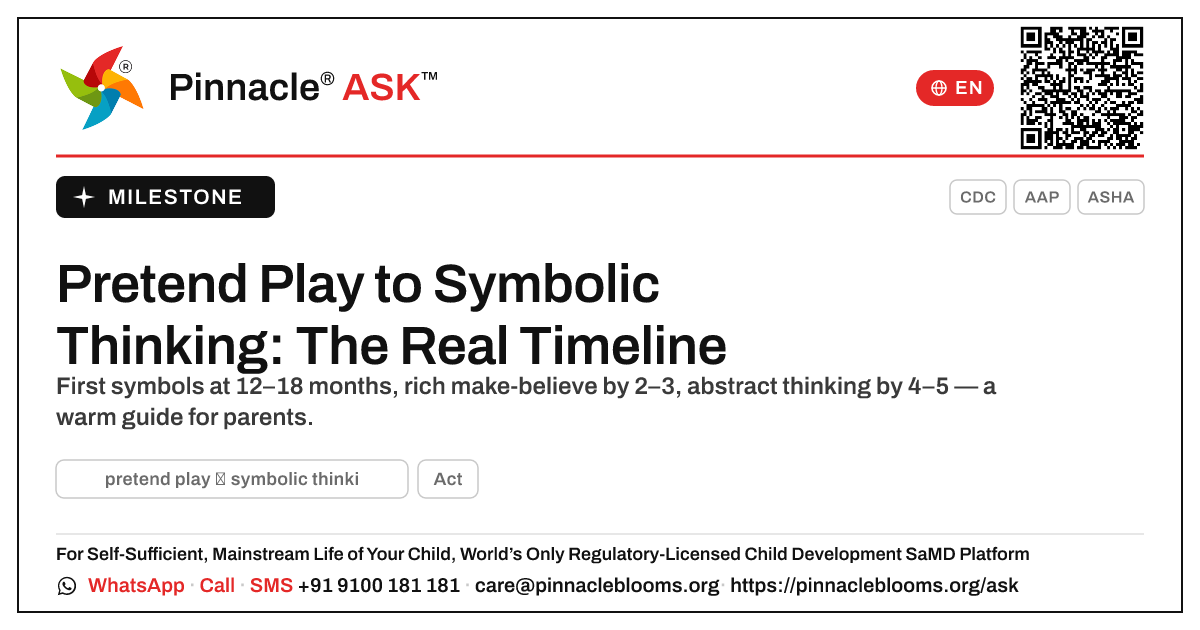
Pretend play is symbolic thinking in action — the same skill unfolding. First symbols appear around 12–18 months, make-believe flourishes by 2–3 years, and abstract symbol-use (words, drawings, numbers, stories) matures by 4–5 years. Ranges are wide; steady progress matters more than exact months.
In this answer 5 sections
The teddy that becomes a patient, the banana that becomes a phone — these tiny moments are your child's mind learning that one thing can stand for another.
In short
Pretend play is symbolic thinking in action — they aren't two separate stages but one unfolding skill. The shift usually begins around 12–18 months (using a real object for its purpose, then on a doll), blossoms into rich make-believe by 2–3 years, and matures into flexible, abstract symbol-use — words, drawings, numbers, imagined stories — by 4–5 years. There's a wide, normal range; what matters is steady forward movement, not the exact month.
How the journey unfolds
Around 12–18 months — first symbols
- Pretends to drink from an empty cup, or feeds a spoon to a doll
- Uses a real phone, then a toy phone, then a block "as" a phone
- First true words appear — themselves symbols, sounds standing for meaning
Around 2–3 years — pretend play flourishes
- One object freely stands for another (a stick becomes a sword, a box becomes a car)
- Acts out little sequences: cooking, putting teddy to bed, going to the shop
- Begins to assign roles and feelings to toys ("dolly is sad")
Around 3–5 years — symbolic thinking deepens
- Rich imaginary scenarios, invented friends, role-play with other children
- Symbols become more abstract — scribbles "are" writing, drawings represent ideas, counting represents quantity
- This same symbolic capacity underpins later reading, maths and storytelling
When to have a friendly check
Pretend play is one of the most reassuring windows into a child's thinking. It's worth a gentle developmental check if, by around 24 months, you see little or no make-believe, no use of objects to stand for others, and limited interest in imitating everyday actions — especially alongside few words or limited back-and-forth interaction. This isn't cause for alarm; it's simply a good moment to look more closely with someone who knows development well.
The Pinnacle way
A clinical AbilityScore® and any diagnosis are formed only at a Pinnacle Blooms Network centre under qualified clinician care — never from an online article. If you'd like to understand how your child's play, language and thinking are developing, our team can map a complete picture across domains and, where helpful, support play and language through occupational therapy and speech therapy.
Trusted sources
Guided by developmental milestone frameworks from the CDC's "Learn the Signs. Act Early." programme, the American Academy of Pediatrics' HealthyChildren guidance, and ASHA resources on play and language. These describe play and symbolic milestones as overlapping ranges, not fixed deadlines.
Next step — to see how your child's play and thinking are tracking, book a developmental check with the Pinnacle team on WhatsApp: +91 91001 81181.
This is general information, not a diagnosis — individual assessment and diagnosis require an appropriately qualified healthcare professional.
CONNECT THE ANSWER TO YOUR CHILD’S DAY
Something to notice. Something to discuss.
What to notice
By around 24 months, look for make-believe play and using one object to stand for another (a block as a phone). Little pretend play alongside few words or limited back-and-forth interaction is a good reason for a gentle developmental check — not alarm.
In everyday life
Offer open-ended props — a box, a cloth, wooden blocks — and follow your child's lead. When you 'feed' the teddy or 'answer' a banana-phone, you're modelling that one thing can stand for another, the seed of symbolic thinking.
Bring your observations and questions to your child’s professional. Choose activities that suit your child’s comfort, abilities and agreed plan.
Bring your questions to a first visitQuestions families ask
At what age should pretend play start?
First signs usually appear around 12–18 months — pretending to drink from an empty cup, or feeding a doll. Richer make-believe with one object standing for another typically blossoms between 2 and 3 years. Ranges are wide and normal.
Is pretend play the same as symbolic thinking?
Essentially yes — pretend play is symbolic thinking made visible. When a child lets a block 'be' a phone, they're using one thing to represent another, which is the heart of symbolic thought and later underpins words, drawings and numbers.
My 2-year-old doesn't pretend much. Should I worry?
Not necessarily — but it's a good reason for a gentle developmental check, especially if there's also limited language or back-and-forth interaction. A diagnosis is never made from an article; a Pinnacle clinician can map the full picture across domains.
How can I encourage symbolic play at home?
Offer open-ended props like boxes, cloths and blocks, follow your child's lead, and join in — narrate what teddy is doing, take a 'phone call', set up a pretend tea party. Everyday play is the most powerful support.
FOLLOW THE SOURCE
References behind this answer.
- Source referenceCDC — Learn the Signs. Act Early. (developmental milestones)
- Source referenceAAP HealthyChildren — toddler development and play
- Source referenceASHA — communication and play development
References are supplied with this answer. An organisation homepage offers further reading; it does not establish an independent review of this page.
Content attribution: SETU Consortium · Pinnacle Blooms Network.
PEOPLE, TOPICS & DEVELOPMENT
See the connections.
Browse the wider question collections connected with this answer’s audience, developmental area and stage.
FROM UNDERSTANDING TO PURPOSEFUL SUPPORT
One question. Your child’s whole life.
Your child’s self-sufficient, mainstream-included life is the purpose from the beginning. At Pinnacle, that purpose shapes what we understand, the goals we choose, the people we bring together, everyday practice and review.
Connect this question with the right support.
Start with your child’s strengths, your observations and what you want everyday life to become.
Make the next conversation useful.
Bring the situations you notice at home or school. We’ll explain a suitable service, centre and first visit, including availability and fees, before you decide.
How PinnacleAI® connects the journeyExplore the seven stages
- 1Understand abilities
A starting picture of your child’s capabilities.
- 2Choose meaningful goals
Readiness and a plan shaped around the child.
- 3Bring the right support together
Suitable therapies and people for those goals.
- 4Carry practice into everyday life
Guidance for family, home and school.
- 5Track and correct
Use observations to adjust the plan.
- 6Reassess and review
Decide what to continue, change or do next.
- 7Grow independence and participation
The child’s life gives each step its purpose.
Explore the whole PinnacleAI® system → · Participation at school and in the community →
PINNACLE’S EVIDENCE, OPEN TO YOU
Look at the evidence behind our work.
Read our research, inspect the original regulatory documents and check what each institutional measure means.
General information supports a conversation with an appropriately qualified professional. Advice, goals and support depend on the individual child.