
YOUR QUESTION. A CLEARER NEXT STEP.
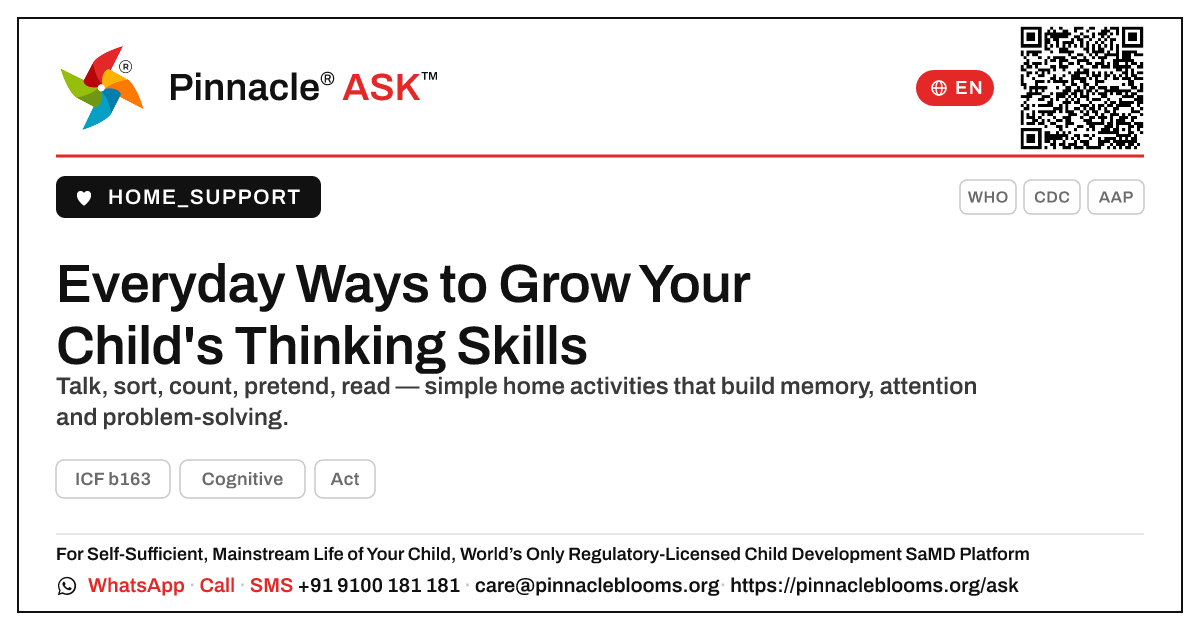
Simple Daily Activities to Build Your Child's Cognitive Skills
A child's thinking skills grow fastest through simple daily play — talking, sorting, counting, hide-and-find, pretend play and shared reading. Responsive back-and-forth interaction matters more than toys; little and often beats long sessions.
In this answer 5 sections
Some of the most powerful brain-building moments happen in your own kitchen, on the walk to the shop, at bedtime — not in a classroom.
In short
A child's cognitive skills — memory, attention, problem-solving, language and reasoning — grow fastest through everyday, playful interaction, not flashcards or screens. The richest ingredients are simple: talk, sort, count, hide-and-find, pretend, and read together each day. Little and often beats long and forced.
Simple daily activities that build thinking
Talk and narrate — describe what you're doing as you cook, dress or shop ("we need two red apples"). This grows vocabulary, sequencing and memory.
Sort and match — let your child group spoons, socks or coloured blocks. Sorting builds categorisation and early reasoning.
Hide-and-find games — hide a toy under a cup and ask "where is it?" This builds object permanence, attention and working memory.
Count everyday things — stairs, dal in a bowl, fingers. Counting in real life makes numbers meaningful.
Pretend play — cooking, shopkeeper, doctor. Make-believe stretches imagination, planning and flexible thinking.
Read and re-read — pause to ask "what happens next?". Shared books build attention, prediction and language together.
Give little choices — "banana or apple?" — small decisions build judgement and confidence.
The science, simply
Under the WHO ICF, cognitive function (b163) develops through repeated, responsive back-and-forth — what researchers call serve and return. Each time your child acts and you respond warmly, you strengthen the brain connections behind memory, attention and problem-solving. Routine, repetition and play matter more than any toy.
The Pinnacle way
Developmental measurement supports care planning; diagnosis requires an appropriately qualified healthcare professional. under qualified clinician care — never from a home checklist. To understand your child's cognitive strengths, explore occupational-therapy and learn what the AbilityScore® is and how it is calculated.
Trusted sources
Aligned with the WHO ICF framework for cognitive function, CDC "Learn the Signs. Act Early.", the American Academy of Pediatrics, and WHO Nurturing Care guidance on responsive caregiving and early learning.
Next step — pick just one activity above to try at the same time each day this week; to map your child's cognitive strengths, reach the Pinnacle team on WhatsApp: +91 91001 81181.
This is general information, not a diagnosis — individual assessment and diagnosis require an appropriately qualified healthcare professional.
CONNECT THE ANSWER TO YOUR CHILD’S DAY
Something to notice. Something to discuss.
What to notice
If your child rarely engages in back-and-forth play, struggles to follow simple instructions for their age, or you have ongoing concerns about memory, attention or problem-solving, arrange a general developmental check rather than waiting.
In everyday life
Narrate your day out loud — "now we pour the water, then we count three spoons". Everyday talk is one of the strongest, cheapest brain-builders there is.
Bring your observations and questions to your child’s professional. Choose activities that suit your child’s comfort, abilities and agreed plan.
Bring your questions to a first visitQuestions families ask
How much time a day do these activities need?
Just a few minutes at a time, woven into your normal routine. Short, frequent, playful moments are more effective than one long session, and far easier to keep up.
Are educational apps and screens good for cognitive development?
Real back-and-forth interaction with a caring adult builds thinking skills far more powerfully than screens. For young children, hands-on play, talk and reading together are recommended over passive screen time.
My child seems behind other children — should I worry?
Children develop at different paces, and everyday play helps all of them. If you have persistent concerns about memory, attention, language or problem-solving, a general developmental check can reassure you or guide next steps. A diagnosis is only ever made by a qualified clinician.
FOLLOW THE SOURCE
References behind this answer.
- Source referenceWHO — Early childhood development and nurturing care
- Source referenceCDC — Learn the Signs. Act Early.
- Organisation website · further readingAAP HealthyChildren — early learning and play
- Organisation website · further readingWHO ICF — cognitive function (b163)
References are supplied with this answer. An organisation homepage offers further reading; it does not establish an independent review of this page.
Content attribution: SETU Consortium · Pinnacle Blooms Network.
PEOPLE, TOPICS & DEVELOPMENT
See the connections.
Browse the wider question collections connected with this answer’s audience, developmental area and stage.
FROM UNDERSTANDING TO PURPOSEFUL SUPPORT
One question. Your child’s whole life.
Your child’s self-sufficient, mainstream-included life is the purpose from the beginning. At Pinnacle, that purpose shapes what we understand, the goals we choose, the people we bring together, everyday practice and review.
Connect this question with the right support.
Start with your child’s strengths, your observations and what you want everyday life to become.
Make the next conversation useful.
Bring the situations you notice at home or school. We’ll explain a suitable service, centre and first visit, including availability and fees, before you decide.
How PinnacleAI® connects the journeyExplore the seven stages
- 1Understand abilities
A starting picture of your child’s capabilities.
- 2Choose meaningful goals
Readiness and a plan shaped around the child.
- 3Bring the right support together
Suitable therapies and people for those goals.
- 4Carry practice into everyday life
Guidance for family, home and school.
- 5Track and correct
Use observations to adjust the plan.
- 6Reassess and review
Decide what to continue, change or do next.
- 7Grow independence and participation
The child’s life gives each step its purpose.
Explore the whole PinnacleAI® system → · Participation at school and in the community →
PINNACLE’S EVIDENCE, OPEN TO YOU
Look at the evidence behind our work.
Read our research, inspect the original regulatory documents and check what each institutional measure means.
General information supports a conversation with an appropriately qualified professional. Advice, goals and support depend on the individual child.