
YOUR QUESTION. A CLEARER NEXT STEP.
Progress a child with autism can make with special education
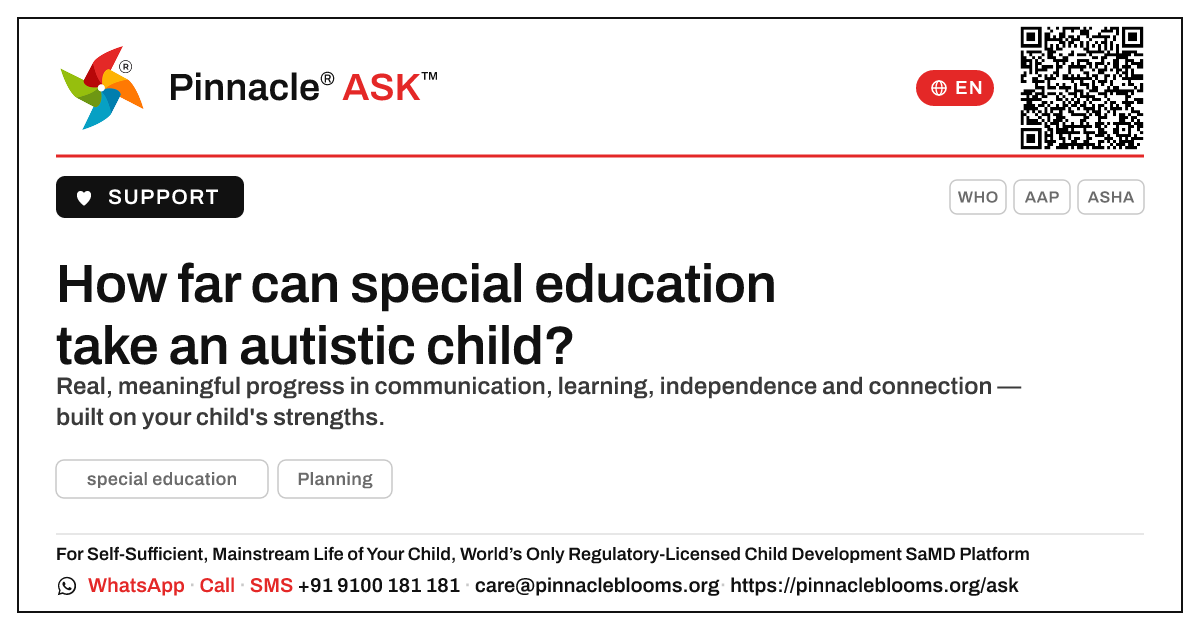
With well-matched, individualised special education, most children on the autism spectrum make meaningful progress in communication, learning, daily independence, social connection and emotional regulation — progress depends on the child's profile and consistency across home and school, and early support tends to bring the strongest gains. AbilityScore® is part of Pinnacle’s developmental assessment. Diagnosis, where needed, requires an appropriately qualified healthcare professional.
In this answer 5 sections
With the right special education, a child on the autism spectrum doesn't just "cope" — they learn, connect and surprise everyone, including themselves.
In short
With well-matched special education, most children on the autism spectrum make real, meaningful progress — in communication, learning, daily independence, social connection and managing big feelings. There is no single ceiling: progress depends on your child's individual profile, the right starting support and consistency across school and home. Early, individualised teaching tends to bring the strongest, most lasting gains, and many children steadily move towards more inclusive settings over time.
What progress can look like
Special education for autism is individualised teaching — small steps, clear structure, visual supports and goals shaped around how your child learns best. Real-world progress often includes:
- Communication — from first gestures, pictures or AAC to single words, sentences and back-and-forth conversation; many children who start non-speaking go on to communicate well in their own way.
- Learning & attention — building literacy, numeracy and the ability to focus, follow instructions and learn in a group.
- Daily living & independence — dressing, eating, toileting, routines and self-care skills that grow confidence.
- Social connection — turn-taking, play, friendships and understanding others — taught explicitly and gently.
- Emotional regulation — learning to recognise and manage overwhelm, with fewer meltdowns as coping tools grow.
Progress is rarely a straight line — children plateau, then leap. The aim is not to make a child "less autistic," but to remove barriers so their strengths can shine and they can take part in life on their own terms.
What helps progress
- Individualised goals — teaching matched to your child's strengths, interests and current level, not their age alone.
- A team around the child — special educators working alongside speech, occupational and behavioural therapists, with one shared plan.
- Consistency between home and school — strategies you use at home multiply what happens in the classroom.
- Starting where the child is ready — earlier, structured support generally builds stronger foundations, though children make progress at every age.
The Pinnacle way
AbilityScore® is part of Pinnacle’s developmental assessment. Diagnosis, where needed, requires an appropriately qualified healthcare professional — never from an app or online form. From there your child receives a precise developmental profile through a clinician-administered structured assessment, and a special-education plan built on their real strengths. Explore how special education and learning support works alongside speech therapy as part of one connected plan.
Trusted sources
WHO ICD-11 (autism spectrum disorder, 6A02); American Academy of Pediatrics (HealthyChildren.org) guidance on educational support for autistic children; American Speech-Language-Hearing Association guidance on communication support in autism.
Next step — Want to know where your child is starting and how far special education can take them? Book an assessment with a Pinnacle clinician.
This is general information, not a diagnosis — individual assessment and diagnosis require an appropriately qualified healthcare professional.
CONNECT THE ANSWER TO YOUR CHILD’S DAY
Something to notice. Something to discuss.
What to notice
Watch how your child responds over weeks and months — small gains in communication, focus, daily routines or calmer responses to overwhelm. Plateaus are normal; celebrate steps and review goals with the team if progress stalls for a long time.
In everyday life
Pick one small skill your child is working on at school — like asking for a turn or putting on shoes — and practise it the same way at home, in short, playful moments, so learning carries across both places.
Bring your observations and questions to your child’s professional. Choose activities that suit your child’s comfort, abilities and agreed plan.
Bring your questions to a first visitQuestions families ask
Is there a limit to how much progress my autistic child can make?
There is no single ceiling. Progress depends on your child's individual profile, the right support and consistency between home and school. Many children who start with very limited communication go on to speak, use AAC fluently or move into more inclusive settings — children often plateau, then make sudden leaps.
Does special education try to make my child 'less autistic'?
No. The goal is not to change who your child is, but to remove barriers so their strengths can grow and they can take part in learning and life in their own way. Good special education builds on a child's interests and abilities.
Will my child always need special education?
Not necessarily. Many children build strong enough skills to move towards more inclusive or mainstream settings over time, often with some ongoing support. The plan is reviewed regularly as your child grows and progresses.
How soon will I see progress?
Progress is rarely a straight line. Some skills appear quickly while others take patient repetition. Reviewing goals every few months with the team helps you see the steady gains that are easy to miss day to day.
FOLLOW THE SOURCE
References behind this answer.
- Organisation website · further readingWHO ICD-11: autism spectrum disorder
- Organisation website · further readingAAP HealthyChildren.org: educational support for autistic children
- Organisation website · further readingASHA: communication support in autism
References are supplied with this answer. An organisation homepage offers further reading; it does not establish an independent review of this page.
Content attribution: SETU Consortium · Pinnacle Blooms Network.
PEOPLE, TOPICS & DEVELOPMENT
See the connections.
Browse the wider question collections connected with this answer’s audience, developmental area and stage.
FROM UNDERSTANDING TO PURPOSEFUL SUPPORT
One question. Your child’s whole life.
Your child’s self-sufficient, mainstream-included life is the purpose from the beginning. At Pinnacle, that purpose shapes what we understand, the goals we choose, the people we bring together, everyday practice and review.
Connect this question with the right support.
Explore how the relevant service contributes to everyday abilities, then speak with us about your child.
Make the next conversation useful.
Bring the situations you notice at home or school. We’ll explain a suitable service, centre and first visit, including availability and fees, before you decide.
How PinnacleAI® connects the journeyExplore the seven stages
- 1Understand abilities
A starting picture of your child’s capabilities.
- 2Choose meaningful goals
Readiness and a plan shaped around the child.
- 3Bring the right support together
Suitable therapies and people for those goals.
- 4Carry practice into everyday life
Guidance for family, home and school.
- 5Track and correct
Use observations to adjust the plan.
- 6Reassess and review
Decide what to continue, change or do next.
- 7Grow independence and participation
The child’s life gives each step its purpose.
Explore the whole PinnacleAI® system → · Participation at school and in the community →
PINNACLE’S EVIDENCE, OPEN TO YOU
Look at the evidence behind our work.
Read our research, inspect the original regulatory documents and check what each institutional measure means.
General information supports a conversation with an appropriately qualified professional. Advice, goals and support depend on the individual child.