
YOUR QUESTION. A CLEARER NEXT STEP.
Developmental Coordination Disorder vs Selective Mutism
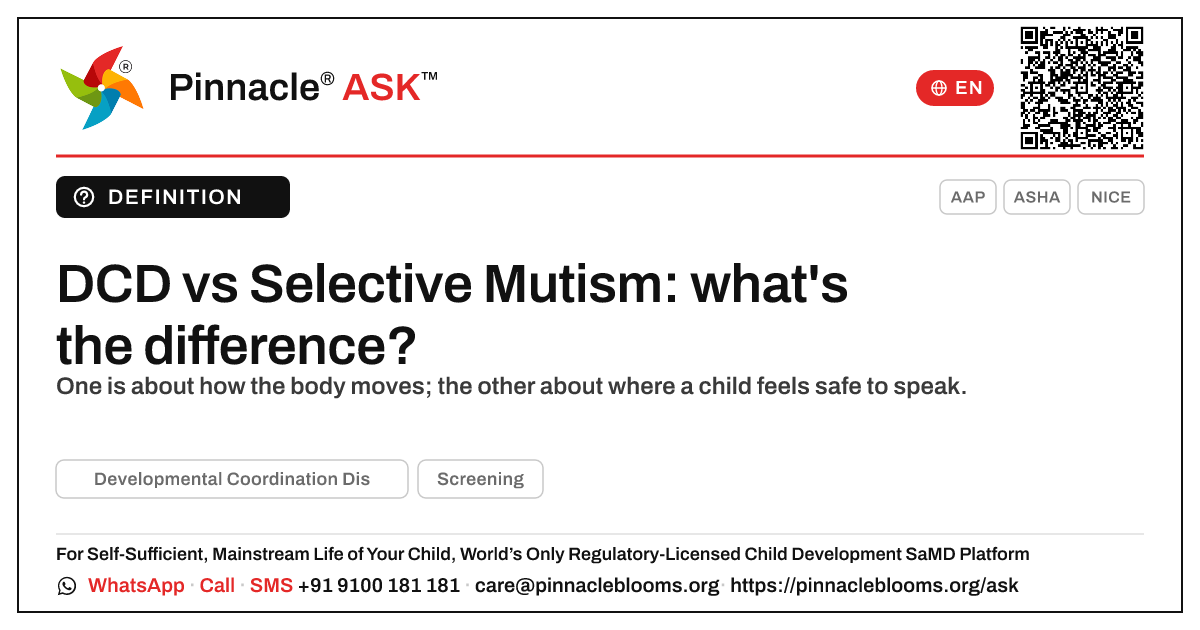
Developmental Coordination Disorder (DCD) and Selective Mutism are entirely different. DCD is a motor difficulty — clumsy movements, trouble with pencils, buttons or sport — despite a child trying hard. Selective Mutism is anxiety-based: a child speaks comfortably in some settings (usually home) but consistently cannot speak in others (often school), despite having normal language. One is about how the body moves; the other about where a child feels safe enough to speak. A child can rarely have both, and both deserve a gentle early developmental check rather than waiting.
In this answer 5 sections
One is about how a child's body moves; the other is about where a child feels safe enough to speak — two very different stories, often confused.
In short
Developmental Coordination Disorder (DCD) is a motor difficulty: a child's movements — running, jumping, holding a pencil, doing up buttons — are noticeably clumsier or harder to learn than expected for their age, even though they are bright and trying hard. Selective Mutism (SM) is an anxiety-based difficulty with speaking: a child talks comfortably in some settings (usually home) but consistently cannot speak in others (often school), despite having the language to do so. One is about motor skills; the other is about communication driven by anxiety. They are entirely separate, and a child can — occasionally — have both.
How they differ in everyday life
DCD shows up in the body. You might notice your child tripping often, struggling with stairs, finding cutlery, scissors or shoelaces frustrating, writing slowly or messily, or avoiding sport and craft. They want to do these things — the messages between brain and muscles are just harder to organise. It is not laziness, and it is not low intelligence.
Selective Mutism shows up in social speaking. A child who chatters happily at home may go completely silent at nursery or with relatives — not refusing out of stubbornness, but frozen by anxiety. The key clue is the consistency: the same child, fluent in one place, silent in another, for a month or more. Their language ability is usually fine; it is the speaking-in-that-setting that locks up.
The simplest way to hold them apart: DCD is 'I can't make my body do this smoothly'; Selective Mutism is 'I can't get my words out here, even though I can elsewhere.'
When to seek a look
For either, the right next step is a gentle developmental check rather than waiting and worrying. With DCD, early support builds motor confidence before school demands pile up. With Selective Mutism, early, anxiety-sensitive help is important — pressure to 'just talk' usually makes it worse, so the right approach matters. If your child loses skills they once had, or there is any sudden change, see your paediatrician promptly.
The Pinnacle way
This is general information, not a diagnosis — a clinical AbilityScore® and any diagnosis are formed only at a Pinnacle Blooms Network centre, under qualified clinician care, never from an app or form. Our team gently observes how your child moves, communicates and copes across situations, then matches the right support — occupational therapy for coordination and daily-living skills, and warm, anxiety-aware speech therapy where speaking is the challenge. Learn more about Developmental Coordination Disorder.
Trusted sources
The American Academy of Pediatrics and HealthyChildren on motor development and milestones; the American Speech-Language-Hearing Association on selective mutism and childhood communication; NICE guidance on supporting children's developmental and emotional needs.
Next step — Unsure which picture fits your child? Book a developmental screening and let a Pinnacle clinician look closely at both movement and communication.
CONNECT THE ANSWER TO YOUR CHILD’S DAY
Something to notice. Something to discuss.
What to notice
For DCD: frequent tripping, trouble with cutlery, scissors, buttons or shoelaces, messy slow writing, avoiding sport or craft. For Selective Mutism: a child who talks freely at home but is consistently silent at nursery, school or with certain people for a month or more, despite having the words.
In everyday life
For coordination, build skills through play — threading beads, play-dough, hopscotch — and praise effort, not neatness. For a child who goes quiet in some places, never pressure them to 'just say it'; lower the spotlight, allow non-verbal responses first, and celebrate any small communication warmly.
Bring your observations and questions to your child’s professional. Choose activities that suit your child’s comfort, abilities and agreed plan.
Bring your questions to a first visitQuestions families ask
Can a child have both DCD and Selective Mutism?
Yes, though it is uncommon. They are separate conditions — one motor, one anxiety-based — but they can co-occur. A clinician can look at both areas during a single developmental assessment and recommend the right blend of support.
Is Selective Mutism just shyness?
No. Shyness usually eases as a child settles in. Selective Mutism is a consistent inability to speak in specific settings driven by anxiety, even after weeks or months. The child often has perfectly good language — they simply cannot get the words out in that place.
Does DCD mean my child is not intelligent?
Not at all. Children with DCD are typically just as bright as their peers; their difficulty is specifically with organising and coordinating movement. With the right support, many gain real confidence in motor skills.
What kind of therapy helps each one?
DCD is usually supported with occupational therapy to build motor and daily-living skills. Selective Mutism is supported with anxiety-aware speech and behavioural approaches that gently reduce pressure and rebuild confidence to speak. A clinician matches the approach after assessment.
FOLLOW THE SOURCE
References behind this answer.
- Organisation website · further readingAAP HealthyChildren — motor development and milestones
- Organisation website · further readingASHA — selective mutism and childhood communication
- Organisation website · further readingNICE — supporting children's developmental and emotional needs
References are supplied with this answer. An organisation homepage offers further reading; it does not establish an independent review of this page.
Content attribution: SETU Consortium · Pinnacle Blooms Network.
PEOPLE, TOPICS & DEVELOPMENT
See the connections.
Browse the wider question collections connected with this answer’s audience, developmental area and stage.
FROM UNDERSTANDING TO PURPOSEFUL SUPPORT
One question. Your child’s whole life.
Your child’s self-sufficient, mainstream-included life is the purpose from the beginning. At Pinnacle, that purpose shapes what we understand, the goals we choose, the people we bring together, everyday practice and review.
Connect this question with the right support.
Explore how the relevant service contributes to everyday abilities, then speak with us about your child.
Make the next conversation useful.
Bring the situations you notice at home or school. We’ll explain a suitable service, centre and first visit, including availability and fees, before you decide.
How PinnacleAI® connects the journeyExplore the seven stages
- 1Understand abilities
A starting picture of your child’s capabilities.
- 2Choose meaningful goals
Readiness and a plan shaped around the child.
- 3Bring the right support together
Suitable therapies and people for those goals.
- 4Carry practice into everyday life
Guidance for family, home and school.
- 5Track and correct
Use observations to adjust the plan.
- 6Reassess and review
Decide what to continue, change or do next.
- 7Grow independence and participation
The child’s life gives each step its purpose.
Explore the whole PinnacleAI® system → · Participation at school and in the community →
PINNACLE’S EVIDENCE, OPEN TO YOU
Look at the evidence behind our work.
Read our research, inspect the original regulatory documents and check what each institutional measure means.
General information supports a conversation with an appropriately qualified professional. Advice, goals and support depend on the individual child.