
YOUR QUESTION. A CLEARER NEXT STEP.
Is intellectual disability the same as mental illness?
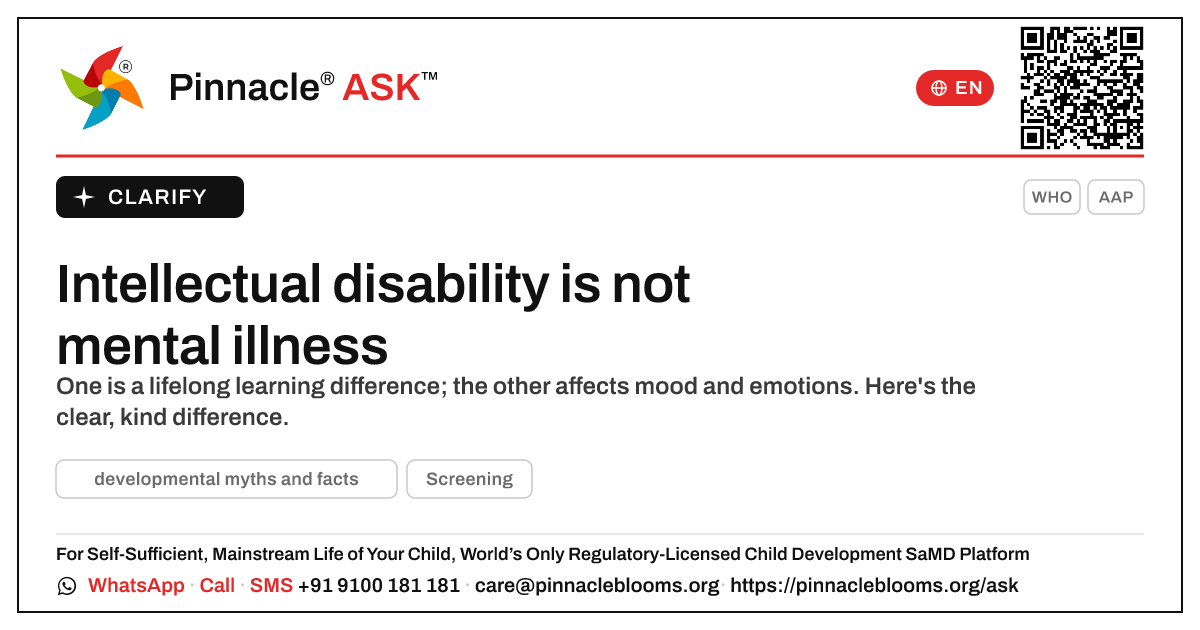
No — intellectual disability and mental illness are different. Intellectual disability is a lifelong difference in learning and everyday functioning that begins in childhood; mental illness affects mood, thoughts or emotions and can begin at any age, often treatable. A child can have one, both or neither, and each needs its own support.
In this answer 5 sections
Two very different words get muddled all the time — and that mix-up can shape how a child is treated for life.
In short
No — intellectual disability and mental illness are not the same thing. Intellectual disability is a difference in how a child learns, reasons and manages everyday skills, present from the developmental years. Mental illness (such as anxiety or depression) is a change in mood, thinking or feeling that can begin at any age and often comes and goes. A person can have one, both, or neither — and each needs its own kind of support.
The myth, and the facts
Myth: “If a child has an intellectual disability, that means they’re mentally ill.”
Fact: These are two separate ideas.
- Intellectual disability is about learning and everyday functioning — things like understanding, problem-solving, communication, and daily-living skills. It begins during childhood and is a lifelong difference, not an illness to be cured.
- Mental illness is about mental health — conditions affecting mood, thoughts or emotions, like anxiety or depression. These can affect anyone, at any age, and are usually treatable, often easing with the right help.
Why the confusion? Older language lumped them together, and the words sound similar to many families. But the support pathways differ completely: a child with an intellectual disability benefits from learning support, speech and language therapy and skill-building, while mental-health concerns may call for emotional and psychological care. A child can certainly experience both — and when they do, each is supported on its own terms.
The most important fact of all: every child can learn, grow and thrive with the right, respectful support around them.
When to seek a developmental check
If you notice your child is taking much longer than peers to reach learning, language or self-care milestones, a general developmental check is the kind, useful next step. It isn’t about labels — it’s about understanding how your child learns best, so support can start early.
The Pinnacle way
At Pinnacle Blooms Network, we begin by understanding your child’s strengths, never just their difficulties. Any clinical Developmental measurement supports care planning; diagnosis requires an appropriately qualified healthcare professional., under the care of a qualified clinician — never from an online article or a single observation. Learn how our clinician-led AbilityScore® builds a clear, multi-domain picture, and how speech therapy supports learning and communication.
Trusted sources
Aligned with WHO ICD-11, which classifies disorders of intellectual development separately from mental and behavioural conditions, and with guidance from the American Academy of Pediatrics and healthychildren.org on child development and mental health.
Next step — if you’d like clarity on how your child learns, book a developmental assessment with our clinical team on WhatsApp: +91 91001 81181.
This is general information, not a diagnosis — individual assessment and diagnosis require an appropriately qualified healthcare professional.
CONNECT THE ANSWER TO YOUR CHILD’S DAY
Something to notice. Something to discuss.
What to notice
Watch for your child taking much longer than peers to reach learning, language or self-care milestones — and separately, watch for lasting changes in mood, sleep, appetite or withdrawal that may point to emotional wellbeing needs. Each deserves its own kind of support.
In everyday life
When you describe your child to others, swap labels for strengths and needs — "she's still building her words" tells people far more, and far more kindly, than any diagnosis word.
Bring your observations and questions to your child’s professional. Choose activities that suit your child’s comfort, abilities and agreed plan.
Bring your questions to a first visitQuestions families ask
Is intellectual disability a mental illness?
No. Intellectual disability is a lifelong difference in learning, reasoning and everyday skills that begins in childhood. Mental illness affects mood, thoughts or emotions and can start at any age. They are classified separately and need different kinds of support.
Can a child have both an intellectual disability and a mental illness?
Yes, a child can experience both. When that happens, each is supported on its own terms — learning and skill-building support for the intellectual disability, and emotional or psychological care for the mental-health concern.
Is intellectual disability something that can be cured?
Intellectual disability is a lifelong difference, not an illness to be cured. With early, respectful support — including learning support and speech and language therapy — children can build skills, grow in independence and thrive.
Who can tell us whether our child has an intellectual disability?
Only a qualified clinician can, through a structured developmental assessment at a centre — never from an online article or a single observation. A general developmental check is a kind, useful first step if you have concerns about learning milestones.
FOLLOW THE SOURCE
References behind this answer.
- Organisation website · further readingWHO ICD-11 — disorders of intellectual development
- Organisation website · further readingAAP healthychildren.org — child development and mental health
- Organisation website · further readingAmerican Academy of Pediatrics
References are supplied with this answer. An organisation homepage offers further reading; it does not establish an independent review of this page.
Content attribution: SETU Consortium · Pinnacle Blooms Network.
PEOPLE, TOPICS & DEVELOPMENT
See the connections.
Browse the wider question collections connected with this answer’s audience, developmental area and stage.
FROM UNDERSTANDING TO PURPOSEFUL SUPPORT
One question. Your child’s whole life.
Your child’s self-sufficient, mainstream-included life is the purpose from the beginning. At Pinnacle, that purpose shapes what we understand, the goals we choose, the people we bring together, everyday practice and review.
Connect this question with the right support.
Explore how the relevant service contributes to everyday abilities, then speak with us about your child.
Make the next conversation useful.
Bring the situations you notice at home or school. We’ll explain a suitable service, centre and first visit, including availability and fees, before you decide.
How PinnacleAI® connects the journeyExplore the seven stages
- 1Understand abilities
A starting picture of your child’s capabilities.
- 2Choose meaningful goals
Readiness and a plan shaped around the child.
- 3Bring the right support together
Suitable therapies and people for those goals.
- 4Carry practice into everyday life
Guidance for family, home and school.
- 5Track and correct
Use observations to adjust the plan.
- 6Reassess and review
Decide what to continue, change or do next.
- 7Grow independence and participation
The child’s life gives each step its purpose.
Explore the whole PinnacleAI® system → · Participation at school and in the community →
PINNACLE’S EVIDENCE, OPEN TO YOU
Look at the evidence behind our work.
Read our research, inspect the original regulatory documents and check what each institutional measure means.
General information supports a conversation with an appropriately qualified professional. Advice, goals and support depend on the individual child.