
YOUR QUESTION. A CLEARER NEXT STEP.
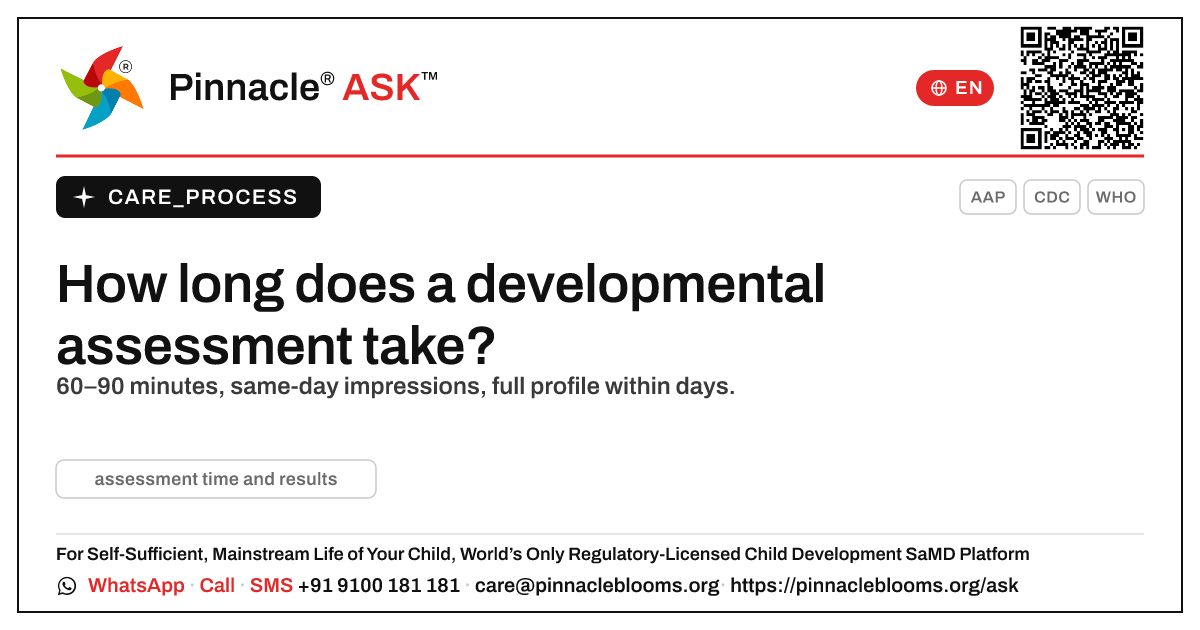
How long does a developmental assessment take?
A developmental assessment at Pinnacle usually takes 60–90 minutes, sometimes across two shorter visits. You'll hear initial impressions the same day, with the full AbilityScore® profile and plan typically shared within a few days — explained in person, never as a cold report.
In this answer 4 sections
The first thing most parents want to know isn't the result — it's how long the day will take, and when they'll finally have answers.
In short
A developmental assessment at Pinnacle usually takes about 60 to 90 minutes with your child, sometimes spread across a couple of shorter visits if your little one needs breaks. You'll have an initial conversation with the clinician on the same day, and your child's full AbilityScore® profile and plan are typically shared within a few days — never as a cold report, but as a sit-down explanation you can ask questions about. There's nothing to prepare and no way to "fail" — it's a starting point, not an exam.
What the day actually looks like
The time isn't all formal testing. Much of it is your clinician watching your child play, talk, move and respond — gathering a picture across communication, thinking, movement, social connection and everyday skills. You'll be asked about your child's history and your own observations, because what you see at home matters as much as what happens in the room.
- Younger or more anxious children may do better across two relaxed sittings rather than one long one — that's normal and planned for.
- Results aren't a single number handed over silently. Your clinician walks you through where your child stands today and what the next steps are.
- Follow-up reviews are shorter, because the baseline is already in place — they simply measure progress against it.
The Pinnacle way
A clinical AbilityScore® and any diagnosis are formed only at a Pinnacle Blooms Network centre, under qualified clinician care — never from a form, an app or this page. Across 70+ centres and 25 million+ therapy sessions, our process is built so families leave the assessment with clarity, not jargon — a clear baseline and a plan you can start straight away.
Trusted sources
World Health Organization guidance on developmental monitoring; American Academy of Pediatrics recommendations on developmental surveillance and screening; CDC developmental milestones resources.
Next step — Ready to find your child's starting point? Book an assessment with a Pinnacle clinician.
This is general information, not a diagnosis — individual assessment and diagnosis require an appropriately qualified healthcare professional.
CONNECT THE ANSWER TO YOUR CHILD’S DAY
Something to notice. Something to discuss.
What to notice
Watch how your child copes with a longer session — if they tire or get overwhelmed, tell the clinician, and the assessment can be split across two relaxed visits.
In everyday life
You don't need to prepare or rehearse anything. Bring your child as they are, with a favourite snack or comfort toy, so they feel relaxed enough to show their everyday self.
Bring your observations and questions to your child’s professional. Choose activities that suit your child’s comfort, abilities and agreed plan.
Bring your questions to a first visitQuestions families ask
How long does a developmental assessment take?
Usually about 60 to 90 minutes with your child. For younger or more anxious children, it can be split across two shorter, relaxed visits so your child is comfortable throughout.
When will I get the results?
Your clinician shares initial impressions on the same day. The full AbilityScore® profile and your child's plan are typically explained to you in person within a few days.
Do I need to prepare my child beforehand?
No. There's nothing to study or rehearse — the assessment is designed to meet your child exactly where they are. Just bring them relaxed, with a comfort item if it helps.
Is the result a diagnosis?
Developmental measurement supports care planning; diagnosis requires an appropriately qualified healthcare professional. by qualified clinicians. The result is a clear baseline and plan, explained to you directly.
FOLLOW THE SOURCE
References behind this answer.
- Organisation website · further readingAAP HealthyChildren: developmental monitoring
- Source referenceCDC developmental milestones
- Organisation website · further readingWHO child development guidance
References are supplied with this answer. An organisation homepage offers further reading; it does not establish an independent review of this page.
Content attribution: SETU Consortium · Pinnacle Blooms Network.
PEOPLE, TOPICS & DEVELOPMENT
See the connections.
Browse the wider question collections connected with this answer’s audience, developmental area and stage.
FROM UNDERSTANDING TO PURPOSEFUL SUPPORT
One question. Your child’s whole life.
Your child’s self-sufficient, mainstream-included life is the purpose from the beginning. At Pinnacle, that purpose shapes what we understand, the goals we choose, the people we bring together, everyday practice and review.
Connect this question with the right support.
Explore how the relevant service contributes to everyday abilities, then speak with us about your child.
Make the next conversation useful.
Bring the situations you notice at home or school. We’ll explain a suitable service, centre and first visit, including availability and fees, before you decide.
How PinnacleAI® connects the journeyExplore the seven stages
- 1Understand abilities
A starting picture of your child’s capabilities.
- 2Choose meaningful goals
Readiness and a plan shaped around the child.
- 3Bring the right support together
Suitable therapies and people for those goals.
- 4Carry practice into everyday life
Guidance for family, home and school.
- 5Track and correct
Use observations to adjust the plan.
- 6Reassess and review
Decide what to continue, change or do next.
- 7Grow independence and participation
The child’s life gives each step its purpose.
Explore the whole PinnacleAI® system → · Participation at school and in the community →
PINNACLE’S EVIDENCE, OPEN TO YOU
Look at the evidence behind our work.
Read our research, inspect the original regulatory documents and check what each institutional measure means.
General information supports a conversation with an appropriately qualified professional. Advice, goals and support depend on the individual child.