
YOUR QUESTION. A CLEARER NEXT STEP.
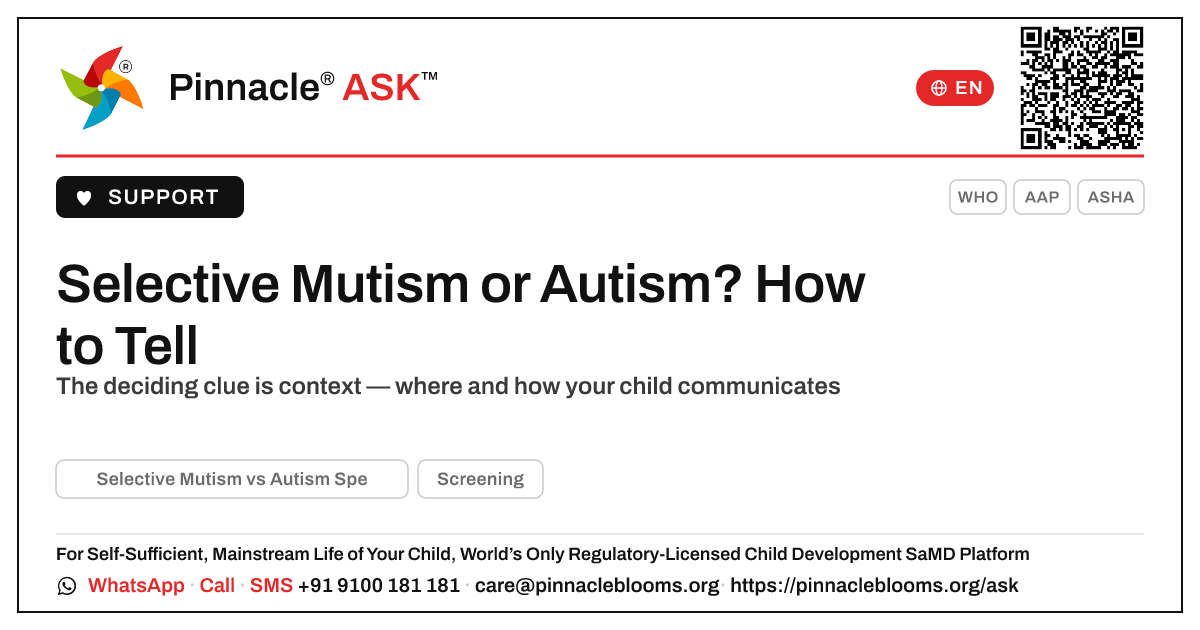
Selective Mutism or Autism Spectrum: How to Tell
The clearest distinction is context: in Selective Mutism a child speaks freely at home but is silent in specific anxiety-provoking settings like school, while in Autism Spectrum communication and social differences appear across all settings alongside repetitive interests and sensory differences. The two can overlap, so only a qualified clinician can tell for certain. AbilityScore® is part of Pinnacle’s developmental assessment. Diagnosis, where needed, requires an appropriately qualified healthcare professional.
In this answer 5 sections
When your child chats happily at home but falls silent at school, the question 'is it shyness, mutism, or something more?' can keep you awake — and the answer matters.
In short
The simplest way to tell them apart is where and how your child communicates. In Selective Mutism, a child speaks freely and warmly in safe settings (usually home) but consistently cannot speak in specific situations like school — their social wish and ability are intact, but anxiety blocks the words. In Autism Spectrum, communication and social differences appear across all settings, including home, alongside things like differences in eye contact, play, repetitive interests or sensory responses. The two can sometimes overlap, which is exactly why only a qualified clinician — never an online checklist — can tell for sure.
What tends to set them apart
Points towards Selective Mutism:
- Speaks fluently and naturally at home with close family, but is silent or whispers in specific places (school, with relatives, in shops).
- The silence is consistent and situation-bound — it's about anxiety, not ability.
- Warm social connection, normal back-and-forth conversation and play when comfortable.
- May still gesture, nod or point in the difficult setting, clearly wanting to connect.
Points towards Autism Spectrum:
- Communication and social differences show up everywhere, including the safe home setting.
- Differences in eye contact, shared attention, or reading social cues.
- Repetitive movements, intense focused interests, strong need for sameness, or sensory sensitivities (to sound, light, textures).
- Language may be delayed, very literal, or used in unusual ways — not just withheld in certain places.
The deciding clue is context: mutism is selective by situation; autism's differences are consistent across situations. But because an anxious autistic child can also be quiet at school — and the two genuinely co-occur — clinical assessment is what brings clarity.
When to seek a check
Seek a developmental check if your child has not spoken in a particular setting (like school) for more than a month beyond an initial settling-in period, if you notice social or communication differences at home too, or if anything about your child's connection, play or sensory responses worries you. Earlier understanding means earlier, gentler support — for either path.
The Pinnacle way
AbilityScore® is part of Pinnacle’s developmental assessment. Diagnosis, where needed, requires an appropriately qualified healthcare professional — never from an app, article or online form. Through a clinician-administered structured assessment, our team gently observes your child across communication, social and sensory domains to distinguish anxiety-driven silence from a broader developmental profile, then shapes support — whether confidence-building speech and communication therapy or a wider developmental plan. Start by exploring how Pinnacle supports your child.
Trusted sources
WHO ICD-11 framework for selective mutism and autism spectrum disorder; American Academy of Pediatrics (HealthyChildren.org) guidance on social communication and anxiety in children; American Speech-Language-Hearing Association resources on selective mutism and social communication.
Next step — Unsure which path fits your child? Book an assessment with a Pinnacle clinician for clear, caring answers.
This is general information, not a diagnosis — individual assessment and diagnosis require an appropriately qualified healthcare professional.
CONNECT THE ANSWER TO YOUR CHILD’S DAY
Something to notice. Something to discuss.
What to notice
Watch whether the silence is situation-bound (speaks warmly at home, quiet at school — suggests selective mutism) or present everywhere including home, alongside differences in eye contact, play, repetitive interests or sensory responses (suggests autism). Seek a check if silence in a setting lasts beyond a month, or if social differences also show at home.
In everyday life
Keep a simple note of where your child speaks freely and where they go quiet — at home, with grandparents, at school, in shops. This 'where and with whom' map is one of the most helpful things you can bring to a clinician.
Bring your observations and questions to your child’s professional. Choose activities that suit your child’s comfort, abilities and agreed plan.
Bring your questions to a first visitQuestions families ask
Can a child have both Selective Mutism and Autism?
Yes — the two can co-occur. An autistic child may also experience situation-specific anxiety that blocks speech. This overlap is one of the main reasons a qualified clinician, rather than an online checklist, is needed to understand your child's full profile.
My child talks happily at home but is silent at school — is that autism?
Speaking warmly and fluently at home while being silent in specific settings like school is the classic pattern of Selective Mutism, which is anxiety-driven, rather than autism. In autism, communication and social differences usually appear across all settings, including home. A clinician can confirm which fits your child.
At what age should I seek a check?
If your child has not spoken in a particular setting for more than a month beyond an initial settling-in period, or if you notice social, communication or sensory differences at home too, it is worth booking a developmental check. Earlier understanding means gentler, more effective support.
FOLLOW THE SOURCE
References behind this answer.
- Organisation website · further readingWHO ICD-11 classification of mental and developmental conditions
- Organisation website · further readingAmerican Academy of Pediatrics — child social communication and anxiety guidance
- Organisation website · further readingASHA — selective mutism and social communication resources
References are supplied with this answer. An organisation homepage offers further reading; it does not establish an independent review of this page.
Content attribution: SETU Consortium · Pinnacle Blooms Network.
PEOPLE, TOPICS & DEVELOPMENT
See the connections.
Browse the wider question collections connected with this answer’s audience, developmental area and stage.
FROM UNDERSTANDING TO PURPOSEFUL SUPPORT
One question. Your child’s whole life.
Your child’s self-sufficient, mainstream-included life is the purpose from the beginning. At Pinnacle, that purpose shapes what we understand, the goals we choose, the people we bring together, everyday practice and review.
Connect this question with the right support.
Explore how the relevant service contributes to everyday abilities, then speak with us about your child.
Make the next conversation useful.
Bring the situations you notice at home or school. We’ll explain a suitable service, centre and first visit, including availability and fees, before you decide.
How PinnacleAI® connects the journeyExplore the seven stages
- 1Understand abilities
A starting picture of your child’s capabilities.
- 2Choose meaningful goals
Readiness and a plan shaped around the child.
- 3Bring the right support together
Suitable therapies and people for those goals.
- 4Carry practice into everyday life
Guidance for family, home and school.
- 5Track and correct
Use observations to adjust the plan.
- 6Reassess and review
Decide what to continue, change or do next.
- 7Grow independence and participation
The child’s life gives each step its purpose.
Explore the whole PinnacleAI® system → · Participation at school and in the community →
PINNACLE’S EVIDENCE, OPEN TO YOU
Look at the evidence behind our work.
Read our research, inspect the original regulatory documents and check what each institutional measure means.
General information supports a conversation with an appropriately qualified professional. Advice, goals and support depend on the individual child.