
YOUR QUESTION. A CLEARER NEXT STEP.
Do hearing aids or cochlear implants fix hearing instantly?
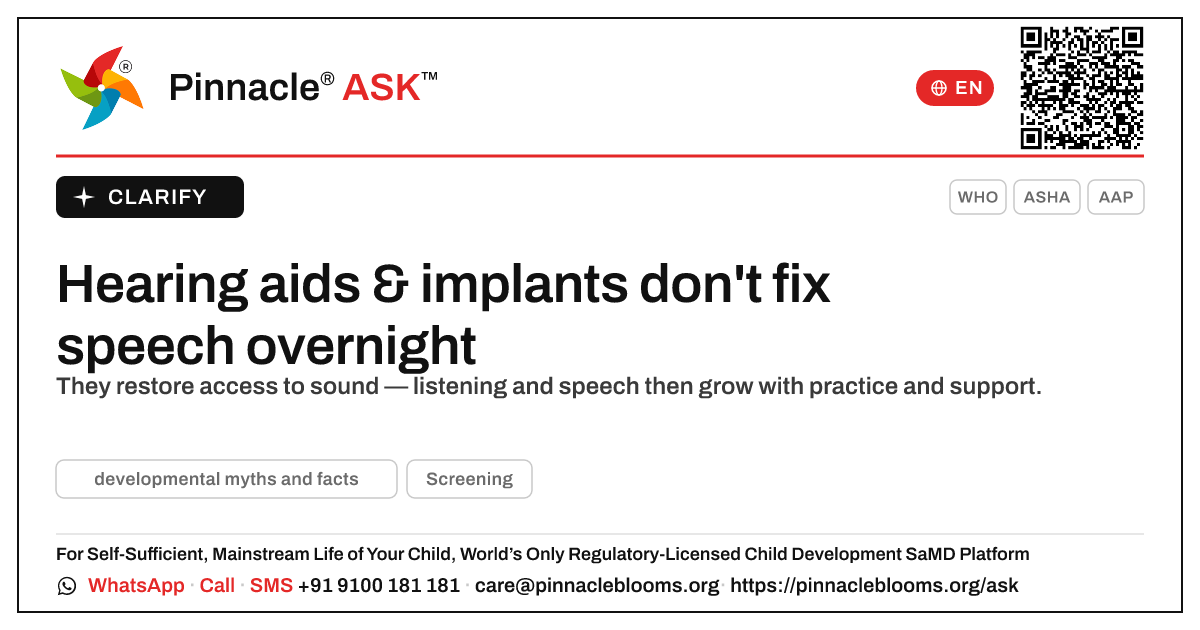
Hearing aids and cochlear implants restore access to sound, but they do not fix hearing or speech instantly. The brain must learn to interpret sound, and spoken language grows over months and years with consistent device wear, audiology tuning and listening-focused support.
In this answer 5 sections
The day a device switches on is a beginning, not a finish line — and that is genuinely good news.
In short
No — hearing aids and cochlear implants do not fix hearing and speech instantly. They restore access to sound, but the brain still has to learn to make sense of that sound, and spoken language grows steadily over months and years with listening practice and support. This is a journey of progress, not a single magic moment.
Myth vs fact
The myth: "Once the device is fitted and switched on, my child will hear normally and start talking straight away."
The fact: A hearing aid amplifies sound and a cochlear implant bypasses damaged inner-ear cells to stimulate the hearing nerve directly. Both give the brain something to hear — but:
- The first activation often sounds strange, mechanical or beepy. This is normal and improves as the brain adapts.
- Devices need careful, repeated tuning (mapping) by an audiologist over the early weeks and months.
- Listening is a learned skill. The brain builds the ability to recognise speech sounds through consistent daily wear and rich, responsive talking around the child.
- Spoken language then follows the usual developmental path — sounds, words, sentences — usually supported by speech therapy and family communication routines.
The earlier a device is fitted and the more consistently it is worn, the better the brain uses this window — but progress is still gradual, and every child's pace is their own.
What helps it work
- Wear time matters most — all waking hours, every day.
- Talk, sing, narrate — the brain learns speech from hearing lots of warm, everyday language.
- Keep audiology appointments — mapping and fine-tuning are part of the process.
- Pair with listening and spoken-language therapy to turn new access into real communication.
The Pinnacle way
Developmental measurement supports care planning; diagnosis requires an appropriately qualified healthcare professional. under qualified clinician care — never from a device alone or an online read. Our team supports children before and after fitting, building listening, attention and spoken language step by step. Explore speech therapy, understand the AbilityScore®, or start at our home page.
Trusted sources
Guidance aligned with the WHO on hearing care, the American Speech-Language-Hearing Association on auditory rehabilitation and listening development, and the American Academy of Pediatrics on early hearing detection and intervention.
Next step — if your child has a hearing device or is being fitted for one, book a developmental and listening-skills check with Pinnacle Blooms Network on WhatsApp: +91 91001 81181.
This is general information, not a diagnosis — individual assessment and diagnosis require an appropriately qualified healthcare professional.
CONNECT THE ANSWER TO YOUR CHILD’S DAY
Something to notice. Something to discuss.
What to notice
Watch consistent daily device wear and growing responses to sound and voices over weeks. If your child resists wearing the device, shows no change in alerting to sound after fitting, or speech is not emerging with support, raise it promptly with your audiologist and speech-language therapist.
In everyday life
Treat the device like glasses for the ears — on every waking hour. Then narrate your day in warm, simple language: the more your child hears, the faster the brain learns to listen.
Bring your observations and questions to your child’s professional. Choose activities that suit your child’s comfort, abilities and agreed plan.
Bring your questions to a first visitQuestions families ask
How long after a cochlear implant is switched on will my child start talking?
There is no fixed date — it varies with age at fitting, consistency of wear and support. Listening develops first over weeks and months, and spoken language builds gradually after that, usually alongside speech and listening therapy.
Will the device make my child hear exactly like other children?
It restores useful access to sound, but the sound experience differs from natural hearing, especially at first with cochlear implants. With consistent wear, brain adaptation and tuning, many children develop strong listening and spoken language.
Is speech therapy still needed after fitting a hearing device?
Usually yes. The device gives access to sound; listening and spoken-language therapy help the brain turn that sound into understanding and speech. The two work best together.
FOLLOW THE SOURCE
References behind this answer.
- Source referenceWHO — hearing loss and ear care
- Source referenceASHA — cochlear implants and auditory rehabilitation
- Organisation website · further readingAAP HealthyChildren — early hearing and intervention
References are supplied with this answer. An organisation homepage offers further reading; it does not establish an independent review of this page.
Content attribution: SETU Consortium · Pinnacle Blooms Network.
PEOPLE, TOPICS & DEVELOPMENT
See the connections.
Browse the wider question collections connected with this answer’s audience, developmental area and stage.
FROM UNDERSTANDING TO PURPOSEFUL SUPPORT
One question. Your child’s whole life.
Your child’s self-sufficient, mainstream-included life is the purpose from the beginning. At Pinnacle, that purpose shapes what we understand, the goals we choose, the people we bring together, everyday practice and review.
Connect this question with the right support.
Explore how the relevant service contributes to everyday abilities, then speak with us about your child.
Make the next conversation useful.
Bring the situations you notice at home or school. We’ll explain a suitable service, centre and first visit, including availability and fees, before you decide.
How PinnacleAI® connects the journeyExplore the seven stages
- 1Understand abilities
A starting picture of your child’s capabilities.
- 2Choose meaningful goals
Readiness and a plan shaped around the child.
- 3Bring the right support together
Suitable therapies and people for those goals.
- 4Carry practice into everyday life
Guidance for family, home and school.
- 5Track and correct
Use observations to adjust the plan.
- 6Reassess and review
Decide what to continue, change or do next.
- 7Grow independence and participation
The child’s life gives each step its purpose.
Explore the whole PinnacleAI® system → · Participation at school and in the community →
PINNACLE’S EVIDENCE, OPEN TO YOU
Look at the evidence behind our work.
Read our research, inspect the original regulatory documents and check what each institutional measure means.
General information supports a conversation with an appropriately qualified professional. Advice, goals and support depend on the individual child.