
YOUR QUESTION. A CLEARER NEXT STEP.
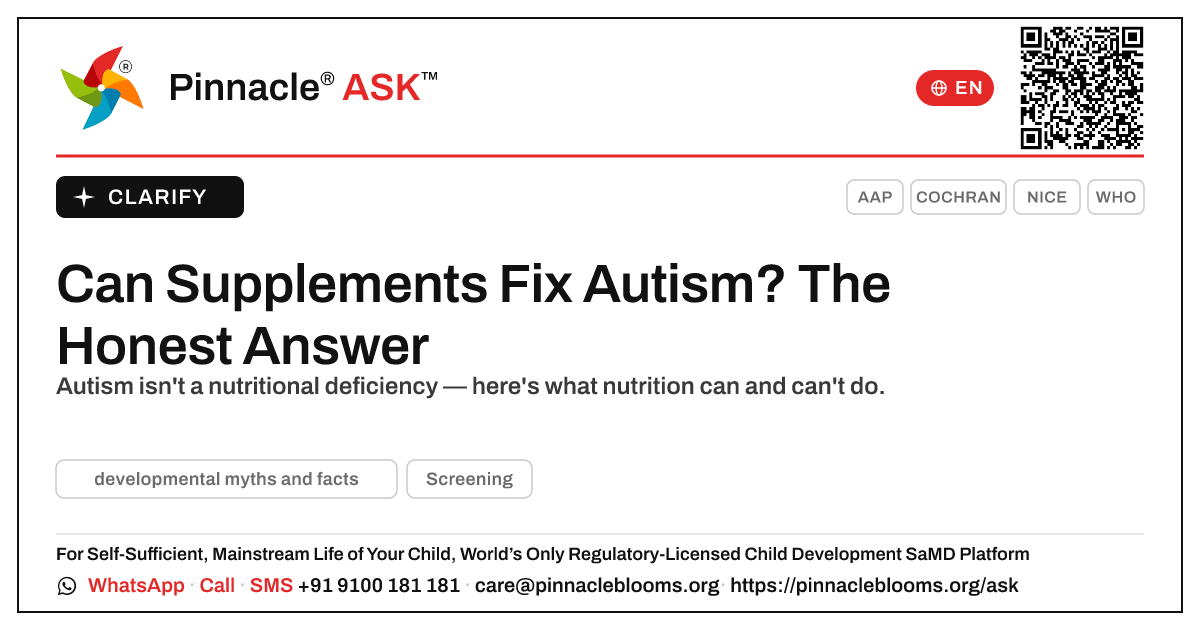
Can Supplements Fix Autism by Correcting a Deficiency?
No supplement, vitamin or diet can fix autism, because autism is a difference in brain development, not a nutritional deficiency. Some autistic children do have genuine, separate nutritional gaps from selective eating that a clinician should check and treat — but that is good health care, not a cure. The strongest help remains evidence-based developmental therapy.
In this answer 5 sections
When a diagnosis is new and frightening, the promise of a simple fix — a powder, a pill, a special diet — can feel like hope in a bottle. Here is what the science actually says.
In short
No. Autism is a difference in how the brain develops and is wired — it is not caused by a nutritional deficiency, and no supplement, vitamin or special diet can "correct" or "fix" it. Some children with autism do have genuine, separate nutritional issues (often linked to selective eating or gut symptoms) that a clinician should check and treat — but treating those is good general health care, not a cure for autism.
Sorting the myth from the fact
The myth: autism is the result of a missing vitamin, mineral or gut imbalance, so the right supplement reverses it.
The fact: decades of research have not found a single nutritional deficiency that causes autism, nor any supplement that changes its core features. Studies of high-dose vitamins, omega-3s, megavitamins and elimination diets have, on careful review, shown no reliable benefit for autism's social-communication or behavioural profile — and some high-dose regimens can actually harm a child.
Where nutrition genuinely matters:
- Many autistic children eat a narrow range of foods, which can lead to real gaps (iron, vitamin D, vitamin B12) worth checking.
- Constipation, reflux or feeding difficulty deserve proper medical assessment.
- If a deficiency is confirmed by a clinician, correcting it improves that child's health and comfort — it does not remove the autism.
The most evidence-backed support remains developmental — speech therapy, occupational therapy and family-centred early intervention — alongside good, balanced nutrition.
Before you buy a supplement
Please talk to a paediatrician or your therapy team first. "Natural" does not mean safe, high doses can be toxic, and money and hope spent on unproven products is money not spent on therapies that genuinely help. A simple blood test and a feeding review will tell you far more than any marketing claim.
The Pinnacle way
At Pinnacle Blooms Network, nutrition is reviewed as part of a child's whole picture — never sold as a cure. A clinical AbilityScore® and any diagnosis are formed only at a Pinnacle Blooms Network centre, under the care of qualified clinicians. With 4.95 lakh+ families supported across 70+ centres, our focus is evidence-based autism therapy that builds real skills. Explore more developmental myths and facts to feel confident sorting hope from hype.
Trusted sources
Guidance aligned with the American Academy of Pediatrics and HealthyChildren.org on unproven autism treatments, Cochrane reviews of dietary and supplement interventions, NICE autism management guidance, and WHO ICD-11 framing of autism as a neurodevelopmental condition.
Next step — before trying any supplement, book a developmental check with our clinical team on WhatsApp: +91 91001 81181, and let evidence guide the path forward.
This is general information, not a diagnosis — individual assessment and diagnosis require an appropriately qualified healthcare professional.
CONNECT THE ANSWER TO YOUR CHILD’S DAY
Something to notice. Something to discuss.
What to notice
Watch for very selective eating, refusal of whole food groups, constipation or low energy — these signal a possible nutritional gap worth a clinician's check, separate from autism itself. Be cautious of any product promising to 'reverse' or 'cure' autism, and of high-dose vitamin regimens, which can harm.
In everyday life
Before buying any supplement you saw advertised, write down the claim and ask your paediatrician one question: 'Is this proven, and is it safe for my child's dose and weight?' A quick blood test reveals more than any label.
Bring your observations and questions to your child’s professional. Choose activities that suit your child’s comfort, abilities and agreed plan.
Bring your questions to a first visitQuestions families ask
Are there any supplements proven to treat autism?
No supplement has been reliably shown to change the core features of autism. Careful research reviews of high-dose vitamins, omega-3s and special diets have not found benefit for social-communication or behaviour. The strongest support is evidence-based developmental therapy alongside balanced nutrition.
My autistic child is a very picky eater — should I worry about nutrition?
It is worth checking. Selective eating can lead to genuine gaps in iron, vitamin D or B12, and constipation or feeding difficulty deserve attention. Ask your clinician for a feeding review and, if needed, a simple blood test — and treat any confirmed deficiency, which improves your child's health but does not remove the autism.
Can a special diet, like gluten-free, cure or reduce autism?
Reviews of elimination diets have not shown reliable benefit for autism's core features, and removing food groups without guidance can create new nutritional gaps. If you suspect a true food intolerance or allergy, discuss it with a clinician rather than starting a restrictive diet on your own.
Why are high-dose vitamins risky?
Some vitamins and minerals are toxic at high doses and can harm a child's liver, kidneys or nerves. 'Natural' does not mean safe. Any supplement should be dosed for your child's age and weight under a clinician's advice, and only when a genuine need is confirmed.
FOLLOW THE SOURCE
References behind this answer.
- Organisation website · further readingAAP HealthyChildren — autism treatments and unproven therapies
- Organisation website · further readingCochrane — reviews of dietary and supplement interventions in autism
- Organisation website · further readingNICE — autism management guidance
- Organisation website · further readingWHO ICD-11 — autism spectrum disorder framing
References are supplied with this answer. An organisation homepage offers further reading; it does not establish an independent review of this page.
Content attribution: SETU Consortium · Pinnacle Blooms Network.
PEOPLE, TOPICS & DEVELOPMENT
See the connections.
Browse the wider question collections connected with this answer’s audience, developmental area and stage.
FROM UNDERSTANDING TO PURPOSEFUL SUPPORT
One question. Your child’s whole life.
Your child’s self-sufficient, mainstream-included life is the purpose from the beginning. At Pinnacle, that purpose shapes what we understand, the goals we choose, the people we bring together, everyday practice and review.
Connect this question with the right support.
Explore how the relevant service contributes to everyday abilities, then speak with us about your child.
Make the next conversation useful.
Bring the situations you notice at home or school. We’ll explain a suitable service, centre and first visit, including availability and fees, before you decide.
How PinnacleAI® connects the journeyExplore the seven stages
- 1Understand abilities
A starting picture of your child’s capabilities.
- 2Choose meaningful goals
Readiness and a plan shaped around the child.
- 3Bring the right support together
Suitable therapies and people for those goals.
- 4Carry practice into everyday life
Guidance for family, home and school.
- 5Track and correct
Use observations to adjust the plan.
- 6Reassess and review
Decide what to continue, change or do next.
- 7Grow independence and participation
The child’s life gives each step its purpose.
Explore the whole PinnacleAI® system → · Participation at school and in the community →
PINNACLE’S EVIDENCE, OPEN TO YOU
Look at the evidence behind our work.
Read our research, inspect the original regulatory documents and check what each institutional measure means.
General information supports a conversation with an appropriately qualified professional. Advice, goals and support depend on the individual child.