
YOUR QUESTION. A CLEARER NEXT STEP.
At what age should a child develop visual scanning?
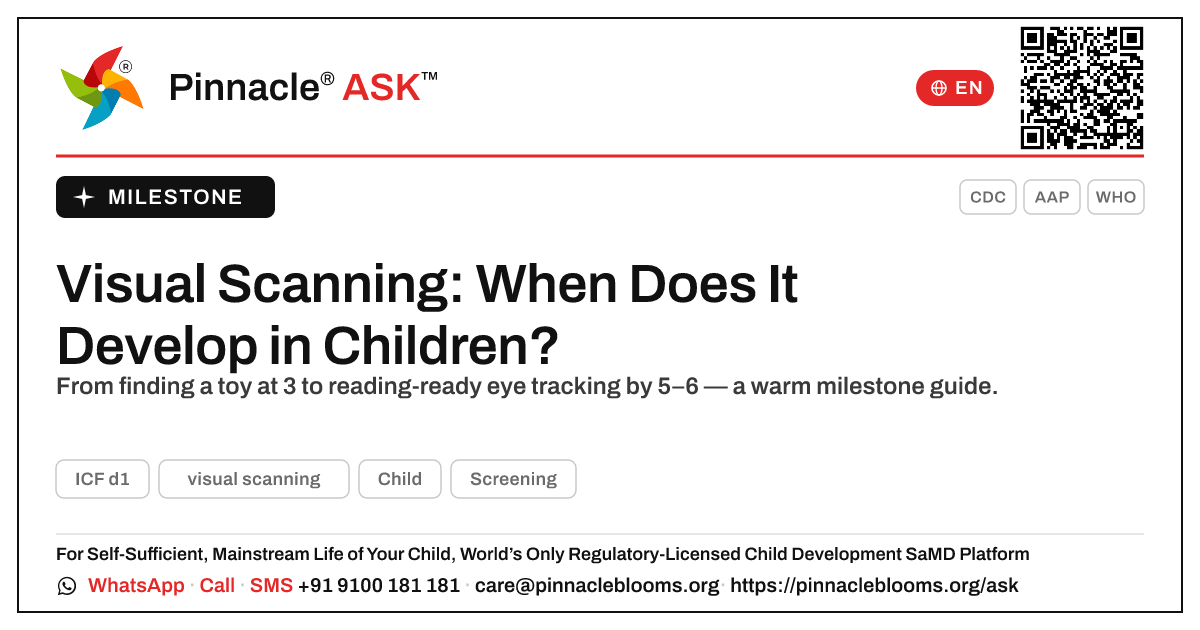
Visual scanning develops steadily between roughly 3 and 7 years — from finding a named toy at 3 to organised left-to-right tracking for early reading by 5–6. It is a developing skill, so steady progress matters more than a single age. A clinician can check it if a child often loses their place or struggles with find-and-search tasks.
In this answer 5 sections
The way a child's eyes sweep across a page, a puzzle, or a busy classroom is quietly building the foundation for reading, writing and play.
In short
Visual scanning — the ability to move the eyes purposefully across a scene to find and gather information — develops steadily through the preschool years. Most children show clear, organised scanning between 3 and 7 years, beginning with searching for a favourite toy and growing into the left-to-right tracking needed for early reading. It is a developing skill, not a pass-or-fail milestone, so steady progress matters more than a single date.
How visual scanning grows
- Around 3 years — finds a named object among a few others, follows a moving toy with smooth eye movements.
- 4–5 years — searches pictures in a book, completes simple puzzles by scanning for the right piece, begins matching shapes and letters.
- 5–6 years — scans left-to-right in an organised way, the pattern that supports early reading and copying from a board.
- 6–7 years — quicker, more efficient scanning across busier scenes, supporting reading fluency and worksheet tasks.
This skill draws on cognitive processing speed and visual attention working together — which is why play that asks a child to look and find is so valuable at this age.
When to check in
If your child often loses their place, skips items, tilts their head oddly, or finds 'spot-it' and puzzle games much harder than peers by 5–6 years, a gentle developmental check (and a routine eye examination) is a sensible step — most differences respond well to early support.
The Pinnacle way
At Pinnacle Blooms Network, Developmental measurement supports care planning; diagnosis requires an appropriately qualified healthcare professional. under qualified clinician care — never from an online read. Our team supports visual and cognitive skills through play-based special education and structured profiling via the AbilityScore®.
Trusted sources
Guided by WHO ICF activity domains, CDC developmental guidance and AAP/HealthyChildren resources on visual and learning development.
Next step — if you're unsure how your child is scanning and searching, book a developmental screen on WhatsApp at +91 91001 81181.
This is general information, not a diagnosis — individual assessment and diagnosis require an appropriately qualified healthcare professional.
CONNECT THE ANSWER TO YOUR CHILD’S DAY
Something to notice. Something to discuss.
What to notice
Watch for a child who repeatedly loses their place, skips objects, tilts the head to look, or finds spot-and-find or puzzle games far harder than peers by 5–6 years — pair a developmental check with a routine eye examination.
In everyday life
Play 'I-spy' and spot-the-difference games, or hide a favourite toy among a few others and ask your child to find it — these build organised eye-searching in a fun, low-pressure way.
Bring your observations and questions to your child’s professional. Choose activities that suit your child’s comfort, abilities and agreed plan.
Bring your questions to a first visitQuestions families ask
What is visual scanning in a child?
It is the ability to move the eyes purposefully across a scene, page or set of objects to find and gather information — the skill behind finding a toy, completing a puzzle and, later, reading across a line of text.
At what age does visual scanning develop?
It develops gradually between about 3 and 7 years, starting with finding a named object at 3 and growing into organised left-to-right tracking for early reading by 5–6 years.
When should I be concerned about my child's visual scanning?
If by 5–6 years your child often loses their place, skips items, tilts their head to look, or finds find-and-search games much harder than peers, a developmental check and a routine eye examination are sensible. Most differences respond well to early support.
FOLLOW THE SOURCE
References behind this answer.
- Source referenceCDC developmental milestones guidance
- Organisation website · further readingAAP HealthyChildren on vision and learning
- Organisation website · further readingWHO ICF activity and participation domains
References are supplied with this answer. An organisation homepage offers further reading; it does not establish an independent review of this page.
Content attribution: SETU Consortium · Pinnacle Blooms Network.
PEOPLE, TOPICS & DEVELOPMENT
See the connections.
Browse the wider question collections connected with this answer’s audience, developmental area and stage.
FROM UNDERSTANDING TO PURPOSEFUL SUPPORT
One question. Your child’s whole life.
Your child’s self-sufficient, mainstream-included life is the purpose from the beginning. At Pinnacle, that purpose shapes what we understand, the goals we choose, the people we bring together, everyday practice and review.
Connect this question with the right support.
Start with your child’s strengths, your observations and what you want everyday life to become.
Make the next conversation useful.
Bring the situations you notice at home or school. We’ll explain a suitable service, centre and first visit, including availability and fees, before you decide.
How PinnacleAI® connects the journeyExplore the seven stages
- 1Understand abilities
A starting picture of your child’s capabilities.
- 2Choose meaningful goals
Readiness and a plan shaped around the child.
- 3Bring the right support together
Suitable therapies and people for those goals.
- 4Carry practice into everyday life
Guidance for family, home and school.
- 5Track and correct
Use observations to adjust the plan.
- 6Reassess and review
Decide what to continue, change or do next.
- 7Grow independence and participation
The child’s life gives each step its purpose.
Explore the whole PinnacleAI® system → · Participation at school and in the community →
PINNACLE’S EVIDENCE, OPEN TO YOU
Look at the evidence behind our work.
Read our research, inspect the original regulatory documents and check what each institutional measure means.
General information supports a conversation with an appropriately qualified professional. Advice, goals and support depend on the individual child.