
YOUR QUESTION. A CLEARER NEXT STEP.
At What Age Do Children Develop Special Interests?
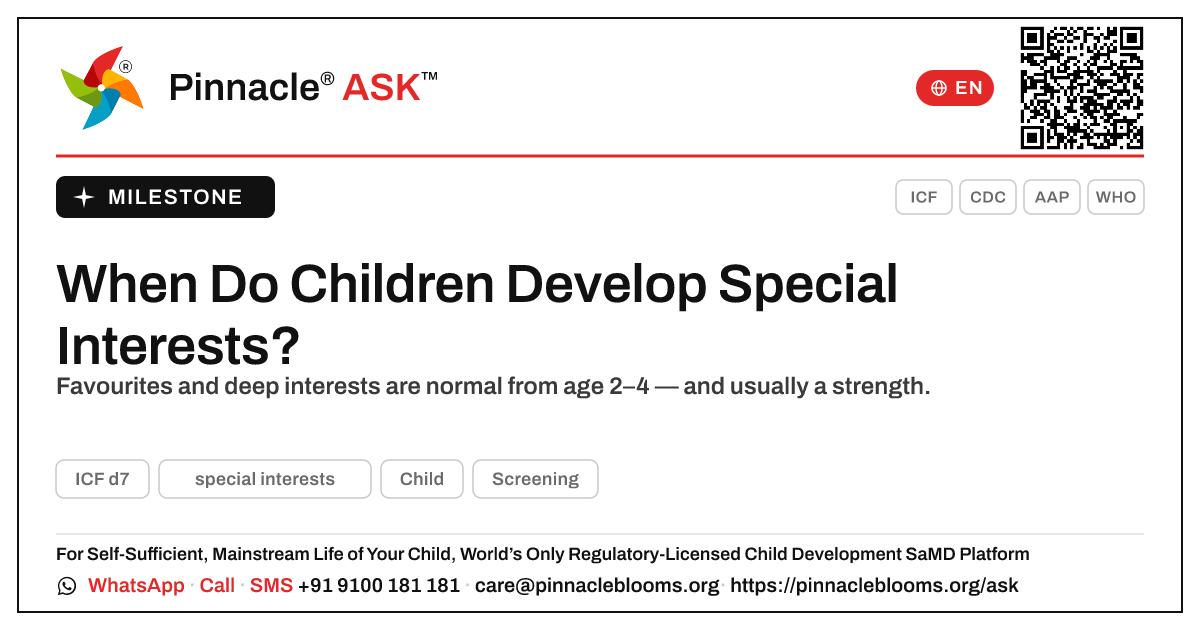
Special interests and strong favourites are a normal part of social and play development from about 2 to 4 years, deepening through ages 3 to 7. They usually signal a thriving, focused mind — only worth a developmental check when an interest crowds out all other play and learning or causes marked distress.
In this answer 4 sections
Every child lights up about something — the question parents ask is when those favourite things become a true sign of a thriving mind.
In short
Strong preferences and special interests are a normal, healthy part of how children aged 3 to 7 years explore the world. Most children develop favourite toys, themes or topics — dinosaurs, trains, drawing, a particular song — somewhere between 2 and 4 years, growing richer and more focused through the early school years. A passionate interest is usually a strength, not a worry; it is only worth a closer look when it crowds out everything else or causes distress.
The science
Special interests sit within social and play development (ICF chapter d7, interpersonal interactions). Around 2–3 years children begin to show clear likes, and by 4–5 these can become absorbing — a child who knows every planet, or every cricket score. This deep focus builds attention, vocabulary, memory and, when shared with others, social motivation. Children naturally use their interests to connect: showing you a favourite toy, telling you facts, inviting you to play.
A gentle flag — not a diagnosis — is when an interest becomes so fixed that the child resists all change, melts down when it is interrupted, or cannot join shared play at all, especially alongside differences in eye contact, response to name, or back-and-forth conversation. That pattern across home and school is worth a friendly developmental check.
The Pinnacle way
Developmental measurement supports care planning; diagnosis requires an appropriately qualified healthcare professional., under qualified clinician care — never from a single behaviour at home. Explore more on special interests, see how a structured profile works in what is the AbilityScore®, and learn how strengths are channelled through behaviour therapy.
Trusted sources
Aligned with CDC developmental milestone guidance, the American Academy of Pediatrics (HealthyChildren), and WHO ICF social-interaction domains.
Next step — if a favourite interest seems to block all play or learning, book a free developmental check on WhatsApp: +91 91001 81181.
CONNECT THE ANSWER TO YOUR CHILD’S DAY
Something to notice. Something to discuss.
What to notice
Watch if a single interest blocks all other play, causes meltdowns when interrupted, or appears alongside reduced response to name and limited back-and-forth conversation across home and school — that pattern warrants a friendly developmental check.
In everyday life
Join your child's favourite interest for a few minutes a day — add one new word or a tiny twist (‘which dinosaur is biggest?’) to gently stretch attention and shared conversation.
Bring your observations and questions to your child’s professional. Choose activities that suit your child’s comfort, abilities and agreed plan.
Bring your questions to a first visitQuestions families ask
Is it normal for my 4-year-old to talk about only one topic?
Yes — intense, narrow interests are very common between 3 and 7 years and usually build attention, vocabulary and memory. It is only worth a check if the interest blocks all other play or upsets your child when interrupted.
When does a special interest become a concern?
When it crowds out everything else, causes distress at any change, or sits alongside differences in eye contact, response to name and back-and-forth conversation across both home and school. That pattern deserves a developmental check — not a self-diagnosis.
Can a strong interest actually help my child?
Often, yes. Shared interests are powerful for building social motivation, language and learning. Joining in and gently widening the topic turns a passion into a bridge for connection.
FOLLOW THE SOURCE
References behind this answer.
- Source referenceICF d7
- Source referenceCDC — Developmental Milestones
- Organisation website · further readingAAP HealthyChildren — Play & Development
- Organisation website · further readingWHO ICF — Interpersonal Interactions (d7)
References are supplied with this answer. An organisation homepage offers further reading; it does not establish an independent review of this page.
Content attribution: SETU Consortium · Pinnacle Blooms Network.
PEOPLE, TOPICS & DEVELOPMENT
See the connections.
Browse the wider question collections connected with this answer’s audience, developmental area and stage.
FROM UNDERSTANDING TO PURPOSEFUL SUPPORT
One question. Your child’s whole life.
Your child’s self-sufficient, mainstream-included life is the purpose from the beginning. At Pinnacle, that purpose shapes what we understand, the goals we choose, the people we bring together, everyday practice and review.
Connect this question with the right support.
Start with your child’s strengths, your observations and what you want everyday life to become.
Make the next conversation useful.
Bring the situations you notice at home or school. We’ll explain a suitable service, centre and first visit, including availability and fees, before you decide.
How PinnacleAI® connects the journeyExplore the seven stages
- 1Understand abilities
A starting picture of your child’s capabilities.
- 2Choose meaningful goals
Readiness and a plan shaped around the child.
- 3Bring the right support together
Suitable therapies and people for those goals.
- 4Carry practice into everyday life
Guidance for family, home and school.
- 5Track and correct
Use observations to adjust the plan.
- 6Reassess and review
Decide what to continue, change or do next.
- 7Grow independence and participation
The child’s life gives each step its purpose.
Explore the whole PinnacleAI® system → · Participation at school and in the community →
PINNACLE’S EVIDENCE, OPEN TO YOU
Look at the evidence behind our work.
Read our research, inspect the original regulatory documents and check what each institutional measure means.
General information supports a conversation with an appropriately qualified professional. Advice, goals and support depend on the individual child.