
YOUR QUESTION. A CLEARER NEXT STEP.
At what age is the M-FUN used for a child?
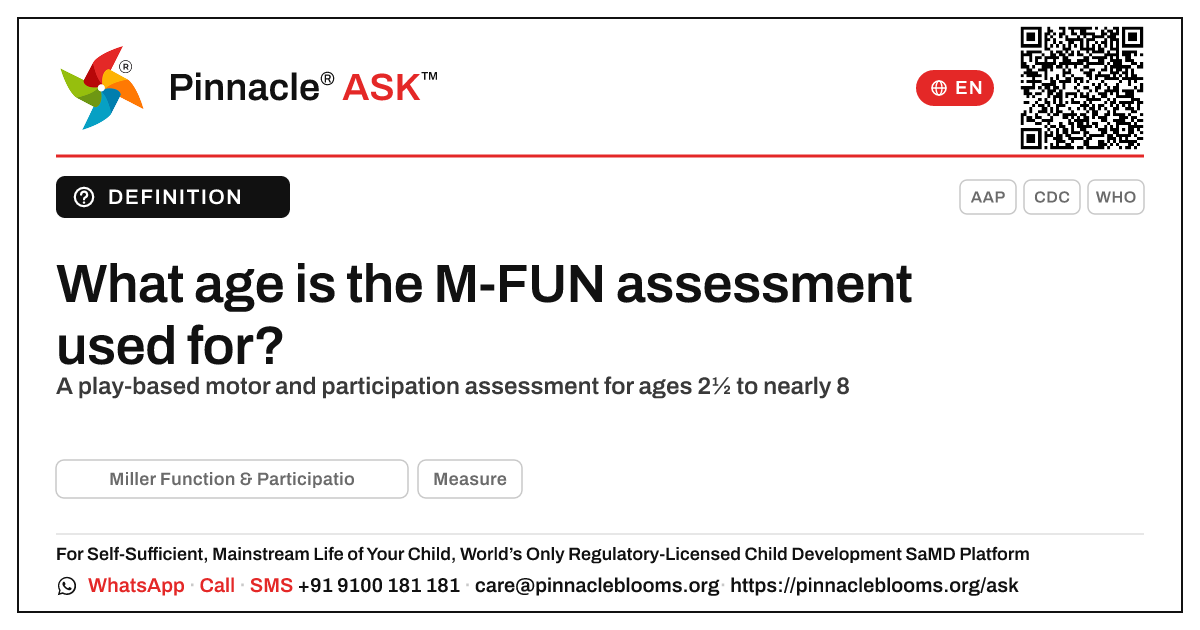
The Miller Function & Participation Scales (M-FUN) is a clinician-administered, play-based developmental assessment used for children aged about 2 years 6 months to 7 years 11 months — the preschool and early-school years. It looks at how a child's fine-motor, gross-motor and visual-motor skills support everyday participation at home, in play and in early classroom tasks. It is not a diagnosis but a way of mapping functional strengths and where support may help.
In this answer 5 sections
Curious which ages the M-FUN is designed for? Here is the simple answer.
In short
The Miller Function & Participation Scales (M-FUN) is a developmental assessment used for children aged roughly 2 years 6 months to 7 years 11 months — broadly the preschool and early-school years. It is a clinician-administered, play-based tool that looks at how a child's fine-motor, gross-motor and visual-motor skills support their everyday participation at home, in play and in early classroom tasks. It is not a label — it is a way of understanding a child's functional strengths and where a little support may help.
What the M-FUN looks at
Rather than testing skills in isolation, the M-FUN watches how a child uses movement and coordination to take part in real activities — holding a crayon, managing scissors, copying shapes, building, and moving with control. Because it is designed for the 2½ to nearly 8 years window, the activities are presented as engaging games, so younger children stay relaxed and motivated. Alongside the hands-on tasks, observations from parents and teachers help build a rounded picture of how a child participates day to day, not just how they perform on a single morning.
When it is used
An occupational therapist or qualified clinician may choose the M-FUN when there are questions about a child's fine-motor or coordination development, school-readiness, handwriting, or how comfortably a child joins everyday and classroom activities within this age band. The aim is always to map strengths first, then identify where playful, targeted support could help a capable child thrive.
The Pinnacle way
This is general information, not a diagnosis — a clinical AbilityScore® and any diagnosis are formed only at a Pinnacle Blooms Network centre, under qualified clinician care, never from an app or form. Our therapists choose the right structured assessment, such as the M-FUN, for your child's age and questions, and may pair it with occupational therapy to build motor and participation skills through play.
Trusted sources
The American Occupational Therapy guidance via ASHA and AAP on early motor and participation development; CDC developmental milestone guidance; WHO Nurturing Care Framework on early childhood development.
Next step — If you would like to understand your child's motor and participation skills, book a developmental assessment with a Pinnacle Blooms Network clinician.
CONNECT THE ANSWER TO YOUR CHILD’S DAY
Something to notice. Something to discuss.
What to notice
Within the 2½ to 8 years window, watch for difficulty holding a crayon or using scissors, struggling to copy shapes, clumsy or effortful movement, and finding it hard to join in everyday play or classroom tasks compared with peers.
In everyday life
Support motor and participation skills through play — offer crayons, scissors with supervision, threading beads, building blocks and obstacle games, letting your child practise without pressure so coordination grows naturally.
Bring your observations and questions to your child’s professional. Choose activities that suit your child’s comfort, abilities and agreed plan.
Bring your questions to a first visitQuestions families ask
What age range is the M-FUN used for?
The M-FUN is designed for children aged roughly 2 years 6 months to 7 years 11 months — broadly the preschool and early-school years.
What does the M-FUN measure?
It looks at how a child's fine-motor, gross-motor and visual-motor skills support their everyday participation at home, in play and in early classroom tasks, using engaging, play-based activities.
Is the M-FUN a diagnosis?
No. It is a clinician-administered structured assessment that maps a child's functional strengths and needs. Any diagnosis is formed only at a Pinnacle Blooms Network centre under qualified clinician care.
Who administers the M-FUN?
It is administered by a qualified clinician, typically an occupational therapist, who chooses the right tool for your child's age and the questions being explored.
FOLLOW THE SOURCE
References behind this answer.
- Organisation website · further readingAmerican Academy of Pediatrics — early development
- Source referenceCDC developmental milestones
- Organisation website · further readingWHO Nurturing Care Framework
References are supplied with this answer. An organisation homepage offers further reading; it does not establish an independent review of this page.
Content attribution: SETU Consortium · Pinnacle Blooms Network.
PEOPLE, TOPICS & DEVELOPMENT
See the connections.
Browse the wider question collections connected with this answer’s audience, developmental area and stage.
FROM UNDERSTANDING TO PURPOSEFUL SUPPORT
One question. Your child’s whole life.
Your child’s self-sufficient, mainstream-included life is the purpose from the beginning. At Pinnacle, that purpose shapes what we understand, the goals we choose, the people we bring together, everyday practice and review.
Connect this question with the right support.
Explore how the relevant service contributes to everyday abilities, then speak with us about your child.
Make the next conversation useful.
Bring the situations you notice at home or school. We’ll explain a suitable service, centre and first visit, including availability and fees, before you decide.
How PinnacleAI® connects the journeyExplore the seven stages
- 1Understand abilities
A starting picture of your child’s capabilities.
- 2Choose meaningful goals
Readiness and a plan shaped around the child.
- 3Bring the right support together
Suitable therapies and people for those goals.
- 4Carry practice into everyday life
Guidance for family, home and school.
- 5Track and correct
Use observations to adjust the plan.
- 6Reassess and review
Decide what to continue, change or do next.
- 7Grow independence and participation
The child’s life gives each step its purpose.
Explore the whole PinnacleAI® system → · Participation at school and in the community →
PINNACLE’S EVIDENCE, OPEN TO YOU
Look at the evidence behind our work.
Read our research, inspect the original regulatory documents and check what each institutional measure means.
General information supports a conversation with an appropriately qualified professional. Advice, goals and support depend on the individual child.