
YOUR QUESTION. A CLEARER NEXT STEP.
Helping your child build verbal knowledge at home
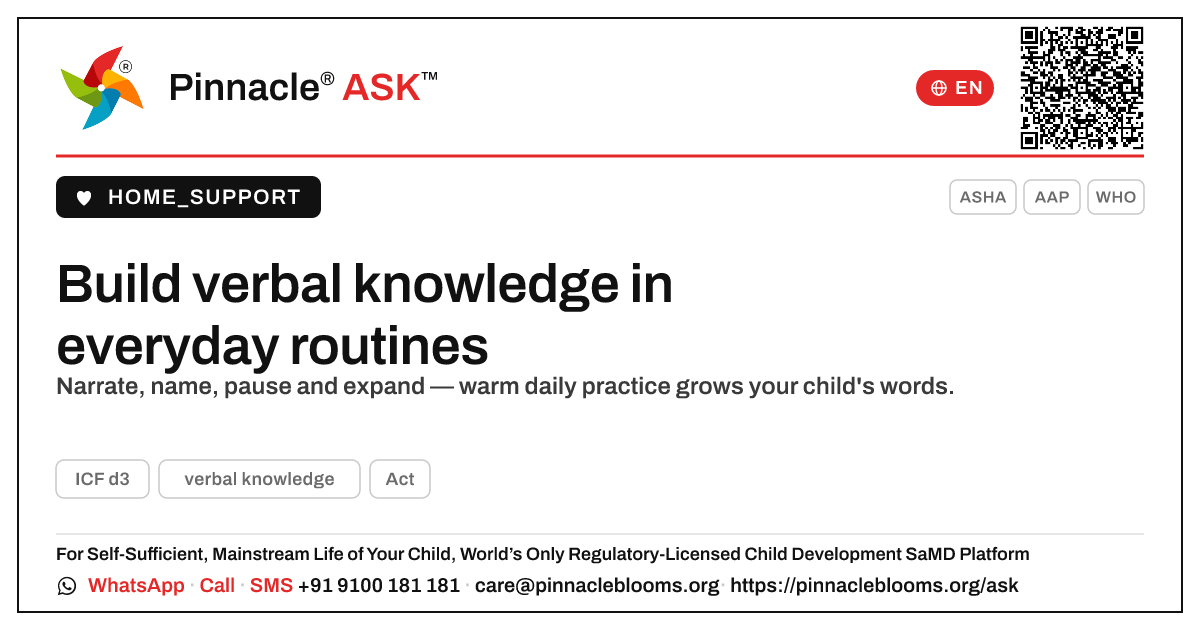
Help a child build verbal knowledge by tying words to everyday moments — narrate routines, name objects before giving them, pause to invite a response, offer choices and expand on what your child says. Responsive, repeated, playful talk across the day grows vocabulary far better than formal drills.
In this answer 5 sections
The richest classroom your child will ever have is the kitchen, the bath, the walk to the shop — and you are already the teacher.
In short
Verbal knowledge — understanding and using words for objects, people and ideas — grows fastest when words are tied to real moments, repeated often and answered warmly. You don't need flashcards or a set lesson; you need narration, naming and a few seconds of pause for your child to respond. Little and often, woven through the day, beats any formal drill.
Gentle ways to practise through the day
- Narrate the routine. Say what you're both doing in short, clear phrases: "Warm water. Soft towel. Dry your hands." Hearing words attached to actions builds meaning.
- Name before you give. Hold the cup and say "cup", the spoon and say "spoon" — then hand it over. Linking word to object makes vocabulary stick.
- Pause and wait. After you ask or name something, count silently to five. That gap invites your child to fill it with a sound, sign or word.
- Offer choices. "Banana or apple?" gives a real reason to use a word, with the answer built in.
- Expand, don't correct. If your child says "car", you reply "yes, a fast red car!" — adding words gently rather than flagging a mistake.
- Read and sing daily. Songs, rhymes and picture books repeat words in a way children love and remember.
The science
Language learning is driven by responsive, contingent talk — adults who follow the child's focus and reply promptly. Frequent, meaningful repetition across familiar routines (ICF d3, communicating) helps words move from understood to spoken. Pressure and testing slow this down; warmth and play speed it up.
The Pinnacle way
Every home win matters — and so does knowing where your child is starting from. A clinical AbilityScore® and any diagnosis are formed only at a Pinnacle Blooms Network centre under qualified clinician care. Explore more about verbal knowledge and how our speech therapy team turns daily routines into language-rich practice.
Trusted sources
Aligned with WHO ICF (activities and participation, communicating), the American Speech-Language-Hearing Association's guidance on early language, and AAP/HealthyChildren advice on talking and reading with young children.
Next step — message our team on WhatsApp at +91 91001 81181 to book a developmental check and get a personalised home-language plan.
This is general information, not a diagnosis — individual assessment and diagnosis require an appropriately qualified healthcare professional.
CONNECT THE ANSWER TO YOUR CHILD’S DAY
Something to notice. Something to discuss.
What to notice
Watch for steady growth in words understood and used over weeks. If your child shows little babble or gesture by 12 months, no single words by 16 months, no two-word phrases by 24 months, or loses words already gained, arrange a developmental check promptly.
In everyday life
During any routine, name the object before you hand it over — "cup" then give the cup — and pause five seconds for a response. Little and often beats long lessons.
Bring your observations and questions to your child’s professional. Choose activities that suit your child’s comfort, abilities and agreed plan.
Bring your questions to a first visitQuestions families ask
How much talking is enough each day?
There's no magic number — what matters is quality and frequency. Weaving short, clear naming and narration into routines you already do (meals, bath, walks) several times a day is more powerful than one long session.
Should I correct my child when they say a word wrong?
Gently expand rather than correct. If your child says "car", reply "yes, a fast red car!" This models the right word warmly without making your child feel they got it wrong.
My child understands more than they say — is that normal?
Yes, understanding usually grows ahead of speaking in early childhood. Keep naming, pausing and offering choices to give reasons to use words. If you're unsure about the gap, a developmental check can reassure you.
FOLLOW THE SOURCE
References behind this answer.
- Source referenceASHA — early speech and language development
- Source referenceHealthyChildren (AAP) — language development
- Organisation website · further readingWHO ICF — communicating (d3)
References are supplied with this answer. An organisation homepage offers further reading; it does not establish an independent review of this page.
Content attribution: SETU Consortium · Pinnacle Blooms Network.
PEOPLE, TOPICS & DEVELOPMENT
See the connections.
Browse the wider question collections connected with this answer’s audience, developmental area and stage.
FROM UNDERSTANDING TO PURPOSEFUL SUPPORT
One question. Your child’s whole life.
Your child’s self-sufficient, mainstream-included life is the purpose from the beginning. At Pinnacle, that purpose shapes what we understand, the goals we choose, the people we bring together, everyday practice and review.
Connect this question with the right support.
Start with your child’s strengths, your observations and what you want everyday life to become.
Make the next conversation useful.
Bring the situations you notice at home or school. We’ll explain a suitable service, centre and first visit, including availability and fees, before you decide.
How PinnacleAI® connects the journeyExplore the seven stages
- 1Understand abilities
A starting picture of your child’s capabilities.
- 2Choose meaningful goals
Readiness and a plan shaped around the child.
- 3Bring the right support together
Suitable therapies and people for those goals.
- 4Carry practice into everyday life
Guidance for family, home and school.
- 5Track and correct
Use observations to adjust the plan.
- 6Reassess and review
Decide what to continue, change or do next.
- 7Grow independence and participation
The child’s life gives each step its purpose.
Explore the whole PinnacleAI® system → · Participation at school and in the community →
PINNACLE’S EVIDENCE, OPEN TO YOU
Look at the evidence behind our work.
Read our research, inspect the original regulatory documents and check what each institutional measure means.
General information supports a conversation with an appropriately qualified professional. Advice, goals and support depend on the individual child.