
YOUR QUESTION. A CLEARER NEXT STEP.
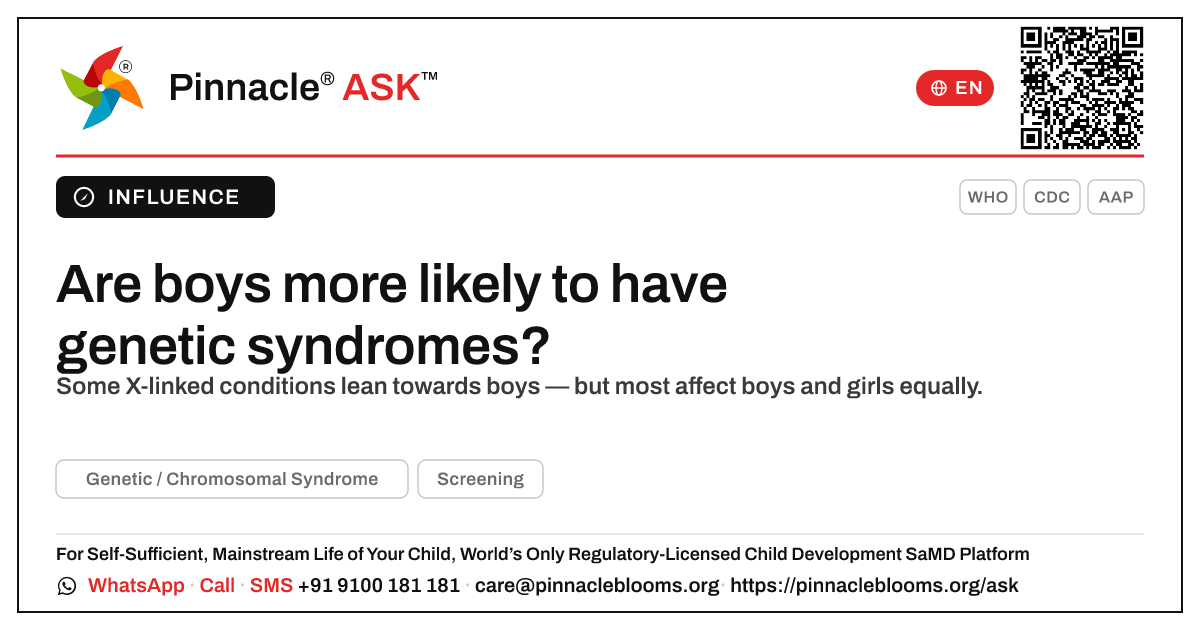
Are boys more likely to have genetic or chromosomal syndromes?
Most genetic and chromosomal syndromes affect boys and girls roughly equally. A specific group — X-linked conditions such as Fragile X and Duchenne muscular dystrophy — affects boys more often and more severely, while others (like Rett syndrome) are seen almost only in girls. A child's sex is one clue, never a diagnosis.
In this answer 5 sections
One of the first things parents wonder is whether sons are simply more at risk — the honest answer is: it depends entirely on which syndrome.
In short
There isn't one simple answer, because "genetic and chromosomal syndromes" is a very large family of conditions, not a single thing. For most syndromes, boys and girls are affected roughly equally. But a specific group — the X-linked conditions, such as Fragile X syndrome and Duchenne muscular dystrophy — does affect boys more often, and usually more severely, because boys have only one X chromosome. So the truthful picture is: some syndromes lean towards boys, many do not, and a few (such as Rett syndrome) are seen almost entirely in girls.
Why sex matters for some syndromes and not others
Girls have two X chromosomes (XX) and boys have one X and one Y (XY). When a condition is caused by a change on the X chromosome, a girl's second, healthy X can often soften or mask the effect, while a boy has no "backup" copy — so X-linked conditions like Fragile X (the most common inherited cause of intellectual disability) and Duchenne muscular dystrophy show up more in boys.
By contrast, conditions caused by a whole extra or missing chromosome that isn't sex-linked — such as Down syndrome (trisomy 21) — affect boys and girls at very similar rates. And some sex-chromosome conditions are sex-specific by definition: Klinefelter syndrome (XXY) occurs in boys, while Turner syndrome (XO) occurs in girls.
The takeaway for any individual family: a child's sex is one small clue, never a diagnosis. What guides care is your child's actual developmental profile and, where indicated, genetic testing arranged by a clinician.
When to seek a developmental check
Sex does not change the value of early observation. Speak to a developmental professional if you notice persistent delays in reaching milestones, distinctive physical features noted at birth, low muscle tone, or a family history of a known genetic condition — for any child, son or daughter.
The Pinnacle way
A clinical AbilityScore® and any diagnosis are formed only at a Pinnacle Blooms Network centre, under qualified clinician care — never from an article or an online form. If you have a concern, a structured developmental check gives you clarity and a plan you can follow. Explore how we support every child's journey, understand what the AbilityScore is and how it is established, and see how early intervention therapy builds real independence.
Trusted sources
WHO ICD-11 classification of developmental and genetic conditions; CDC information on chromosomal and X-linked conditions; American Academy of Pediatrics guidance on developmental surveillance.
Next step — Have a concern about your child's development? Book a developmental check with a Pinnacle clinician.
This is general information, not a diagnosis — individual assessment and diagnosis require an appropriately qualified healthcare professional.
CONNECT THE ANSWER TO YOUR CHILD’S DAY
Something to notice. Something to discuss.
What to notice
Persistent delays in reaching milestones, distinctive physical features noted at birth, low muscle tone, or a known genetic condition in the family — in any child, son or daughter.
In everyday life
Don't let your child's sex reassure or alarm you on its own. Track milestones for every child the same way, and raise anything that feels persistently behind with your paediatrician.
Bring your observations and questions to your child’s professional. Choose activities that suit your child’s comfort, abilities and agreed plan.
Bring your questions to a first visitQuestions families ask
Why are some genetic conditions more common in boys?
Boys have only one X chromosome, so X-linked conditions like Fragile X syndrome and Duchenne muscular dystrophy affect them more often and more severely. Girls have a second X that can soften or mask the effect.
Is Down syndrome more common in boys?
Down syndrome (trisomy 21) is caused by an extra copy of chromosome 21, which is not a sex chromosome, so it affects boys and girls at very similar rates.
Are any genetic syndromes more common in girls?
Yes. Rett syndrome is seen almost entirely in girls, and Turner syndrome (a single X chromosome) occurs in girls. So sex influences risk only for certain specific conditions.
Does my son's sex mean he will have a genetic condition?
No. Sex is one small clue and never a diagnosis. What matters is your child's actual developmental profile and, where indicated, genetic testing arranged by a clinician.
FOLLOW THE SOURCE
References behind this answer.
- Organisation website · further readingWHO ICD-11 classification of genetic and developmental conditions
- Organisation website · further readingCDC — chromosomal and X-linked conditions
- Organisation website · further readingAAP HealthyChildren — developmental surveillance
References are supplied with this answer. An organisation homepage offers further reading; it does not establish an independent review of this page.
Content attribution: SETU Consortium · Pinnacle Blooms Network.
PEOPLE, TOPICS & DEVELOPMENT
See the connections.
Browse the wider question collections connected with this answer’s audience, developmental area and stage.
FROM UNDERSTANDING TO PURPOSEFUL SUPPORT
One question. Your child’s whole life.
Your child’s self-sufficient, mainstream-included life is the purpose from the beginning. At Pinnacle, that purpose shapes what we understand, the goals we choose, the people we bring together, everyday practice and review.
Connect this question with the right support.
Start with your child’s strengths, your observations and what you want everyday life to become.
Make the next conversation useful.
Bring the situations you notice at home or school. We’ll explain a suitable service, centre and first visit, including availability and fees, before you decide.
How PinnacleAI® connects the journeyExplore the seven stages
- 1Understand abilities
A starting picture of your child’s capabilities.
- 2Choose meaningful goals
Readiness and a plan shaped around the child.
- 3Bring the right support together
Suitable therapies and people for those goals.
- 4Carry practice into everyday life
Guidance for family, home and school.
- 5Track and correct
Use observations to adjust the plan.
- 6Reassess and review
Decide what to continue, change or do next.
- 7Grow independence and participation
The child’s life gives each step its purpose.
Explore the whole PinnacleAI® system → · Participation at school and in the community →
PINNACLE’S EVIDENCE, OPEN TO YOU
Look at the evidence behind our work.
Read our research, inspect the original regulatory documents and check what each institutional measure means.
General information supports a conversation with an appropriately qualified professional. Advice, goals and support depend on the individual child.