Describe what you want to open up
Bring an everyday moment, an interest and the support your child already uses.

Pinnacle Global Autism Framework
“I want my child to ask for help, join in and take more of a part in everyday life.” Start there. The framework gives assessment, relevant therapies, family practice and review a shared purpose that makes sense in your child’s day.
Pinnacle / BHCL · Free 24/7 telephone guidance. The receiving team confirms your appointment, suitable professional, service and fees.
The purpose determines the work
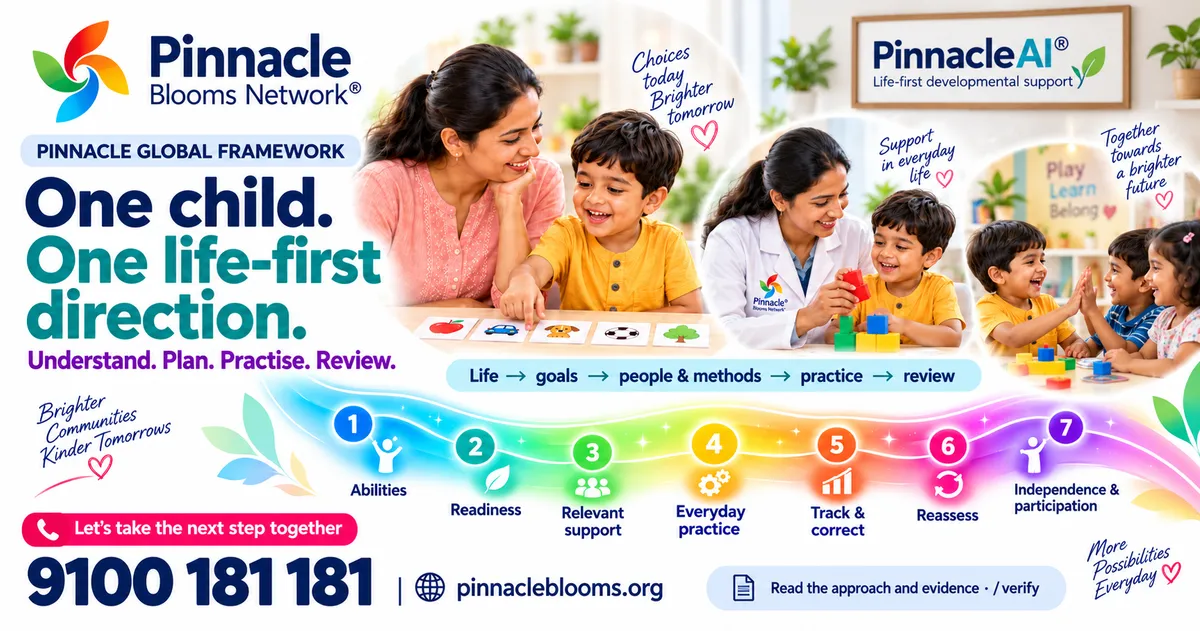
The Pinnacle Global Autism Framework is Pinnacle’s documented approach to organising child-development support around a self-sufficient, mainstream-included life. The purpose determines what abilities to understand, which goals and professional contributions matter, what practice fits everyday life and how observations shape the next review.
Useful techniques and measures are like parts of a car: they serve the journey the whole car is built to make. Your child’s day gives those individual contributions their direction.
Read the complete documented explanationAn illustrative planning example
A familiar interest can open a meaningful next step. Here is an illustrative example of how your family and the relevant people can connect one priority with home, learning and review. The purpose is greater independence and participation in the child’s life.
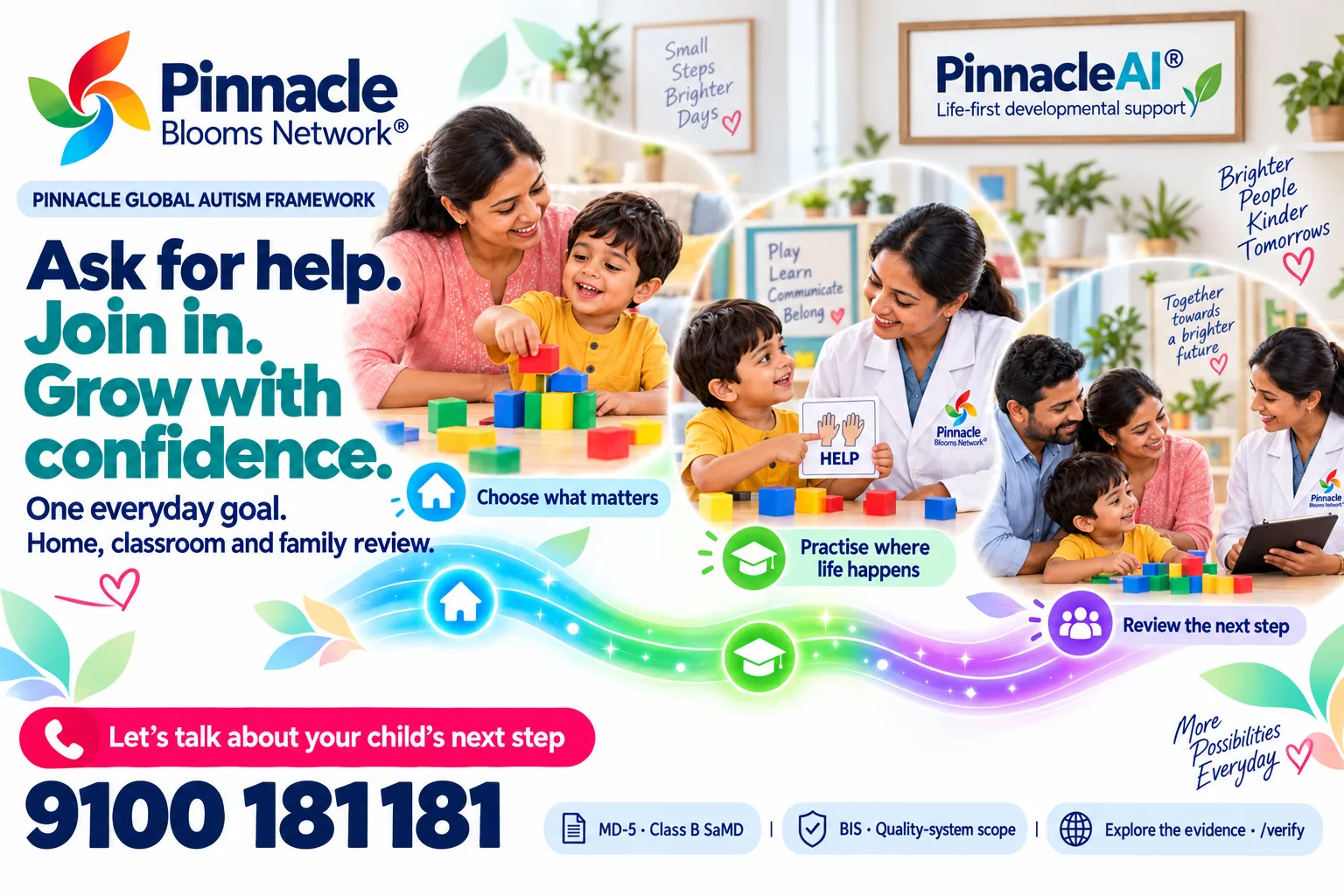
Imagine a child who loves colourful blocks and already points to a favourite colour. Their family wants them to join a short shared activity and ask for help comfortably. Together, we choose that useful life moment as the priority, with room for the child’s preferences and a break.
How everyday independence gives the work purposeThe family and suitable professional explore a help gesture, picture or word the child can recognise and use. The starting picture includes communication, present abilities and the setting. Where AbilityScore® contributes, its measurement is read with professional judgement and context.
Understand the starting pictureSpeech support may help make the request usable. Occupational support may matter if materials or sensory access make joining difficult. An educator or consenting teacher can make the invitation accessible. Behavioural support can contribute when relevant, while respecting a request for a break or a decision to decline. The goal selects the contributions; there is no fixed therapy bundle.
See how the relevant therapies work togetherIn this example, the family agrees a manageable block-building opportunity with one familiar adult at home. With consent and the teacher’s agreement, a similar opportunity may be tried in a small classroom group. The help cue remains available. Practice should fit the child’s comfort and the family’s day, rather than turn every moment into a lesson.
Carry useful practice into daily lifeAn illustrative observation: the child asks for help after one reminder with a parent at home, but does not use the same cue in a noisy group. The family and teacher bring both observations to review, including comfort, interest and the help offered. This difference gives the team something specific to understand; a session-only success would miss it.
Bring observations from different settings togetherThe family, relevant professional and consenting teacher consider keeping the familiar help cue and, where possible, offering a quieter setting or a shorter group opportunity. They discuss offering less help when the child is comfortable, while retaining useful support. At the next agreed review, they compare comfort and help requests across settings, then decide what to keep or change.
Make review a decision about the child’s lifeThis illustrative example explains planning and review; it is not a recorded child outcome. Your family, child and suitable professionals shape the actual priorities, support and next step.
Talk about your child’s everyday priority · 9100 181 181Seven stages · one child’s life
Start with strengths, everyday observations and suitable assessment. Read AbilityScore with the child’s age, context and skills.
Explore this part →Discuss what you want to make possible and agree useful priorities. Readiness views support professional judgement.
Explore this part →Bring in the therapies, educational support or health review that fit this child. Every child does not need every service.
Explore this part →Use manageable, guided practice in meaningful routines. Family participation connects the work with daily life.
Explore this part →Bring relevant observations back into review. Ask what became useful, what support remains and what needs to change.
Explore this part →Compare abilities and context over time. Continue, adapt or complete support according to the child’s needs.
Explore this part →Keep self-sufficiency, learning, relationships and mainstream participation in view. Progress is individual.
Explore this part →Communication, routines, learning and participation can need different kinds of support. Relevant professional contributions follow the child-specific priorities.
AbilityScore® and the readiness views support the starting picture and planning discussion. Child context, professionally chosen support, everyday practice, observations and reassessment connect the work over time.
Human judgement, family knowledge and the child’s response guide decisions. Read the whole PinnacleAI ecosystem and its non-diagnostic software scope.
Your family knows the child’s day
Bring an everyday moment, an interest and the support your child already uses.
Ask why a priority matters, how it serves your child’s life and what a useful next step could look like.
Agree manageable, guided opportunities. Family participation is informed and supported, rather than another burden.
Bring your observations and the child’s response back to the professional. Keep useful support, adapt what needs to change and review again.
Original publication · a stable citation
Read the report’s original publication trail, credits and version in the public Verify record. Independent peer-review was not established in the current catalogue. The report version is separate from the licensed software version.
Explore the current research catalogue for individual works, methods, versions and publication status.
Confidence with a source you can inspect
The child’s self-sufficient, mainstream-included life determines abilities, goals, methods, people, practice and review.
Read the source →Institution-authored report, 22 May 2025, version 1.0. Koti Reddy Saripalli is credited as author and Sreeja Reddy Saripalli as editor. DOI 10.5281/zenodo.15487405; independent peer-review was not established in the current catalogue.
Read the source →The current public explanation describes family knowledge, questioning goals and informed participation with professional governance.
Read the source →Meaningful observations inform the human discussion about support and the next step.
Read the source →The original licence and annexure describe PinnacleAI GPT-OS v1.0.0 as Class B non-diagnostic developmental-support software for ages 0–12.
Read the source →Read the named software and quality-system scope beside the original document. The scope is separate from an individual professional’s credentials or child outcome.
Read the source →Version 3.0, 9 April 2026: methodology and preliminary psychometric work. Read the developmental index in context with suitable professional judgement.
Read the source →Version 2.1, 9 April 2026: planned comparator and retest research. A research protocol describes proposed work; it is separate from completed validation findings.
Read the source →Questions families ask
It is Pinnacle’s documented approach to organising child-development support around a self-sufficient, mainstream-included life. That purpose guides abilities, goals, relevant people and methods, everyday practice and review.
Start with one meaningful everyday possibility, such as being understood, asking for help, joining an activity or taking part in a routine. Present abilities and context guide the next assessment and support discussion.
Relevant speech, occupational, behavioural and educational contributions follow the child-specific priorities. The framework keeps the everyday life purpose in view; it does not assume every child needs every therapy.
Describe the child’s day, understand and question priorities, agree manageable guided practice and bring observations into professional review. The child’s response and useful support can change the next decision.
The public publication record links DOI 10.5281/zenodo.15487405, an institution-authored report dated 22 May 2025, version 1.0. It credits Koti Reddy Saripalli as author and Sreeja Reddy Saripalli as editor. Independent peer-review was not established in the current catalogue.
Call 9100 181 181 with one everyday priority, read the relevant therapy explanation or send a short enquiry. The team confirms the suitable professional, centre, appointment, service and fees.
Start with one meaningful everyday possibility
Being understood. Getting ready. Learning or joining in. Bring the moment that matters to your family. The first conversation helps clarify the suitable professional, centre and next step.